Tag Archives: media

Interview Part 2 – A mindful dimension to media law course design

By MARK PEARSON

Griffith University doctoral candidate David Costin recently interviewed me as part of his research into engaging with the online environment in higher education and has kindly allowed me to reproduce sections of that interview transcript in my blog.  Last week, in the first edited installment, we discussed my design of an online / on campus course in media law. This week we delve further into how principles of ‘mindful journalism’ have influenced the course design…

Q (David Costin):        Okay, so it’s practical – so I suppose what you’ve done is you’ve set up so it’s a practical, interactive course with reflection at the same time, which would then assist them in their development down the track with it, I suppose.

A (Mark Pearson):         The approach incorporates – the mindful journalism part of it is incorporating the idea that journalists aren’t going to be able to sit there and meditate in the lotus position in the newsroom, but if they learn to pause to reflect and they learn to take opportunities to do so, whether it’s on the train to work or in what others might call a ‘smoko’ break at work and they think through some of these basic principles there, then the theory goes that they might eventually, after doing this many times, be in what both Schon and others call ‘in the zone’, which is basically the consummate expert being able to reflect in action, but it being somewhat of an innate process so that they are almost subconsciously reflecting upon their learning to make the right decisions in those moments. And the basic Buddhist principles that go into my writings about all of this are from what is foundational to all of Buddhism called the ‘Eightfold Path’. And it’s not a religious thing, in fact some call Buddha the first psychologist and phenomenologist, but the principles are ‘right understanding’ – so this is from 2500 years ago, all right and it was meant for monks, but … part of the integrated reflection and he made a big point of saying all of this is integrated, it’s not just one or the other, the path is not uniform steps, but ‘right understanding’. ‘Right livelihood’ – so how does what I’m doing match my livelihood? Is this what I went into it for? You know, which is very important for journalists in this modern environment. ‘Right intent’ – so what is my intent here with this story or this, (from my perspective), with this lesson or this interview today? o basically having that partly considered. ‘Right speech’, because back then it was just oral, but that’s all form of communication and in multimedia it’s very important for journalists to think, you know, ‘how am I communicating this?’, ‘am I using both the right form of expression in speaking to this source or student or whatever it happens to be?’, or and also the way I’m actually putting the words together. ‘Right action’, so what behaviours am I exercising and should I exercise in this situation? ‘Right effort’, and the effort is all-embracing because it comes back to, you know, ‘how often am I reinforcing thinking about this, you know, reflecting upon these issues?’. ‘Right mindfulness’, which obviously for the monks it’s hours of meditation, but for the working journalist, it’s a moment of reflection – just to stop and go, “Oh, okay, I did media law today, what did I really pick up from that?” And that’s embedding the learning through reflecting.

Q:        Reflective practice, yeah.

A:         Yeah and the final one is ‘right concentration’ and that’s being ‘in the zone’, that’s basically putting it together so that it’s all happening and you’re able to adapt any of those elements appropriately for the circumstances.

Q:        I like that because in a couple of weeks’ time I’ve actually been asked to speak on a panel to third year students and I could see that translating across very, very nicely indeed as to their effectively – what they see and into a long term view, because that’s beautiful.

A:         Yeah, well to be quite frank, while I work in journalism, I can see that applying at an ethical and a practical level very much in teaching and it could be some – I mean I’m late in my career, but it could be at some stage I move part of it across into there and apply it there as well.

Q:        Mm, no, it’s simple. I mean to say, that’s a firm foundation, isn’t it?

A:         It is, yeah and it’s not ramming some religion down someone’s throat.

Q:        No.

A:         It’s basically a map of life.

Q:        Yeah, exactly right. And I suppose that comes on in the next question too, I mean to say, when you’ve been reflecting and then you’ve altered the course at the same time, so then I suppose the next question is what do you see as an effective operator in that online environment to your students? Because obviously, you know, you’ve got an encompassing overview of what you want to do, okay?

A:         Mm.

Q:        But what do you see as being an effective operator in that online environment for you?

A:         Yeah, it’s – no course or approach can be all things to all people. And I believe in my area, a professional area, only some curricula areas are particularly well suited to online, to totally online delivery.

Q:        Okay.

A:         So I don’t think anything and in fact Schon was all about the teacher is the coach and the studio environment. For professional education, I really think nothing beats the shoulder-to-shoulder coaching by a real …

Q:        Person.

A:         … experienced practitioner, just as the concert pianist, how effectively are you going to become a pianist by doing an online course in playing the piano? Yeah, some people might, you know, and there could be – these days there are all sorts of ways you could envisage that.

Q:        Yeah.

A:         But the question is, would any of them match sitting shoulder-to-shoulder with the maestro in a studio situation, masterclass situation, for at least part of that journey? So I’m lucky that media law and the other course that I’ve designed here for public relations and crisis communication people called ‘Social Media Law and Risk Management, they lend themselves to that because you know, these days it’s much of the way journalists communicate and because of that knowledge base to the thing and then the problems that are written problems, accompanied by a whole bunch of AV material. So you’ll see that there’s those mini lectures which MOOC experience has told us is best done up to 18 minute bursts. So this one goes just beyond it at 22 minutes for the very first one and it’s …

(Audio visual playing)

A:         All right, all that sort of stuff. Now that’s the mini lecture and so that’s reinforced for online students with just a copy of the slides. And then there is, as you’re probably aware, from …. University there’s also the full slides that are available through the Lecture Capture.

Q:        Yeah.

A:         So that’s the full two-hour version, one hour and 50 and some of them will want to immerse themselves in that, but it’s proven to be not that effective a way of, certainly in its analogue form, it’s actually very effective for foreign students particularly, the videoed lecture version, because they like to slow it down in the pace, pick it up for the, you know, so there are certain students that like that. And there’s also, I mean the genre of university study, there’s something about having lectures like that, rather than just having a bunch of materials you could get on any old MOOC, you know, so there’s something about the full-on thing. So the slides and the lectures are there for them as well. Now we make both campus’ lectures, which are repeats, available to all the students and the reason for that is occasionally there is a glitch with the recording, but more of a problem for my class is typically they’re – well this semester they were timetabled on a Monday and a Tuesday and you have the public holiday problem.

Q:        Yeah, okay.

A:         So that way the whole cohort can go to the other day’s lecture, because we had Anzac Day on a Tuesday and then the other Monday public holiday, so at least they get the lecture that week. So there are those things and then in addition to that, some people are very visually driven and over the past, the time I’ve been here at …., four-and-a-half years, I’ve put together a number of interviews, some of them are on Skype, with experts in the field or people who have been through that particular media law experience. And every one of the modules has one or two of these guest lectures. So what that does is give an anchor in the real newsroom experience to complement the theory, I suppose, or I try to make it as far from theoretical as we can in the class, but just so that they’re seeing that there’s a practical edge to it. The other thing is that although we might from time to time get a live guest, I will try to film that professionally because that’s just a one-off thing and lost forever unless it’s captured for other students to enjoy. It’s very rare you get a live guest who will appear at both campuses in that week and otherwise it just becomes part of the Lecture Capture experience and is just a one-off for that trimester ever.

Q:        To utilise again and again, like you said.

A:         Yeah and the final element is in each of the modules I do a – I got this off the MOOCs, ‘Office Hours’ – and the ‘Office Hours’ is basically positioning yourself in my home or work office.

(Audio visual playing)

A:         So you’ve got the idea of that and that’s what we’re talking about there within the …

Q:        Mm.

A:         Yeah, it’s just amazing, it’s 400 students and at any moment you’ve got people that haven’t studied for a long time or they’ve got various stressors in their life, they’re not very technologically literate and it’s just amazing how many still don’t know to press that. So that basically tells them a lot more about the actual assessment.

Q:        But it’s interesting from my side looking in because you’re accommodating and I suppose this is your character, maybe it’s part of your own character too, that you can accommodate – you’re accommodating, you’re also entrepreneurial, because I haven’t seen anything like that before.

A:         Oh really?

Q:        Yeah, yeah and it’s quite interesting.

A:         Have you gone on MOOC though?

Q:        Oh yeah, I’ve done – yeah.

A:         When MOOCs came out, I immersed myself in a few of those just to pick up from that experience.

Q:        Okay and that’s certainly coming through as well, that people go out on their own and experiment and then come back and bring that wealth of information with them at the same time.

A:         Mm.

Q:        So obviously – and the flexibility, because you’ve obviously, from your own life experience as well, you realise that students are doing different things at different times. So you take that flexibility into account as well. So I can see those things coming through.

A:         Yeah.

Q:        And also that reflective practice.

A:         Yeah, yeah.

Q:        One of your other colleagues actually used the term ‘pracademic’.

A:         Oh okay, that’s nice.

Q:        It is a nice term because all your work is practical, very practical and it’s aimed at I suppose the end point of where you want your students to be.


NEXT WEEK: Strategies to embed media law learning

———–

Disclaimer: While I write about media law and ethics, nothing here should be construed as legal advice. I am an academic, not a lawyer. My only advice is that you consult a lawyer before taking any legal risks.

© Mark Pearson 2017

Leave a comment

Filed under blogging, Buddhism, defamation, Eightfold Path, free expression, journalism, journalism education, media ethics, media law, mental health, mindful journalism, online education, reflective practice, social media, terrorism

Designing a media law course for reflection in action

By MARK PEARSON


Griffith University doctoral candidate David Costin recently interviewed me as part of his research into engaging with the online environment in higher education and has kindly allowed me to reproduce sections of that interview transcript in my blog. Here, in the first edited installment, we discuss my design of an online / on campus course in media law.

Q:        In the online environment, what theory and pedagogical knowledge do you draw upon when you’re operating in the online environment?

A:         I can mention a principal theory that’s driven a lot of my career and I carry into the online environment… My first major point is that I believe theory and pedagogical understanding and approaches are crucial to teaching in the online environment. But they are not necessarily something that you are conscious of every day of your teaching. I think it’s fundamental to your learning in the area, it’s fundamental that you revise that occasionally, revisit it, but my own experience is it’s not something that is at the forefront of your mind as you’re teaching every class. So, the main pedagogical approach which is entrenched in a theory that I’ve used since the 1980s and have carried into the online environment is Donald Schon’s work in teaching – The Reflective Practitioner. My area of journalism education is very much about preparing students to do what Donald Schon called ‘reflect-in-action’, which is basically when they are confronted with new situations in the newsroom (or these days in various professional communication environments), that they will also be able to reflect, sometimes innately (like I do on pedagogies and theories). In that same way, one should be confident that they can reflect on what I have taught them and be able to solve their own problems, whatever they may be, technologically and ethically and professionally in changing environments. So to my mind, if that is done properly, then you effectively have someone who is a change agent and is able to reflect in action upon their education, no matter how long ago that may have been, to shape and be able to come to a consciously right decision in their work in a new context. And that’s my take on the Schon approach.

I have something to add to that though and that is in more recent years, since 2013, I’ve developed what – I’ve worked with colleagues and have coined the expression ‘mindful journalism’. Because in my undergraduate years, I did explore some Eastern philosophies and so on and in more recent times I’ve used meditation practises for various reasons in my life and have rediscovered Buddhism, but from a secular perspective. So in other words, some of the foundation stones of Buddhism are actually very secular, reflection in action practices. So mindful journalism is something I’ve actually built into my media law classes, teaching students how to reflect in action because my biggest worry in teaching media law is that a graduate who may have only passed with 50 per cent result, may not be able to recognise in the newsroom the legal risk that should be apparent to them. So I’m using this as a way of embedding an approach that hopefully deepens their knowledge at the tertiary level enough to be able to carry with them into the workplace.

Q:        So your basis, then, is working from that practical on-the-ground reflection status, would that be correct?

A:         That is correct. Obviously media law has two major components to it. One is enough knowledge about and familiarity or literacy to do with the language of law, to be able to understand what defamation or contempt of court or confidentiality, these sorts of things are. And the second element is the actual putting that into practice, to be able to navigate those laws effectively in a highly competitive, under resourced, time poor, stressful news environment where there are other imperatives, in fact there are very significant rewards for pushing the boundaries of the law in a technological era based on clickbait and page views. So the challenge within that is being able to do that both in the classroom environment, but also in an online environment, so there’s no reason why media law, from that content end of the equation, can’t be taught very effectively both in the classroom and online or in a hybrid way.

Q:        Okay.

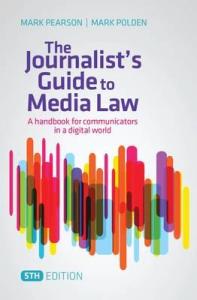
A:         It’s only recently we’ve really ramped up the online offering of the course and so I’ve had to encounter the challenges of being able to capture that for students just working in a fully online environment as well. …So the course, as I’ve redeveloped it for this year, well for the past few years, but I’ve really refined it for this year, has a dovetailed knowledge-problem based approach. So it’s textbook driven. The Journalist’s Guide to Media Law is the main textbook used in the field throughout Australia … which has little exercises and things in the back of it. Clearly in law you just have to cover certain topics, but unlike a standard legal text, you would already see in the textbook itself, being The Journalist’s Guide, a handbook for communicators with the chapters and headings reflecting – it’s not what they – typically a law textbook is what they call black letter law. … It’s multi-dimensional.

So the second element is a problem based approach and it used to be we had a problem a week that they were dealing with a scenario and now we’ve narrowed that down so they are having more time to work with particular problems and they’re getting guidance within that. So there are, over the course, four or five problems that they work with over the 12 weeks and the first three are submitted as a learning journal approach to the problems. Not learning journal as in “what did I learn from it?”, but learning journal as in a record of their answers to key newsroom law questions that they would need to answer about these things. So if you go to the actual course itself, all of this material is available to the students who are on campus and online.

Q:        Okay.

A:         And I mean we have a very good – within our group here, we have a very good blended learning team based out of Mt Gravatt and they run various courses and a couple of years ago I did the online learning course. A lot of this has been developed with their curriculum design assistance. But the idea is that the students – there’s a certain suite of activities and a lot of it is to do with developing their understanding of reflecting on their learning, even from the very early stages. So in the early slides, it explains the actual – this is just the mini lecture, so there are only three slides here, but it has the study plan of what they’re expected to do as part of their course.

Q:        Yeah, yeah.

A:         So it’s a little, just like a five to 10 minute mini lecture, there’s a learning problem that they preview early on and there are online discussion boards or tutorials or both that they can attend. They read the relevant chapters and the study guide and earlier on it was starting to get to the point that even the textbook talks about mindful practice and the textbook navigates what I call the “legalities and the realities” of media law. In other words, it’s not just about what’s legal and illegal, it’s about how one might navigate legal risk within a work environment and not just for journalists but for public relations practitioners, other new media entrepreneurs, those sorts of things. So they read the chapters, there’s an online study guide as well …

Some people prefer the print material, so they get just a basic run through the main areas. The learning problems are set up with each learning problem the student having to consider the scenario that is put to them in the terms of what are the main media law issues arising in this scenario, what laws and defences might apply, what cases or examples would you draw upon or talk about or to make your decisions there and assuming your goal is to publish as much of it as is legally allowable, you know, what are you going to do in this situation. Or there’s a longer one here, the really prickly things that we normally really hone in on are ones to do with situations involving defamation and contempt of court. There should be really problem two here somewhere, it was like the arrest of a sex murderer on Moreton Island, … – with little study tasks for the online students, which are normally quite similar to the ones at the back of the textbook chapters, although there are a couple of variations in there. So they answer the end of chapter questions, the study guide and the textbook, complete the formative quiz, so that’s something I picked up from the blended learning people, that the – and also just a bit of reading around that area of knowledge, because there’s that knowledge base component.

At the end of each of the five modules, there’s a 20-question quiz. On the actual substantive knowledge where the students have 30 minutes to be able to look up the textbook to get their answers as to what defamation is and that kind of stuff. But what I learnt through my reading around this kind of thing was that the learning is embedded more in that context if the students are presented with the same question again and so for the more important topics like defamation and contempt, those questions are geared to repeat in the later formative quizzes and the formative quizzes are non-assessable but the final one is worth 20 per cent of the assessment and is done in a single hit of 20 randomly generated questions from the others with no backtracking allowed.

Q:        The thing I like with what you’ve just done is that you’ve actually, in some ways, you’ve talked about your problems and then how you’ve set it out, in some ways you’re actually catering for that diversity of the learner too. …If they don’t want the audio, they can go to this to look at the problem or they’ve got that visual …

A:         Yeah and that’s something that’s been drilled home by our blended learning people through the various online development courses, is to try to cater to those different learning styles. And so while on the slide I’m saying they should do all of these things and always return to the learning problems, so preview the learning problem, come back to it later, engage in the tutorial discussion or discussions about it and find and reflect upon the recent readings. Because in media law there’s always new cases unfolding and stuff, people find and so we share that on our Twitter, #MLGriff Twitter feed, which is just a hashtag that people put on it. So this Rebel Wilson’s in the news, all the students are throwing that there. I tweet to that when I’m at seminars and things like that. And you know, it becomes almost like a really useful summary of media law because there are more than 400 students [per year] doing this course … and I’ve got them all integrated into the same program. OUA is a different site just because there’s just slightly different terminology and everything that they use.

Q:        Yeah, that’s right, yeah.

A:         So at any one time, through some of the activities such as the discussion board, you’ll get three of those four cohorts all there on the discussion board, discussing the learning problem or having general course questions or the tutors are engaging with them in their discussion about the answer.

Q:        Okay, so it’s practical – so I suppose what you’ve done is you’ve set up so it’s a practical, interactive course with reflection at the same time, which would then assist them in their development down the track with it, I suppose.

NEXT WEEK: A mindful dimension to the media law course

———–

Disclaimer: While I write about media law and ethics, nothing here should be construed as legal advice. I am an academic, not a lawyer. My only advice is that you consult a lawyer before taking any legal risks.

© Mark Pearson 2017

Leave a comment

Filed under blogging, defamation, free expression, journalism, journalism education, media ethics, media law, mindful journalism, online education, reflective practice, social media, terrorism

Submission to Public Interest Journalism Committee calls for new defence to gag laws

By MARK PEARSON

My submission to an Australian parliamentary committee examining the future of journalism proposes a new defence to give genuine public interest journalism a market advantage over fake news, celebrity gossip and other unethical infotainment products.

The Australian Senate established the Select Committee on the Future of Public Interest Journalism – known as the ‘Public Interest Journalism Committee’- on May 10, 2017. The committee is  inquiring into the future of public interest journalism.

The closing date for submissions is June 15, although the committee’s site explains that late submissions will be considered.

Here is my submission.


I hereby offer my personal submission to your committee’s important inquiry into the future of public interest journalism.

My research and expertise includes media and social media law, ethics and regulation. I am lead author of The Journalist’s Guide to Media Law[i], now in its fifth edition, and have been author or editor of numerous other books and scholarly articles and research projects intersecting with your broad terms of reference. My current position is as Professor of Journalism and Social Media at Griffith University as a member of both the Law Futures Centre and the Griffith Centre for Social and Cultural Research. However, this submission represents my own opinions and does not purport to represent the views of my university or of those research centres.

While I have views on several aspects of your inquiry I will restrict this submission to a proposal to amend the media laws and regulations within the direct or indirect control of the Commonwealth Parliament which serve to shackle the enterprise of ‘public interest journalism’ in Australia and ineffectively distinguish it from ‘fake news’[ii] and other misleading, deceptive and sometimes harmful communication products. In summary, I propose that in light of the lack of constitutional protections for public interest journalism in Australia, the Commonwealth should build into every identified restriction on media freedom a “public interest journalism” defence, which would excuse a “legitimate and demonstrated public interest in freedom to communicate on this occasion”, where the court would take evidence on the importance of the matter of public concern, the publisher’s genuine track record of adherence to professional ethical standards, its resolve to remedy past breaches (if any), and its commitment to train their staff in legal and ethical issues. It should encourage other Australian jurisdictions to take a uniform approach.

Legal impediments to public interest journalism

Free expression and a free media should be foundational principles in any democratic society, and the principle of open justice should be equally foundational to any country with respect for the rule of law. Each is enshrined in its own way in international human rights instruments.[iii] Almost all democratic nations other than Australia include a right to free expression or a free media in their Constitutions or ancillary documents. However, the closest Australia has to any such constitutional recognition is the High Court’s so-called implied freedom to communicate on matters of politics and government, which has evolved in a qualified fashion through a series of cases since the 1990s.[iv] The proof of the inadequacy of the principles of media freedom and open justice in Australia can be found in the exceptions to those liberties in a litany of laws across Australia’s nine jurisdictions which serve to impede attempts at public interest journalism. They are evident in both the common law and in legislation in areas including (but not limited to) defamation (despite purported uniformity), contempt, trespass, surveillance, confidentiality, privacy, source protection, court and tribunal suppressions and identification restrictions, along with a host of national security and anti-terror laws.

Even measures designed to allow greater freedoms to those engaged in public interest journalism suffer from jurisdictional inconsistency, with significant differences apparent in whistleblower protections, journalists’ shield laws and the courts’ tolerance of journalists’ use of new communication technologies. Some, like freedom of information laws, have been abused and eroded by your colleagues across the political spectrum as they have exploited the numerous exemptions to their own protection and advantage, prompting cynics to call them ‘freedom from information’ laws. As former foreign minister Alexander Downer once told newspaper publishers: ‘Freedom of information always seems a great idea when you are in Opposition but less so when you are in Government’.[v]

This leaves public interest journalism battling this array of laws at State, Territory and Commonwealth levels limiting free expression and a free media because of competing rights and interests – often without free expression or a free media being acknowledged in the wording of certain statutes or in their interpretation in cases. The Senate must bear the responsibility for passing some of these laws and the various attorneys-general across jurisdictions and political affiliations must accept culpability for failing to work to ensure their uniformity.

Exceptions and journalist/news media privileges

There a few privileges, exemptions or defences available to journalists and news organisations, which vary markedly in their wording, including:

  1. The Privacy Act, which at s7B(4) which exempts ‘media organisations’ which are ‘publicly committed’ to privacy standards published by themselves or their representative organization;
  2. The Australian Consumer Law (detailed at Schedule 2 to the Competition and Consumer Act 2010), which offers a broad ‘media safe harbour’ (Section 19) to ‘information providers’ under the ‘misleading and deceptive conduct’ provisions (Section 18).
  3. Shield laws, which at Commonwealth level offer a discretion to the courts to excuse a journalist from revealing a source, in consideration of “the public interest in the communication of facts and opinion to the public by the news media”[vi];
  4. Metadata retention laws, which offer a limited and opaque protection to professional journalists under protocols detailed at Telecommunications (Interception and Access) Act 1979 at Division 4C. The protocols were famously breached in 2017 when the AFP admitted a journalist’s call records had been accessed without following the procedures.[vii]
  5. A fair dealing defence for the purpose of news under the Copyright Act, itself subject to a judicially determined reasonableness test.[viii]
  6. Uniform state and territory defamation laws, which make available a qualified privilege ‘public interest’ defence;[ix]
  7. A common law ‘public interest’ defence to sub judice contempt (known as the ‘Bread Manufacturers’ defence);[x]
  8. A range of other limited exemptions available in journalistic or public interest grounds (sometimes at the discretion of the court) in various jurisdictions including the use of recording devices in court, contacting jurors, publishing secretly recorded conversations, reporting upon closed court cases, interviewing prisoners or parolees, identifying sexual assault victims with their permission, etc.[xi]

While such limited exemptions offer some acknowledgement of the importance of public interest journalism, free expression and open justice, their wording is ad hoc and their application across jurisdictions is unpredictable. This is farcical in an era of global publication to 24/7 deadlines by a large variety of organisations and individuals engaged in public interest journalism in its multiple forms – many of whom might not even call themselves ‘journalists’ in a traditional sense of the term, but who might nevertheless be engaging in the practice[xii].

Some statutes offer blanket exemptions which in some ways encourage the creation and republication of fake news, celebrity gossip and click bait misinformation. The Australian Consumer Law is a prime example, where the ‘media safe harbour’ (Section 19) offered to ‘information providers’ under the ‘misleading and deceptive conduct’ provisions (Section 18) allows news organisations have a blanket, almost unchallengeable protection for misleading and deceptive conduct. I proposed to the Independent Media Inquiry in 2011 that there should be a rebuttable presumption that corporations publish responsible news and current affairs material of legitimate public interest in accordance with a journalism code of practice to earn this exemption[xiii].

A ‘public interest journalism’ exemption or defence

A simple and effective measure to reduce this imposition on public interest journalism would be for the Senate to require all Commonwealth legislation imposing a demonstrable limitation upon the enterprise of public interest journalism to include a ‘public interest journalism’ exemption or defence. This would confer a discretion to a court to make an exception to the operation of the particular measure in instances where there may be a public interest in the communication of a matter of genuine public concern which at least balances, or perhaps outweighs, other rights and interests in the particular circumstances.

The current exemptions within the control of the Commonwealth (privacy law, consumer law, shield laws, etc) would be simplified where possible to meet such a test. In some cases this would require those exempted under current legislation to do more to demonstrate they are worthy of such an exemption (under the Privacy Act s7B(4), for example, ‘media organisations’ are automatically exempted if they are ‘publicly committed’ to privacy standards published by themselves or their representative organization.) In other cases the existing laws should be broadened to the advantage of others who demonstrably engage in public interest journalism. (For example, academics, non-government organisations, journalism students and serious bloggers might then qualify for shield laws which at Commonwealth level are currently restricted to “journalists” being people “engaged and active in the publication of news”.[xiv] This would attach the exemptions to those engaging in the enterprise of ‘public interest journalism’ instead of trying to define who might qualify as a ‘journalist’ in the modern era).

I have deliberately not ventured into the wording of any such defence or exemption because that is not my area of expertise and the particularities of the restrictions will inevitably require slightly different wording in each situation. While its definition of ‘journalist’ at s 126K should be broadened, the Evidence Act 1995 s. 126K (2) is a useful starting point where it states:

(2)  The court may, on the application of a party, order that subsection (1) is not to apply if it is satisfied that, having regard to the issues to be determined in that proceeding, the public interest in the disclosure of evidence of the identity of the informant outweighs:

(a)  any likely adverse effect of the disclosure on the informant or any other person; and

(b)  the public interest in the communication of facts and opinion to the public by the news media and, accordingly also, in the ability of the news media to access sources of facts.

(3)  An order under subsection (2) may be made subject to such terms and conditions (if any) as the court thinks fit.

The uniform Defamation Act[xv] offers guidance within its qualified privilege defence to the kinds of factors a judicial decision maker might take into account when deciding whether or not to allow such a public journalism exemption:

(3) In determining for the purposes of subsection (1) whether the conduct of the defendant in publishing matter about a person is reasonable in the circumstances, a court may take into account:

(a) the extent to which the matter published is of public interest, and

(b) the extent to which the matter published relates to the performance of the public functions or activities of the person, and

(c) the seriousness of any defamatory imputation carried by the matter published, and

(d) the extent to which the matter published distinguishes between suspicions, allegations and proven facts, and

(e) whether it was in the public interest in the circumstances for the matter published to be published expeditiously, and

(f) the nature of the business environment in which the defendant operates, and

(g) the sources of the information in the matter published and the integrity of those sources, and

(h) whether the matter published contained the substance of the person’s side of the story and, if not, whether a reasonable attempt was made by the defendant to obtain and publish a response from the person, and

(i) any other steps taken to verify the information in the matter published, and

(j) any other circumstances that the court considers relevant.

Such other circumstances could include the legal and ethical track records of the individuals and organizations seeking the exemption and their demonstrable commitment to legal and ethical standards and training.

If the Commonwealth takes the leadership in such a simplification of the approach to a ‘public interest journalism’ exemption, then I am confident it can impose its considerable weight upon the states and territories via the Law, Crime and Community Safety Council and the Council of Australian Governments to mirror this approach in their myriad of publishing restrictions. Such a measure would help foster a real backbone of encouragement of genuine public interest journalism – whether created by large traditional media, freelancers, activists or new media entrepreneurs – in the absence of a constitutional right to free expression and a free media enshrined in a Bill of Rights, which appears to be an unrealistic aspiration at this stage. It would also offer genuine public interest journalism a market advantage over fake news, celebrity gossip and other unethical infotainment products.

I sincerely hope your committee is able to improve the standing of public interest journalism and wish you well in your deliberations.

Notes:

[i] Pearson, Mark and Mark Polden (2015). The Journalist’s Guide to Media Law. Allen & Unwin, Sydney.

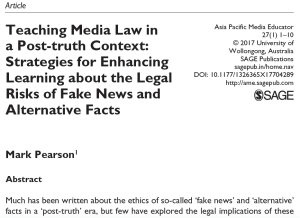
[ii] Please note that some parts of this submission are explained further in my recent article in the journal Asia Pacific Media Educator’. Pearson, Mark (2017) ‘Teaching media law in a post-truth context – strategies for enhancing learning about the legal risks of fake news and alternative facts’ Asia Pacific Media Educator, 27(1) 1–10.

[iii] See, for example, Articles 11 and 19 of the Universal Declaration of Human Rights.

[iv] See: Australian Capital Television Pty Ltd v Commonwealth (1992) 177 CLR 106; Stephens v West Australian Newspapers Ltd (1994) 182 CLR 211, Lange v. Australian Broadcasting Corporation (1997) 189 CLR 520; Wotton v Qld [2012] HCA 2.


[v] McNicoll, D. D. (2006, 31 August). The diary. The Australian [Media section]. p. 18.

[vi] Evidence Act 1995, s. 126K.

[vii] Royes, Luke (2017) AFP officer accessed journalist’s call records in metadata breach. ABC News online. Available: http://www.abc.net.au/news/2017-04-28/afp-officer-accessed-journalists-call-records-in-metadata-breach/8480804

[viii] Copyright Act 1968 ss40 and 103B.

[ix] See Defamation Act NSW 2005 s. 30.

[x] Pearson & Polden, op. cit., p. 147.

[xi] See Pearson & Polden, op. cit., Chapter 6, ‘Covering Court’

[xii] See Slater v Blomfield [2014] NZHC 2221, at paras 47-55.

[xiii] Pearson, Mark. (2011). ‘Consumer law holds solution to grossly irresponsible journalism’. Journlaw blog. Available: https://journlaw.com/2011/11/07/consumer-law-holds-solution-to-grossly-irresponsible-journalism/


[xiv] Evidence Act 1995 ss. 126J and 126K

[xv] See Defamation Act NSW 2005 s. 30.


———–

Disclaimer: While I write about media law and ethics, nothing here should be construed as legal advice. I am an academic, not a lawyer. My only advice is that you consult a lawyer before taking any legal risks.

© Mark Pearson 2017

2 Comments

Filed under free expression, journalism, journalism education, media ethics, Media regulation, Uncategorized

Fake news prompts a mindful approach to teaching media law in a ‘post-truth’ context – #MLGriff

By MARK PEARSON

My article ‘Teaching media law in a ‘post truth context’ has just been published in the Sage journal Asia Pacific Media Educator, edited by Professor Stephen Tanner from the University of Wollongong.

Much has been written about the ethics of so-called ‘fake news’ and ‘alternative’ facts in a ‘post-truth’ era, but few have explored the legal implications of these and the flow-on to education in media law.

This article suggests there are clear legal risks for journalists adopting the hallmark practices of ‘fake news’ – particularly in linking identifiable individuals to reputationally damaging falsities (defamation) and in making misleading or deceptive claims in the course of business (consumer law).

Whether or not such an ethically dubious practice is actionable will depend on a host of factors including the strength of publishing defences, the availability of legal advice, and the jurisdictional reach of any legal suit.

This article suggests a problem-based approach – including recent examples and classical media law principles – might encourage a ‘mindful’ (reflective) practice when assessing media law risks in the news room.

When a graduate makes the news for a serious legal error – as one Yahoo!7 journalist did in Australia in 2016 (DPP v Johnson & Yahoo!7 [2016] VSC 699 (28 November 2016) ) – journalism educators are deceiving themselves if they think such a fate might not await their own graduates.

If we accept there is no guarantee our students will retain the key knowledge they need in an important area like media law, we need to at least ensure they are equipped with the requisite skills to pause and reflect in the midst of their news reporting and production to assess their capacity for reporting a particular story or addressing a legal or ethical dilemma.

We have developed and refined one approach to achieving this over recent years which we have called ‘mindful journalism’. I’ve  written a short account of the basic principles of mindful journalism in the journal Ethical Space: The International Journal of Communication Ethics, and the editors have been kind enough to make that article available for free viewing as a feature item on their website here. Our book Mindful Journalism and News Ethics in the Digital Era: A Buddhist Approach (Shelton Gunaratne, Mark Pearson and Sugath Senarath eds; Routledge, NY, 2015)  explored the possibilities of applying mindfulness techniques to journalism practice.

The Asia Pacific Media Educator article explains that in applying the mindful journalism approach to media law, students are taught to work through an eight-point checklist to self-assess their capacity for dealing with an ethical or legal dilemma. When applied to the proposed construction and/or publication of ‘fake news’, the eight points of questioning and reflection might appear as follows:

Understanding – What is my understanding of the media laws relevant to this situation? What are the legal implications of publishing something false – even the false words or constructions of others? What are the risks of publishing something true, which might still be in breach of a law (for example, in breach of a suppression order or in breach of sub judice contempt rules)?

Intent – Why do I even want to report this story? What public interest does it serve? What am I intending to achieve by my involvement in its production?

Livelihood – Am I in the right occupation here? Where does the task I am approaching (‘fake news’) sit within my career definition?

Speech – What is the factual basis to the words I am selecting and how are they best selected and crafted to demonstrate truth, accuracy and good faith? Whose voices are in my story and is there a sufficient range of voices and perspective to earn the relevant defences? What needs to be said that is not being said in this story, contributing to falsities, misunderstandings, or imputations about others?

Actions – What aspects of my behavior in this reporting and publishing sit within the bounds of the law and the defences to which I aspire? How do I manage the fact-checking of the words others are saying here and how do I explain any falsities to my audience? Can the publication of my story be delayed until I can substantiate any claims with further evidence?

Effort – To what extent am I trying to follow both the letter and spirit of the law in the pursuit of this story? How hard have I worked to gather evidence to prove the truth of the facts in my story, and to give all key stakeholders the opportunity to speak and respond?

Mindfulness – What techniques of self-reflection and micro-meditation upon media law risks and approaches have I learned and implemented? What time have I devoted to working through each of the other factors here and in applying them to my situation at hand?

Concentration – How accomplished is my concentration upon the multiplicity of legal dimensions to the story in focus? How well have I focused upon each of them and worked systematically through its elements and the extent to which I have addressed them?

Interested? Please go to the Sage site to access the full article.

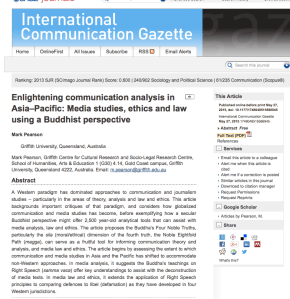
If you are interested in reading more about my application of mindful journalism to media law and ethics, please see my treatment of its relationship to defamation in the International Communication Gazette in my article titled ‘Enlightening communication analysis in Asia-Pacific: Media studies, ethics and law using a Buddhist perspective’. Its abstract and link to the full article is available here. See also the mindful approach to navigating mental health reporting restrictions I used with colleague Tom Morton, reported in the Pacific Journalism Review article “Zones of Silence”, accessible here.

———————-

Disclaimer: While I write about media law and ethics, nothing here should be construed as legal advice. I am an academic, not a lawyer. My only advice is that you consult a lawyer before taking any legal risks.

© Mark Pearson 2017

Leave a comment

Filed under Buddhism, contempt of court, defamation, Eightfold Path, free expression, journalism, journalism education, media ethics, mindful journalism, Uncategorized

Mindful journalism explained in Q&A style

By MARK PEARSON

It is heartening to see fellow journalism academics taking an interest in ‘mindful journalism’ – an important area of my research over recent years.

I was honored to be interviewed on the topic by lecturer in journalism and electronic media from the University of Tennessee, Melanie Faizer, and she kindly allowed me to record the interview to screen via this blog.

UPDATE: View Melanie Faizer’s article in Columbia Journalism Review here:

So here it is for those of you interested in mindful journalism as I see it a few years into my journey…

Our book Mindful Journalism and News Ethics in the Digital Era: A Buddhist Approach (Shelton Gunaratne, Mark Pearson and Sugath Senarath eds; Routledge, NY, 2015)  explored the possibilities of applying mindfulness techniques to journalism practice.

Screen Shot 2015-05-29 at 3.08.59 pmI  recently wrote an article on the “Right Speech” aspect of mindful journalism for the International Communication Gazette titled ‘Enlightening communication analysis in Asia-Pacific: Media studies, ethics and law using a Buddhist perspective’. Its abstract and link to the full article is available here.

The article backgrounds important critiques of the Western approach to communication  studies, and considers how globalized communication and media studies has become, before exemplifying how a secular Buddhist perspective might offer 2,500 year-old analytical tools that can assist with media analysis, law and ethics.

I’ve also written a shorter account of the basic principles of mindful journalism in the journal Ethical Space: The International Journal of Communication Ethics, and the editors have been kind enough to make that article available for free viewing as a feature item on their website here. You might also want to explore some of their other fascinating articles on media ethics here and perhaps subscribe.

———–

Disclaimer: While I write about media law and ethics, nothing here should be construed as legal advice. I am an academic, not a lawyer. My only advice is that you consult a lawyer before taking any legal risks.

© Mark Pearson 2017

Leave a comment

Filed under blogging, Buddhism, Eightfold Path, free expression, journalism, media ethics, mental health, mindful journalism, social media

Alternative media values offer hope in a ‘post-truth’ media world, says journalism academic

By MARK PEARSON

Alternative and community media offer a vehicle to combat the forces of ‘fake news’ in the so-called ‘post-truth’ era, Griffith University’s Associate Professor Susan Forde suggested in the 2017 Arts Education Law Professorial Lecture in Brisbane tonight (May 16).

Associate Professor Susan Forde delivers the 2017 AEL Professorial Lecture

The director of the Griffith Centre for Social and Cultural Research told her South Bank audience it was a tall order to expect the “somewhat diminished media sector” to shoulder the burden in a “neo-liberal era that has fairly successfully marginalized social democratic views of the world”.

She pointed to independent media operating on alternative funding models such as the Guardian, the New Daily, Crikey, the Monthly and New Matilda as a foundation for a “healthy and diverse media landscape”.

“In an advanced democracy, we do have structures which can support financial contributions to media organisations without threatening their independence and autonomy,” Dr Forde said.

“When we can deliver this – a much larger public and community-based media sector that is well supported – we will find it much easier to marginalise lound and deceitful voices.”

She was addressing the topic “The Media in Dangerous Times”, suggesting the traditional role of the Fourth Estate as an effective watchdog on power had been significantly challenged by a range of forces over the past decade.

“We’ve witnessed the rise of far-right political movements based on racism and identity politics and not much else,” she said.

“The media has been complicit in their rise. These two issues are tied together by a third factor and that is the successful marginalizing of thoughtful, informed and progressive views as political correctness and propaganda from a media elite.”

The decline in traditional media revenue streams at the expense of international new media platforms like Google and Facebook had prompted the removal of more than a quarter of Australia’s journalism workforce over the past six years – and the price that has been paid has been quality journalism.

But the answer for journalism was not to place faith in cost cutting and new technologies, but rather in content reflecting “a particular set of professional commitments and traits”.

Alternative media journalists were driven by such values, Dr Forde contended.

“They are driven to provide information to their audiences which will overtly encourage them to take part in democracy – to participate, to do something,”she said.

“They provide what we call mobilizing information.”

———–

Disclaimer: While I write about media law and ethics, nothing here should be construed as legal advice. I am an academic, not a lawyer. My only advice is that you consult a lawyer before taking any legal risks.

© Mark Pearson 2017

Leave a comment

Filed under free expression, journalism, journalism education, media ethics, Media regulation, Uncategorized

Is an Open Justice Advocate the solution to overly restrictive suppression orders? #MLGriff

By MARK PEARSON

Jason Bosland [@JasonBosland] – Deputy Director of the Centre for Media and Communications Law at Melbourne Law School – has called for the introduction of a state-funded Open Justice Advocate as a measure to alleviate the continuing practice of judges issuing overly restrictive suppression orders.

Bosland’s explanatory article in Pursuit and his research article the Sydney Law Review come just as we are about to examine open justice and court restrictions in our Griffith University Media Law course, so they are essential reading for students.

He is the acknowledged leader in the field of suppression order scholarship in Australia and his work tracked firstly the need for the Open Courts Act 2013 in Victoria and, more recently, its failings to impact effectively on court practices.

https://twitter.com/JasonBosland/status/836835663614001157

Bosland writes in the Pursuit article:

This leads to a critical question: who is going to protect the fundamental principle of open justice if the courts themselves are not as vigilant as they should be and if the media are increasingly unable or unwilling to intervene? It is my view that the only solution is for the introduction of a state funded open justice advocate.

His longer Sydney Law Review is an expert combination of insightful policy analysis, meticulous scrutiny of the legislation, and illuminating statistics drawn from his funded research projects on the topic. I commend them to all media law geeks and students.

His concludes that article with this wise counsel:

This state of affairs is clearly unsatisfactory. The solution, however, is not to be found in further legislative reform of the courts’ powers. Rather, attention should be directed towards further professional and judicial education, and the development of a range of suitable model orders. Furthermore, a scheme facilitating the appearance of contradictors in suppression order applications — such as the Open Courts Act Duty Barrister Scheme introduced at the instigation of the Chief Justice — is likely to improve current practices. However, it will only be truly effective in solving the problems identified in the present study if it can be extended to all courts.

Insightful indeed.

[See also – my article in The Conversation on how the 2015 edition of our textbook inadvertently breached a Victorian suppression order and had to be reprinted.]

Disclaimer: While I write about media law and ethics, nothing here should be construed as legal advice. I am an academic, not a lawyer. My only advice is that you consult a lawyer before taking any legal risks.

© Mark Pearson 2017

2 Comments

Filed under blogging, citizen journalism, contempt of court, free expression, journalism, media ethics, media law, Media regulation, social media, sub judice

Lessons for us all in $300k Yahoo!7 fine for contempt [updated]

By MARK PEARSON

Most Australian followers of this blog will have seen in the news that Yahoo!7 has been fined $300,000 for sub judice contempt over a publication which triggered the discharge of a jury in a Victorian murder trial.

The relatively inexperienced online journalist who wrote and uploaded the story to the organisation’s news site (without attending the court case on which she was reporting) escaped with a two year good behaviour bond, but Supreme Court Justice John Dixon noted the impact upon her of the media coverage and public shaming.

The main problem with her story was that it included excerpts from the victim’s social media accounts indicating the accused had a history of violence towards her and that she feared for her life – prejudicial evidence of which the jury was unaware.

This was enough for Dixon J. to rule:

“I find that the conduct of the respondents in publishing the article during the trial of an accused on a murder charge was conduct in contempt of court. I am satisfied beyond reasonable doubt that the publication, objectively and as a matter of practical reality, had a real and definite tendency to prejudice the trial of the accused.” (2016 judgment, para 3).

As university classes resume for the new academic year, it is timely to consider the lessons of the sorry episode for journalists and journalism students, educators and media organisations.

The two judgments – the conviction in 2016 and the sentencing in 2017 – deserve careful examination by all. Here are the take-home messages for us all:

Journalists and Journalism students

According to her LinkedIn page, the journalist was a graduate of a one year broadcast journalism program in 2013 and had since worked at modeling, sales, and internships as a television producer before gaining her position with Yahoo!7 as morning news producer in June 2015, just over a year prior to the offending story.

No doubt some basics of media law would have been covered in that institution’s media law course as they are in tertiary journalism programs throughout Australia. However, just because a student passes a media law subject with a mark of more than 50% does not mean he or she has learned and remembered every key topic covered.

If you are a student about to embark on a media law course you must realize that the consequences for failing to remember and apply the key elements of media law in your workplace can cost you your professional reputation, many times your annual salary in fines or damages awards, and even your liberty in the form of a jail term.

This means media law is way too important to undertake with that common student approach of “passes build degrees”. You need to read your textbooks and assigned readings, review them, view and engage in other recommended learning materials and tools, grapple with learning problems – and set your mind to keep up to date with developments in each of the media law topic areas. In other words, you need to make media law your passion and hobby if you are to have a good chance of staying out of trouble with the law.

That goes for working journalists as well as students. My experience in training working journalists is that most have forgotten the basic principles of defamation and contempt they learned at university or in training courses many years prior.

As for content, the key lesson from this case is that while a criminal trial is pending or in progress you should only report what has been stated in court in the presence of the jury. Dixon J. summed up the basic principles of sub judice contempt particularly well at para 24 of the 2016 trial:

(a) All contempt of court proceedings involve circumstances where there has been an interference with the due administration of justice;

(b) The law is concerned with the tendency of the matter published in the risk created by its publication.[3] It is unnecessary to prove that a juror or potential juror actually read or heard the prejudicial material;[4]

(c) The test for liability for sub judice contempt is whether the published material has, as a matter of practical reality, a real and definite tendency to prejudice or embarrass particular legal proceedings or interfere with the due administration of justice in the particular proceeding;[5]

(d) The tendency is to be ‘determined objectively by reference to the nature of the publication and it is not relevant for this purpose to determine what the actual effect of the publication on the proceedings has been or what it probably will be. If the publication is of a character which might have an effect upon the proceedings, it will have the necessary tendency, unless the possibility of interference is so remote or theoretical that the de minimis principle should be applied’;[6]

(e) The tendency is to be determined at the time of the publication;[7]

(f) Publication on the internet occurs when the material is uploaded onto the internet;[8]

(g) Proof of an intention of the contemnor to interfere with or obstruct the administration of justice is not a necessary element to be proved;[9]

(h) It is not relevant to consider the actual effect of the publication. Regard is had to the nature and content of the publication and to the circumstances in which it occurred;[10]

(i) Publishing or broadcasting material that is inadmissible before a jury may have the necessary tendency to prejudice an accused’s right to a fair trial;[11]

(j) It is an elementary principle in the administration of criminal justice that, apart from exceptional cases, usually defined by statute, the bad character or prior convictions of an accused cannot be put before the jury on a trial;[12]

(k) The law sets its face against trial by prejudice and innuendo. The principle that the prosecution may not adduce evidence, tending to show that an accused person has been guilty of other criminal acts or has a propensity to violent behaviour, for the purpose of leading to the conclusion that he is a person likely to have committed the offence with which he is charged is deeply rooted and jealously guarded;[13]

(l) The weight and importance of the various factors that will be material in assessing the circumstances of publication will vary from case to case. Broadly speaking, the more important factors will include the following: the content of the publication; the nature of the proceedings liable to be affected, whether they are civil or criminal proceedings and whether at the time of publication they are pending at the committal, trial or appellate stage; the persons to whom the publication is addressed; and finally, the likely durability of the influence of the publication on its audience;[14]

He continued:

Para 25: For centuries, a ‘golden rule’ has been observed by journalists and publishers that while proceedings are being tried before the courts, information that is not admitted as evidence before the jury is not reported or published to prevent the possibility that the jury is influenced by prejudicial, extraneous, or irrelevant information. The rationale is well understood. In 1811, Lord Ellenborough stated in R v Fisher:[18]

“If anything is more important than another in the administration of justice, it is that jurymen should come to the trial of those persons on whose guilt or innocence they are to decide, with minds pure and unprejudiced’.”

Para 26: More recently, in 1985, Watkins LJ in Peacock v London Weekend Television[19] reaffirmed the balance between a fair trial and media reporting:

“In our land we do not allow trial by television or newspaper. Until the well-recognised institution of this country for the doing of justice, namely the courts, have worked their course, then the hand of the writer and the voice of the broadcaster must be still.”

Para 27: The rule is well understood by journalists through their education and is communicated to journalists by the court. The court’s website has a guide ‘Covering the Courts’[20] that stresses the importance of not disclosing material that is kept from a jury:

“Remember the golden rule: do not report anything said in the absence of the jury.

Advice: study, understand and remember these basic principles and you might avoid the fate of this Yahoo!7 reporter.

Journalism Educators

Much as we would like to believe otherwise, we all secretly know that this Yahoo!7 journalist could have been any one of our graduates in the modern news media environment.

24/7 rolling deadlines, staffing shortages, acute competition, minimal on the job training, combined with the rookie’s urge to prove themselves in a tough occupation mean that shortcuts are taken, mistakes are made, and much of the knowledge gained doing highly caffeinated swatting for media law exams has long since exited the memory banks.

This case is a clarion call to us to revisit our curricula and pedagogies and implement the latest learning and teaching techniques to “scaffold” and “deepen” our learning.

My recent experience has been that a combination of problem-based learning, formative quizzes, and end of semester problem scenarios seem to be far superior to the traditional end of semester sit-down exam of yesteryear. Add to the mix student discussion of cases and law reforms as they unfold, along with the embedding of some key media law revision in other subjects, and you gain confidence that the key principles will be learned and remembered in the news room – an exercise in genuine “mindful journalism” or “reflection-in-action”.

Media organisations

The halcyon era for media law training in news organisations was 1990-1994 with the operation of the Keating Government’s training guarantee levy – an obligation on corporations to spend 1.5% of their payroll on structured training courses. Back then regional journalists, for example, received up to five full days of media law training as part of their award and could not be promoted without being certified that they had undertaken it. From memory, it consisted of two days of defamation training, one day on contempt, another on court reporting, and the final on a mixed bag of other media law topics.

If they are lucky, journalists today might get a couple of hours every year or so of a media law briefing from a lawyer, on the strong (and usually false) assumption that they already know most of it from their university degrees.

In his 2017 sentencing judgment, Dixon J. found serious shortcomings in Yahoo!7’s training and workplace protocols justified the $300,000 fine:

“Para 26: I infer that the contemptuous publication likely occurred, at least in part, as a consequence of inadequate resourcing, driven by profit or commercial motivations. Conduct by media organisations that contributes to the risk of sub judice contempt in pursuit of a profit motive must be strongly discouraged.”

He was skeptical about the sustainability of the company’s assurances that it now had new systems in place to train journalists, assign extra editorial staff to manage the workload, and to engage external lawyers to assess court stories.

“Para 27: I can find no feeling of comfort that, should the profit motive rear its head in the future, Yahoo!7 (and other media organisations) will continue to incur expense to maintain systems and procedures that protect the integrity of court processes.”

“Para 30: The arrangements about legal advice before articles are uploaded to the internet appear clumsy, unrealistic in some respects, and may prove more difficult to enforce in practice, given time constraints and their importance in the business model being employed by Yahoo!7”.

One can only hope that all of those stakeholders – students, journalists, educators and media organisations – pay heed to those important lessons the learned judge has so eloquently expressed.

UPDATE: Court copycats caught out. ABC Media Watch exposes how some news organisations lift court reports from their competitors – an unethical practice with major legal pitfalls. View here.

———–

Disclaimer: While I write about media law and ethics, nothing here should be construed as legal advice. I am an academic, not a lawyer. My only advice is that you consult a lawyer before taking any legal risks.

© Mark Pearson 2017

1 Comment

Filed under contempt of court, free expression, journalism, journalism education, media ethics, media law, Media regulation, mindful journalism, Press freedom, Uncategorized

Reporting Islam panel and workshop at #newnewsau

By MARK PEARSON

We were honoured to have our Reporting Islam project showcased at this year’s New News forum hosted by the University of Melbourne’s Centre for Advancing Journalism (October 29).

Our project manager Dr Abdi Hersi and I conducted a workshop centred around the reporting of a mosque proposal in a regional community and later joined lawyer and South Sudanese community leader Kot Monoah on a panel chaired by Denise Ryan-Costello, journalism lecturer at Swinburne University.

The discussion has been ably reported here on The Citizen by Master of Journalism student Emily Porello.

Here is the Twitter coverage of the session:

https://twitter.com/Melita_Ferguson/status/792238794049069056

https://twitter.com/Melita_Ferguson/status/792233882414227456

Our Griffith University project (co-led by colleague Associate Professor Jacqui Ewart) recently won the 2016 Queensland Multicultural Award for our ground-breaking Reporting Islam Project.

Since its inception in 2014, our team has created a suite of research-based multi-media training and education resources for Australian media practitioners and tertiary institutions.

———–

Disclaimer: While I write about media law and ethics, nothing here should be construed as legal advice. I am an academic, not a lawyer. My only advice is that you consult a lawyer before taking any legal risks.

© Mark Pearson 2016

Leave a comment

Filed under free expression, Islam, journalism, journalism education, media ethics, Muslim, Reporting Islm

Addressing the Sri Lankan Press Council on media law and mindful journalism

By MARK PEARSON

For the past two weeks I have been in Sri Lanka, where my speaking and interview schedule has been arranged by Dr Sugath Senarath, my co-author of our book Mindful Journalism and News Ethics in the Digital Era: A Buddhist Approach (Shelton Gunaratne, Mark Pearson and Sugath Senarath eds; Routledge, NY, 2015).
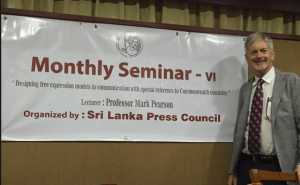
srilankawithsugath

Professor Mark Pearson (@journlaw) at the Sri Lanka Press Council event. Photo: Julie Pearson

The highlight was my address to the Sri Lankan Press Council last Wednesday (August 31) on the topic “Designing free expression models in communication with special reference to Commonwealth countries – a mindful Australian perspective”.

I offer the full text of the address to you here. [Please note that sections are excerpted from earlier work, including The Journalist’s Guide to Media Law (co-authored with Mark Polden, Allen & Unwin, 2015), Mindful Journalism (reference above) and my unpublished 2013 address to the Timor Leste National Congress for Journalists.]


Press Commissioner, Press Council Chair and board members, co-author and host Dr Sugath Senarath, academic and media colleagues, journalism and media students and young reporters and other honored guests…

Thank you sincerely for having me here today to talk about the important topic of free expression – a fundamental feature in a working democracy.

It is important that all citizens – particularly journalists and politicians – have a grasp of the principles of free expression, media freedom and their historical context.

Origins of free expression

The free expression of certain facts and views has always been a dangerous practice, with countless people put to death for expressing religious or political views throughout history. Many more have been imprisoned, tortured or punished for such expression. Socrates in 399 BCE elected to drink a poison—hemlock—rather than recant his philosophical questioning (Brasch and Ulloth, 1986, p. 9). The history of freedom of expression is as much a history of censorship, because when free expression has been threatened, intellectuals have been called upon to defend it. It was Johann Gutenberg’s invention of movable type in about 1450 and the massive growth in the publishing industry over the sixteenth and seventeenth centuries in the form of newsbooks and the activities of ‘pamphleteers’ that first triggered repressive laws, and then the movement for press freedom (Feather, 1988: 46). (It is interesting that these individuals were the forerunners of the citizen journalists and bloggers we know today—often highly opinionated and quick to publish speculation and rumour.)

srilankapcaddress

Delivering the Sri Lankan Press Council address in Colombo. Photo: Julie Pearson

The pamphleteers took umbrage at government attempts to impose a licensing system for printers from the mid-sixteenth century (Overbeck, 2001: 34). Political philosopher and poet John Milton took aim at this in 1644 with Areopagitica, a speech to the parliament appealing for freedom of the presses. He went on to utter the famous free speech principle: ‘Give me the liberty to know, to utter, and to argue freely according to conscience, above all liberties.’ (Patrides, 1985: 241). Milton inscribed his name on the title page of his unlicensed work, in defiance of the law he was criticising. The notion of free expression had spawned its offspring: press freedom.

Part of Milton’s argument centred on the ‘marketplace of ideas’—the belief that truth will win over falsehood when the two compete. This proposition of a contest between truth and falsehood was often used during the seventeenth and eighteenth centuries to justify freedom of expression (Smith, 1988: 31). It continues in public discourse today.

srilankawithbanner

Two of the co-authors of ‘Mindful Journalism’, Professor Mark Pearson (left) and Dr Sugath Senarath from the University of Colombo.

Philosopher and political theorist John Locke took up the fight after Milton’s death. Under his social contract theory, governments are there to serve the people, and central to this is freedom of expression (Overbeck, 2001: 36).

Like Milton, Locke campaigned for the end of the English printing licence system, which expired in 1694 (Overbeck, 2001: 36). Those to speak out against restrictions on press freedom at the turn of the eighteenth century included novelist and journalist Daniel Defoe, who wrote ‘An Essay Upon the Regulation of the Press’ around 1704 (Brasch and Ulloth, 1986: 62), and John Trenchard and Thomas Gordon who, under the pen name ‘Cato’, wrote a series of letters about freedom in the 1720s (Brasch and Ulloth, 1986: 64–8).

England’s foremost philosopher of the late nineteenth century, John Stuart Mill, articulated the need for free speech in a liberal democratic society in On Liberty, first published in 1859 (Mill, 1991). He wrote:

The time, it is to be hoped, is gone by, when any defence would be necessary of the ‘liberty of the press’ as one of the securities against corrupt or tyrannical government. No argument, we may suppose, can now be needed, against permitting a legislature or an executive, not identified in interest with the people, to prescribe opinions to them, and determine what doctrines or what arguments they shall be allowed to hear. (1991: 20)

Mill’s On Liberty built on Milton’s ‘marketplace of ideas’ to define the boundaries of freedom of expression in the modern nation-state. One of the great legal minds of the eighteenth century, Sir William Blackstone, in his Commentaries on the Laws of England, had a great impact on the evolution of press freedom by defining it as the absence of ‘previous restraints upon publications’ (Blackstone, 1765–69: 151–2).

Blackstone’s notion of ‘prior restraint’ has underscored the development of media law in the United States. The idea was that freedom of the press could tolerate no restrictions before publication, such as licensing and taxes that had been imposed in Britain, but that the law should take its course after publication to punish those who abused this freedom. Publications should be tax and licence free, but subject to laws like defamation and contempt once published. In both Britain and its colonies, a common weapon for silencing the press had been the crime of ‘seditious libel’—any serious criticism of government or the Crown, whether or not the criticism was truthful. William Murray, Lord Chief Justice and Earl of Mansfield (1704–93), had coined the expression ‘the greater the truth, the greater the libel’ (Whitton, 1998), ensuring that truth would not stand up as a defence to seditious libel.

Despite these restrictions, basic press freedom had taken hold in Britain. Some thought the press had gone too far. In this context, the expression ‘the Fourth Estate’ was coined. At that time, there were said to be three ‘estates of the realm’—the Lords Spiritual, the Lords Temporal and the Lords Common. In 1790, English statesman Edmund Burke is said to have pointed to the press gallery in parliament and said: ‘There are three estates in Parliament but in the reporters’ gallery yonder sits a fourth estate more important far than they all.’ (Inglebart, 1987: 143).

The libertarian ideals on which press freedom is based were not confined to Britain. The movement for civil rights and individual liberties spread throughout Western Europe during the seventeenth to nineteenth centuries, epitomised by the French Revolution in 1789, leaving a legacy of press freedom throughout that region and its colonial outposts.

In Western democratic societies, journalists often take their liberties for granted. But there has never been utterly unshackled free speech or a completely free media: we operate on an international and historical continuum of free expression through to censorship. It is only over the past half-century that the notion of free expression and a free media has gained traction on a broader international scale.

Free expression internationally

There is no enforceable worldwide agreement on free expression as a fundamental human right, although some nations and regions have entrenched free expression in their constitutions. The key international document is the United Nations Universal Declaration of Human Rights, which in 1948 enshrined free expression at Article 19:

Everyone has the right to freedom of opinion and expression; this right includes freedom to hold opinions without interference and to seek, receive and impart information and ideas through any media regardless of frontiers.

At face value, this statement seems to give all the world’s citizens a right to free expression. While a declaration of a lofty goal, it has many limitations, as we will see.

Stronger protections came internationally in 1966 when the United Nations (UN) adopted the International Covenant on Civil and Political Rights, prompting a series of binding treaties. The covenant introduces a right to free expression for the world’s citizens, again at Article 19.

However, the right is limited because the covenant also recognises duties, responsibilities and restrictions covering respect for the rights and reputations of others, and the protection of national security, public order, public health or morals. Add to this the fact that many countries either have not ratified the covenant, or have not incorporated its provisions to make them part of their domestic law—as in the case of Australia.

At least three major democratic English-speaking nations in addition to the United States have bills of rights enshrining free speech. British and European liberal ideals found their way into the wording of the American Declaration of Independence in 1776, the US Constitution in 1789 and its Bill of Rights in 1791. Central to the Bill of Rights was the First Amendment to the US Constitution:

Congress shall make no law respecting an establishment of religion, or prohibiting the free exercise thereof; or abridging the freedom of speech, or of the press; or the right of the people peaceably to assemble, and to petition the Government for a redress of grievances.

US government attempts to restrain publications in the national interest have usually failed on First Amendment grounds.

The Canadian Charter of Rights and Freedoms (1982), like the US First Amendment, recognises freedom of the press as part of section 2(b), which confers upon every citizen the following freedoms: ‘freedom of thought, belief, opinion and expression, including freedom of the press and other media of communication’. The United Kingdom and New Zealand legislation does not mention media freedom, opting instead for the broader term ‘freedom of expression’.

New Zealand’s Bill of Rights, enacted in 1990, states at section 14:Everyone has the right to freedom of expression, including the freedom to seek, receive, and impart information and opinions of any kind in any form’. In 2011, the New Zealand Supreme Court found that the right protected Valerie Morse, an anti-war protester who burned her country’s flag during a dawn memorial service in Wellington. Her conviction for offensive behaviour was set aside.

Despite this, there are many nations with such a free expression clauses in their constitutions where their governments have chosen to ignore them to advance their own interests or to prevent scrutiny of their actions. This has sometimes led to the harassment, assault, imprisonment and even murder of journalists. I note that the Sri Lankan Constitution also enshrines “freedom of speech and expression including publication” and it is encouraging that your new government has taken some first steps towards honouring that right which appears to have been neglected in recent decades. The recent passage of a Right to Information Act is one such encouraging step. Of course, such freedom of information instruments in many countries are ineffective because of the large numbers of exemptions to the release of documents available to governments, the cost of making applications, and the glacial speed with which bureaucracies approve requests for government information – using refusals and appeals to wear down the journalists rightfully seeking facts and information on behalf of the citizenry.

For many truth-seekers and truth-tellers, the commitment to free expression has taken the form of physical injury or danger—even death. The Committee to Protect Journalists (CPJ) lists more than 1200 journalists confirmed as killed in the course of their work since 1992, including 27 in 2016 to date. As a former correspondent for Reporters Without Borders, I must highlight the fact that the world is watching the new Sri Lankan government to see how enthusiastically it pursues and prosecutes those responsible for the murder of 19 journalists in this country since 1992 – criminals who it seems have been able to conduct their assassination of this democracy’s messengers with complete impunity. I suggest the Press Council might consider keeping this issue on the agenda in the interests of media freedom and as a tribute to those who have paid the ultimate price for exercising their Constitutional right to free expression.

Throughout the Asia-Pacific region, many others have died, suffered violence or have been imprisoned for what they report. Some have suffered in other ways, as the victims of lawsuits by those who set out to gag them.

Australia

Australia’s early history was marked by considerable censorship of its media, although an early battle between Governor Darling and the Chief Justice in 1827 prevented the licensing of newspapers.

Australia has no equivalent to the US First Amendment enshrining freedom of the press. However, in recent decades the High Court of Australia has recognised an implied freedom to communicate on matters of politics and government.

Press systems and ethical frameworks are on the agenda in all societies, and we are challenged to accommodate free expression and its close relative, press freedom, within new regulatory, technological and cultural contexts.

Recent inquiries into media regulation in the United Kingdom (Leveson, 2012), Australia (Finkelstein, 2012) and New Zealand (Law Commission, 2013) have recommended major changes to the regulation of media corporations and the ethical practices of journalists. Their motivation stems, at least ostensibly, from public angst—and subsequent political pressure—over a litany of unethical breaches of citizens’ privacy over several years in the United Kingdom, culminating in the News of the World scandal and the subsequent revelations at the Leveson Inquiry (2012), all of which had an undoubted ripple effect in Australia.

Two major inquiries into the Australian news media in 2011 and 2012 prompted a necessary debate over the extent to which rapidly converging and globalised news businesses and platforms might require statutory regulation at a national level. Four regulatory models emerged—a News Media Council backed by recourse to the contempt powers of courts; a super self-regulatory body with legislative incentives to join; a strengthened Australian Press Council policing both print and online media; and a government-appointed Public Interest Media Advocate.

All proposals for any such government intervention with media freedom by such a controlling body by a Press Council or News Council were rejected after considerable pressure from media organisations as anathema to free expression.

Both inquiries acknowledged—and rejected—the notion of a revamped Australian Press Council, proposed in various submissions and in appearances by its then chair. The Australian Press Council was established in 1976 as a newspaper industry ‘self-regulatory’ body—a purely voluntary entity with no powers under law.) Nevertheless, both during and after these two reports, and with new support from most of its members, the Press Council moved quickly to ramp up its purview and powers to address many of its documented shortcomings, such as the refusal of some member newspapers to publish its findings and the threat of withdrawal of funding from others (Simpson, 2012). It locked its members into four-year commitments and established an independent panel to advise on a review of content standards.

At the same time as these changes to media regulation were being proposed, several reformulations of existing media laws were being considered by state, territory and federal governments and their respective law-reform bodies. They covered such topics as privacy law, media classification, intellectual property, cyber-bullying, shield laws and national security laws. Of these, new shield laws have subsequently been introduced in most Australian jurisdictions. Media law and regulation constitute a field subject to continual scrutiny and change, which makes it all the more important for students and professional communicators to keep pace with developments.

It is noteworthy that the self-regulatory institution journal­ists fear most – more than the Press Council and other self-regulation tribunals, is the ABC’s weekly program Media Watch, which was first screened in 1989. Its website promotes it as follows: ‘Everyone loves it until they’re on it’ (www.abc.net.au/mediawatch/). Criticised for being sometimes trite, and often bitchy, Media Watch has exposed some of the nation’s most spectacular ethical breaches over the past two decades. These include blatant instances of plagiarism and privacy invasion and, most famously, an exposé of secret payments being made to talkback radio stars for their endorsement of products and services without the knowledge of their listeners. While Media Watch itself has no sanctions available, the power of the program lies in the fact that ethical breaches and glaring errors are screened on national television, when journalists know their colleagues are watching. The ultimate tool of media self-regulation can indeed be the media itself!

There are several ways journalists in other countries considering regulatory models can learn from this recent experience in Australia.

  1. Comparisons can be dangerous. Even in a democracy with a long history of relatively free expression politicians and governments will seek out and seize any opportunity to regulate the media. International comparisons can be dangerous because we operate within different political and cultural frameworks. When they were arguing for their media reforms, Ministers cited RSF’s World Press Freedom Index, using the argument that Finland remained in number one position there despite having a statutory mechanism for its press regulation. They failed to mention that Finland also has a section in its Constitution guaranteeing free expression and the free flow of information so all laws are formed and applied against that backdrop. It also lacks the hundreds of other media laws that impact on free expression in other countries like Australia.
  2. Beware of regulation creep. Existing laws such as defamation and contempt that apply to all citizens go a long way towards controlling media behavior. I have seen few serious ethical breaches that could not be handled by the existing laws. Once media laws have been introduced it is hard to wind those laws back to re-establish eroded freedoms. Australia passed more than 60 new anti-terror laws after the September 2001 attacks on the US – many impacting on the media – and few of those have been wound back. Media regulation is hard to undo because governments like to have that power.
  3. Don’t trade press freedom. Well meaning journalists and academics are sometimes willing to sacrifice media freedom because of the misbehavior of some media personnel. When you offer governments new powers to control the misbehaviour of some elements in the media you need to accept that those same powers might be used against you at some later stage.
  4. Beware de facto licensing. There is the temptation to issue journalists with accreditation and registration in actual or de facto licensing schemes. While journalists might like the idea of carrying an official card with privileged access, the narrow defining of journalists and journalism by governments presents a real danger to free expression because it privileges some citizens over others as communicators. This gives those issuing and revoking such licenses influence over the message itself. It is even less appropriate in a new era of blogging and social media because the nature of news and journalism is even harder to define. Citizens might become reporters temporarily because of the scale of an event or issue or on an ongoing basis in a narrow field of interest that might momentarily become of broader public interest. It is inappropriate that they should have to seek registration or licensing as a journalist or that they should be punished for reporting without such official licence. Rather, their words or actions should be subject only to the communication limitations placed on all citizens, and in a working democracy they should be limited to only extreme breaches.
  5. Judge a proposed law by its ultimate possible sanction. The best test when trying to gauge the potential impact of new media regulations is not the assurances of their proponents that they will be used only rarely and only in extreme cases, or perhaps not used against journalists. The real test is to look at the ultimate maximum sanctions available and if these involve the potential jailing or fining of journalists then they are anathema to press freedom in a democracy.
  6. Media freedom is above politics. Media regulation was certainly a long overdue debate in Australia, but it was politicised from the outset which undermined the likelihood of the implementation of any of the proposals. Some political parties supported tougher regulation of the media because they had been the target of adverse coverage. A basic human right like free expression should be above politics in a democracy, yet most governments will strive to limit it.
  7. Media freedom is above commercial interest. Opponents of media regulation need to be careful they are not being seen as simply protecting their own commercial enterprises. Criticism of the recommendations by the larger Australian media groups on free expression grounds – particularly by Murdoch executives – were dismissed as a defence of their vested interests (Meade and Canning, 2012). It helps to recruit other senior intellectuals in defence of media freedom – including academics, business leaders and other public intellectuals.
  8. Be wary of ethics codes imposed by governments. Too often governments use ethics codes as a Trojan Horse to push through tougher restrictions on journalists. Ethical codes should be SELF regulatory systems, not legally enforceable instruments carrying potential fines and jail terms.
  9. Training and education in law and ethics is crucial. Media outlets need to be more pro-active in developing better in-house processes for assessing ethical decisions and in explaining those decisions to their audiences. All reforms will, of course, need to be supplemented with better training of journalists about their rights and responsibilities and broader education of ordinary citizens to raise their understanding of the important role of the media in a democracy.
  10. Educate the community about free expression and a free media. The constitutional right to press freedom and free expression need to be part of every school’s civics curriculum and media organisations need to remind their audiences of this constitutional right and its important history at every opportunity.

Mindful Journalism

Just as important as external regulatory and legal systems are the internal processes of journalists’ decision-making – their internal ‘moral compasses’. I have explored this phenomenon in developing the concept of ‘mindful journalism’ with colleagues Shelton Gunaratne and Sugath Senarath in a recent book – Mindful Journalism – published by Routledge in New York last year.

We explore the possibilities of applying some of Buddhism’s core principles to the secular phenomenon of journalism. It must be accepted that Buddhist practices such as ‘mindfulness’ and meditation have been adopted broadly in Western society in recent decades and have been embraced by the cognitive sciences in adapted therapeutic ways (Segal et al 2012).

Each of the constituent steps of the Noble Eightfold Path – understanding free of superstition, kindly and truthful speech, right conduct, doing no harm, perseverance, mindfulness and contemplation – has an application to the modern-day practice of truth-seeking and truth-telling – whether that be by a journalist working in a traditional media context, a citizen journalist or a serious blogger reporting and commenting upon news and current affairs.

We do not propose a definitive fix-all solution to the shortcomings in journalism ethics or their regulation. Rather, ‘mindful journalism’ is an acknowledgment that the basic teachings of one of the world’s major religions can offer guidance in identifying a common – and secular – moral compass that might inform our journalism practice as technology and globalization place our old ethical models under stress. Media coverage can be vastly improved with the application of such principles – working towards a journalism of wisdom and compassion.

One of the problems with emerging citizen journalism and news websites is that their proponents do not necessarily ascribe to traditional journalists’ ethical codes. In a global and multicultural publishing environment the challenge is to develop models that might be embraced more broadly than a particular country’s repackaging of a journalists’ code. However, codes of ethics have often failed to work effectively in guiding the ethics of the traditional journalists for whom they were designed, let alone the litany of new hybrids including citizen journalists, bloggers, and the avid users of other emerging news platforms. Core human moral principles from key classical teachings like the Noble Eightfold Path could form the basis of a more relevant and broadly applicable model for the practice of ‘mindful journalism’.

The recent international inquiries triggered by poor journalism ethical practices have demonstrated that journalism within the libertarian model appears to have lost its moral compass and we need to explore new ways to recapture this. We should educate journalists, serious bloggers and citizen journalists to adopt a mindful approach to their news and commentary accommodating a reflection upon the implications of their truth-seeking and truth-telling as a routine part of the process. They would be prompted to pause and think carefully about the consequences of their reportage and commentary for the stakeholders involved, including their audiences. Truth-seeking and truth-telling would still be the primary goal, but only after gauging the social good that might come from doing so.

Journalists must tell uncomfortable truths for the benefit of society and for the proper functioning of democracies. Politicians particularly need to have thick skins in recognition of the transparency and accountability of the public positions they hold. Before they attack the media they need to reflect upon whether they are acting through craving, attachment or ego.

Even the Buddha allowed for such uncomfortable truths to be spoken. In the Abhaya Sutta, the Buddha addressed Prince Abhaya on the qualities of Right Speech. He related to the prince six criteria for deciding what is worth saying. The third represents how the mindful journalist might approach such criticism of public figures:

[3] “In the case of words that the Tathagata knows to be factual, true, beneficial, but unendearing and disagreeable to others, he has a sense of the proper time for saying them.

Mindful journalists should strive to get their timing correct, but there is no doubt that painful truths sometimes must be spoken. This requires reflection, meditation and insight in the planning and execution of a story to help alleviate suffering. A functioning democracy requires that such unendearing and disagreeable statements sometimes be made about our fellow citizens – particularly those entrusted with the public purse and special powers. It is no less than the role of the Fourth Estate to fulfil this function, and it is heartening to see that Sri Lanka is again investing in the fundamental freedoms that allow journalists to do so. I am sure the Sri Lankan Press Council can play an important role in advocating for press freedom and encouraging a robust journalism of truth, wisdom and compassion.

Thank you.

———–

Disclaimer: While I write about media law and ethics, nothing here should be construed as legal advice. I am an academic, not a lawyer. My only advice is that you consult a lawyer before taking any legal risks.

© Mark Pearson 2016

Leave a comment

Filed under blogging, Buddhism, citizen journalism, Eightfold Path, free expression, media ethics, mental health, social media