Category Archives: defamation

Defending truth: case study from our new edition

By MARK PEARSON

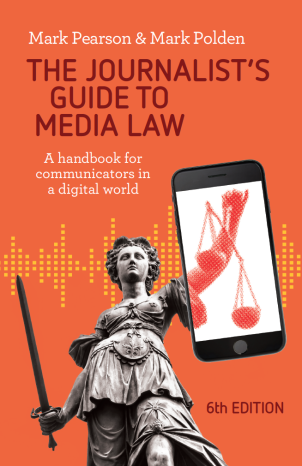
DEFENDING a defamation action using the truth or justification defence can have its hurdles, but this case we profile in the forthcoming sixth edition of The Journalist’s Guide to Media Law (Allen & Unwin, 2019) demonstrates how a major publication used it effectively.

—-

The Vocational Education case

Charan v Nationwide News Pty Ltd [2018] VSC 3

Facts

In late 2015, The Australian newspaper published a print article (‘Watchdog Takes Peak Training College to Court’) and a similar online version (‘ACCC to Take Top Training College Phoenix Institute to Court’). The story was about proposed court action by the Australian Competition and Consumer Commission (ACCC) against a vocational training college called Phoenix Institute owned by the publicly listed Australian Careers Network. The article mentioned earlier media reports that alleged Phoenix had sent sales staff into housing commission estates, pressuring potential students to join up, and stated that the parent company was under investigation by both the federal Department of Education and the Australian Skills Quality Authority (ASQA) and that its shares had been suspended from trading on the stock exchange for the previous month. The article identified the plaintiff, Atkinson Prakash Charan, as one of the company’s heads and stated that he had amassed a $35 million fortune from the vocational education business. In short, it suggested that, ‘whilst under his management, VET organisations acted unscrupulously, in breach of regulatory standards, and that he made a large amount of money as a result of that conduct’ (para. 2). Mr Charan had in fact left the company about a year earlier and the next day The Australian published a correction to that effect in its print edition and later an online apology for the error.

Law

The plaintiff pleaded that eight imputations arose from the article, which the judge grouped into four headings (para. 27):

  1. Mr Charan was head of ACN, a company that engaged in unscrupulous business practices that took advantage of vulnerable consumers.
  2. Mr Charan was head of ACN, a company that engaged in misleading and deceptive conduct.
  3. Mr Charan was head of ACN, which engaged in unscrupulous door-to-door marketing practices to vulnerable consumers.
  4. Mr Charan [as head of] ACN carried on a business which was significantly non-compliant with quality standards.

The defendant, Nationwide News—publisher of The Australian—argued successfully that imputations 2 and 3 did not arise in the articles and defended the imputations of unscrupulous business practices and significant non-compliance with quality standards using the justification (truth) defence by proving that the imputations were substantially true as required under section 25 of the Defamation Act 2005. To prove the substantial truth of the unscrupulous conduct allegations, it had to convince the court under the civil burden of proof—the ‘balance of probabilities’—that there was ‘clear and cogent proof’. To do so, it drew upon a host of material obtained after the publication, including:

  • the oral testimony of a number of witnesses who had worked in the Community Training Initiatives (CTI) group
  • the oral testimony of three ‘students’ allegedly enrolled in CTI courses conducted by CTI companies
  • the contents of a series of audit reports, student interviews and file reviews (with associated documentation), carried out in 2015
  • a large number of emails and associated documents flowing to and from Mr Charan and other officers or employees of the CTI companies (para. 77).

The latter included records of phone calls and messages subpoenaed from Mr Charan’s telephone service provider, Telstra.

Justice Forrest found that the plaintiff was ‘was an entirely unreliable witness, not only on this issue but as to all matters relevant to his claim’ (para. 111). He concluded with a concise summary of his 768-paragraph judgment:

(a)   Mr Charan was defamed in both the written and online versions of the article;

(b)  the article defamed him by conveying imputations that:

(1)       Mr Charan managed a VET organisation which engaged in unscrupulous business practices which took advantage of vulnerable consumers which resulted in him making a large amount of money; and

(2)       Mr Charan managed a VET organisation which was significantly non-compliant with quality standards

I am satisfied that Nationwide has established the substantial truth of both imputations (paras 762–3).

Lessons for professional communicators

Several lessons arise from this rare successful use of the justification (substantial truth) defence by a publisher:

  • Considerable evidence can be needed to prove the truth of imputations stemming from an article, and sometimes this has to be located after publication and before trial, although as much evidence as possible should be available at the time of publication;
  • A publisher defendant can still win a case on the pleaded imputations even if there is a basic error in the story—in this case, the fact that Mr Charan had not been formally involved with the management of the company for a year. (Of course, such errors should normally be avoided.)
  • Defamation cases can be enormously expensive. In this case, the 35-day trial was reported to have cost both sides more than $3.5 million in legal fees (Houston, Duke and Vedelago, 2018)

JGML6eCOVERorange

—-

Like earlier editions, our text aims to give professional communicators and students a basic working understanding of the key areas of media law and ethical regulation likely to affect them in their research, writing and publishing across media platforms. It tries to do this by introducing the basic legal concepts while exploring the ways in which a professional communicator’s work practices can be adapted to withstand legal challenges.

If you wish to request a copy for course inspection or media review please contact the publisher, Allen & Unwin, who will have printed copies available from late November.

Disclaimer: While I write about media law and ethics, nothing here should be construed as legal advice. I am an academic, not a lawyer. My only advice is that you consult a lawyer before taking any legal risks.

© Mark Pearson 2018


1 Comment

Filed under citizen journalism, defamation, free expression, journalism, media law, Media regulation

Social media developments have legal implications and require a new literacy

By MARK PEARSON

Every new development in Internet and social media communication renders countless new people ‘publishers’ –  exposed to risky media law situations they might never have anticipated. 


Advances in communication technology in this new millennium have redefined the ways in which most of us share news and information. Industry upheaval and technological disruption have prompted many journalists to retool as bloggers, public relations consultants, multimedia producers and social media editors.

These roles add exciting new dimensions to journalism and strategic communications—including conversations and engagement with audiences and instant global publishing at the press of a button. But they also present new legal risks that most professional communicators – and even ordinary citizens – did not envisage in the twentieth century.

The changes have been so profound that they have impacted the ways we live and organise our lives and work practices. It is only when we review some of the milestones of the internet and Web 2.0, together with the legal and regulatory changes they have prompted, that we start to appreciate the need for all professional communicators to be knowledgeable about media law.

While the worldwide connection of computers, giving rise to the phenomenon we know as the internet, dates back to the early 1980s, it did not start to impact the lives of ordinary citizens until the mid-1990s. Melbourne’s Age newspaper became one of the first in the world to offer an online edition in 1995 (van Niekerk, 2005). Over the ensuing years, entrepreneurs started to embrace the commercial potential of the World Wide Web, just as consumers began to use it to source products and services, and students began to engage with it as an educational tool—predominantly from their desktop computers.

By the end of 2016, there were approximately 13.5 million internet subscribers in Australia (ABS, 2017). It was not until August 2003 that the first major social networking platform, MySpace, was launched in California. It was the leading social networking site in the world from 2005 until 2008, when it was surpassed in popularity by Facebook, which by 2017 had almost two billion monthly users, including 15 million in Australia (Media Watch, 2017). In the six months to June 2016, 93 per cent of internet users aged 18 to 24 used social networking sites (ACMA, 2016:  58). Streaming of entertainment and news has also become part of daily life.

In June 2016, 39 per cent of Australian adults had watched Netflix in the previous seven days, while 27 per cent had watched professional content on YouTube and 16 per cent had viewed the pay television service Foxtel (ACMA, 2016: 82). In the United States by 2017, six out of ten young adults were primarily using online streaming to watch television (Rainie, 2017). Associated with this was the remarkable uptake of the mobile telephone and other devices. The iPhone was only launched in 2007, but by 2016 more than three-quarters of Australians owned a smartphone (ACMA, 2016: 18). The iPad was born in mid-2010 into a market segment that many experts thought did not exist, but by 2016 more than half of Australians used or owned a tablet device (ACMA, 2016: 55).

Even more technologies are unfolding rapidly, with implications for both the media and the law, with the increasing use of drone devices for news-gathering purposes and the awe-inspiring Internet of Things (IoT), where everyday devices are all interconnected, offering novel news-gathering and delivery systems for the media but also complex legal ramifications—particularly in the realm of privacy and security law.

Governments, courts and other regulators have been forced to decide on the various rights and interests affected by these new media forms, and some of their decisions have taken private enterprise by surprise. It is a far more difficult task, however, to educate the broader community about social media legal risks.

The core message is that we are all publishers in the eyes of the law when we publish a blog or post to a social media platform, and in that role all citizens are subject to the same laws that have affected journalists and publishers for centuries.

Further, the instantaneous and global nature of the media means that we may also be the subject of foreign laws of countries other than Australia—particularly if we work for a multinational corporation, or choose to travel to, or have had material we wrote downloaded in, a place where our posts might have broken the law or infringed upon someone’s rights. These laws include defamation, contempt of court, intellectual property, confidentiality, privacy, discrimination and national security.

All this makes a strong argument for greater social media literacy among professional communicators and the wider community.

[Excerpted from Pearson, M. and Polden, M. (2019, 6th edition, forthcoming). The Journalist’s Guide to Media Law. A Legal Handbook for Digital Communicators. (Allen & Unwin, Sydney).]

References

Australian Associated Press (AAP) 2017, ‘Changes to media ownership laws’, SBS, 14 September, <www.sbs.com.au/news/article/2017/09/14/changes-media-ownership-laws>.

Australian Bureau of Statistics] 2017, Internet Activity, Australia, December 2016, cat. no. 8153, ABS, Canberra, <www.abs.gov.au/ausstats/abs@.nsf/mf/8153.0>.

Australian Communications and Media Authority] 2016, Communications Report 2015–2016. ACMA, Sydney, <www.acma.gov.au/theACMA/Library/researchacma/Research-reports/communications-report-2015-16>.

van Niekerk, M. 2005, ‘Online to the future’, The Age, 28 January, <www.theage.com.au/news/National/Online-to-the-future/2005/01/27/1106415726255.html>.


Disclaimer: While I write about media law and ethics, nothing here should be construed as legal advice. I am an academic, not a lawyer. My only advice is that you consult a lawyer before taking any legal risks.

© Mark Pearson 2018

Leave a comment

Filed under blogging, defamation, free expression, journalism, journalism education, media ethics, media law, mindful journalism, online education, reflective practice, social media, terrorism

Defamation research and social media mean it’s time to consider reform

By MARK PEARSON

The Sydney Morning Herald recently published my commentary welcoming the NSW Government’s rethink of defamation law in the light of recent research showing a large number of cases involve ordinary citizens (rather than celebrities) and social media posts (as distinct from media publications).

It was titled ‘Social media gives people a wider audience for their bile – and defamation laws must reflect that’.

Here is the extended unedited version for those with a special interest:

The decision to review NSW defamation laws announced yesterday is overdue, and changes need to address several aspects of the legislation as well as the very human flaws of vindictive remarks, fragile egos and ignorance of the law.

NSW District Court defamation expert Judge Judith Gibson called for reform this week, pointing to the rise of Internet-related defamation cases, a phenomenon unanticipated when uniform defamation laws were introduced throughout Australia in a landmark 2005 reform.

Her argument was underscored by research released last week by the UTS Centre for Media Transition which found that more than half of defamation cases over the past five years involved reputational damage in a digital medium, up from 17 per cent in 2007 when social media was in its infancy.

The common perception that defamation cases typically involve celebrities suing the media for millions of dollars – like recent litigants Rebel Wilson and Geoffrey Rush – is a myth. The study showed that among the 189 decided cases from 2013-2017, only one third of defendants were media companies, and only about one fifth of those bringing the action were celebrities or public figures.

When you read the detail on the cases, it becomes clear that most defamation cases are contests between ordinary citizens over negative remarks they have made about each other on social media, websites, emails and other means of digital communication.

With the advent of social media, everyone is a publisher in the eyes of defamation law – and many more people in far-flung places can see or hear the nasty things we say about each other.

Broken friendships, business disagreements and political or moral debates escalate and get vindictive and personal.

There was the first Twitter case where a misguided former student posted a social media character assassination against a school teacher because he mistakenly thought she had cost his father his job.

And the disgruntled businessman who used the social media platform WeChat and targeted emails to tell the world a meat trader was a conman, corrupt and a criminal, with no factual basis.

And the Victorian junior football umpire with Asperger’s Syndrome who was taunted on a US autism website with falsities that he was a pedophile and was faking his condition.

For centuries there have been some people inclined to write poison pen letters, spread nasty rumours and to post sick messages on public noticeboards and toilet walls. The Internet and social media has given them a wide audience for their bile and some of these now result in defamation trials.

Prior to the 2005 reforms, defamation law in Australia was a complicated mess. Major variations existed across the states and territories on a host of issues, including the limitation periods in which people could bring an action and the defences available. ‘Forum shopping’ was rife, with plaintiffs selecting the jurisdiction where the law best suited their case.

The reforms were remarkable in that attorneys-general in eight states and territories reached agreement and forged the changes through their parliaments.

But those laws are desperately in need of reform if they are to catch up with the social and technological changes of the past decade.

The ‘offer of amends’ system introduced with the last reforms was a novel initiative to keep actions out of court with encouragement for an early offer of damages and an apology. But it is complex, often appealed, and other mediation incentives should be put in place to educate parties about settling their differences earlier to avoid the public and personal expense and distress of litigation. Alternative remedies to damages and injunctions would be a bonus.

The triviality defence is flawed and needs to include something of the flavor of the UK’s “serious harm” test – requiring serious reputational harm as a prerequisite to an action.

Changes also need to encourage public interest journalism rather than punish it.

Journalists deserve a stronger public interest (qualified privilege) defence which does not fail when they refuse to reveal their confidential sources and allows for minor errors in important exposés.

And the truth defence should be narrowed to focus on the single most obvious defamatory meaning to give certainty to the reportage so that lawyers do not generate more obscure meanings a journalist might never have anticipated when researching a story.

The implied freedom to communicate on matters of government – a welcome but technical initiative of the High Court – should be enshrined as a formal statutory defence and satirists should get their own defence to better protect robust political critique via parody and satire.

But in tandem with defamation reforms we need government investment in digital legal literacy. School and adult learning curricula must include the basic legalities of social media and Internet use – stressing the key risks posed by defamatory and contemptuous posts.

Teachers might use some of those moral aphorisms our mothers used to tell us.

They would scold us over our nasty comments with “Do not say to others what you would not want said to you”.

And they would soothe our fragile egos:  and “Sticks and stones may break my bones, but names will never hurt me.”

Education and mediation encouraging mindful communication might resolve some defamation actions before they even start.


Disclaimer: While I write about media law and ethics, nothing here should be construed as legal advice. I am an academic, not a lawyer. My only advice is that you consult a lawyer before taking any legal risks.

© Mark Pearson 2018

Leave a comment

Filed under courts, defamation, free expression, media law, Press freedom

Rare victory for truth defence in vocational education case – #MLGriff

By MARK PEARSON

CASE REPORT: Charan v Nationwide News Pty Ltd [2018] VSC 3

The Australian newspaper had a rare victory using the truth (or justification) defence to defamation in a recent case involving a vocational education businessman.

Pure truth defences rarely make their way through the courts because they are usually either settled or decided on other defences such as honest opinion, fair report, triviality or qualified privilege.

Plaintiffs will not usually undergo the pain of public defamation trials if there is some semblance of truth to the allegations against them which will be aired for all to see in media coverage.


Facts

On November 20, 2015, The Australian newspaper published a print article (‘Watchdog takes peak training college to court’) and a similar online version (‘ACCC to take top training college Phoenix Institute to court’). The story was about proposed court action by the Australian Competition and Consumer Commission (ACCC) against a vocational training college called Phoenix Institute owned by the publicly listed Australian Careers Network company (CAN) in the midst of a general crackdown on the sector over unscrupulous door-to-door marketing practices. The article mentioned earlier media reports that alleged Phoenix had sent sales staff into housing commission estates, pressuring potential students to join up and stated that the parent company was under investigation by both the Federal Department of Education and the Australian Skills Quality Authority and that its shares had been suspended from trade for the previous month. The article identified the plaintiff, Atkinson Prakash Charan, as one of the company’s heads and stated he had amassed a $35 million fortune from the vocational education business. In short, it suggested that, “whilst under his management, VET organisations acted unscrupulously, in breach of regulatory standards, and that he made a large amount of money as a result of that conduct” (para 2). Mr Charan had in fact left the company about a year earlier and The Australian the next day published a correction to that effect in its print edition and later an online apology for the error.

Law

The plaintiff pleaded eight imputations arose from the article, which the judge grouped into four headings:

  1. Mr Charan was head of ACN, a company which engaged in unscrupulous business practices that took advantage of vulnerable consumers

  2. Mr Charan was head of ACN, a company which engaged in misleading and deceptive conduct.

  3. Charan was head of ACN, which engaged in unscrupulous door-to-door marketing practices to vulnerable consumers

  4. Mr Charan [as head of] ACN carried on a business which was significantly non-compliant with quality standards (para 27).

The defendant Nationwide News – publisher of The Australian – argued successfully that imputations 2 and 3 did not arise and defended the imputations of unscrupulous business practices and significant noncompliance with quality standards successfully using the justification defence by proving that the imputations were substantially true as required under section 25 of the Defamation Act 2005. To prove the unscrupulous conduct allegations it had to convince the court under the civil burden of proof – the ‘balance of probabilities’ – that there was ‘clear and cogent proof’. To do so it drew upon a host of material obtained after the publication, including:

(a) the oral testimony of a number of witnesses who had worked in the CTI group;

(b) the oral testimony of three “students” allegedly enrolled in CTI courses conducted by CTI companies;

(c) the contents of a series of audit reports, student interviews and file reviews (with associated documentation) of CTT and AMA, carried out in 2015 under the instructions of DET; and

(d) a large number of emails and associated documents flowing to and from Mr Charan and other officers or employees of the CTI companies” (para 77).

The latter included records of phone calls and messages subpoenaed from Mr Charan’s telephone service provider Telstra.

Justice Forrest found the plaintiff was ‘was an entirely unreliable witness, not only on this issue but as to all matters relevant to his claim’ (para 111). He concluded with a concise summary of his 768 paragraph judgment:

(a) Mr Charan was defamed in both the written and online versions of the article;

(b) the article defamed him by conveying imputations that:

(1) Mr Charan managed a VET organisation which engaged in unscrupulous business practices which took advantage of vulnerable consumers which resulted in him making a large amount of money; and

(2) Mr Charan managed a VET organisation which was significantly non-compliant with quality standards

I am satisfied that Nationwide has established the substantial truth of both imputations. (paras 762 -763).

Lessons for professional communicators

Several lessons arise from this rare but successful use of the justification (truth) defence by a publisher:

  • Considerable evidence can be required to prove the truth of imputations stemming from an article, and sometimes this has to be located after the reporting and publishing process has finished, although as much evidence as possible should be available at the time of publication;
  • A publisher defendant can still win a case on the pleaded imputations even if there is basic error in the story – in this case the fact that Mr Charan had not been formally involved with the management of the company for a year. (Of course, such errors should normally be avoided).;
  • Defamation cases can be enormously expensive. In this case the 35-day trial was reported to have cost both side mores than $3.5 million in legal fees (Duke and Vedelago, 2018)

Disclaimer: While I write about media law and ethics, nothing here should be construed as legal advice. I am an academic, not a lawyer. My only advice is that you consult a lawyer before taking any legal risks.

© Mark Pearson 2018

1 Comment

Filed under courts, defamation, free expression, media law, Press freedom

INFORRM a highly recommended resource for journalists and media law students #MLGriff

By MARK PEARSON

Congratulations to UK-based media law blog INFORRM (INternational Forum for Responsible Media) on reaching an impressive 4 million hits since it started seven years ago.

The site – international but with an understandable UK orientation – boasts more than 5,500 followers including  3,500 on Twitter @inforrm.

INFORRM has just listed its Top Twenty Posts of all time (in descending order of popularity):

From time to time over recent years they have been kind enough to repost my blogs or commentary pieces, including these:

Australia: Whither media reform under Abbott? – Mark Pearson

25 11 2013

Where will the new Liberal-National Coalition government led by Prime Minister Tony Abbott head with the reform of media regulation? Communications Minister Malcolm Turnbull and Attorney-General George Brandis were vocal opponents of the former Gillard Government’s proposals to merge press self-regulation with broadcast co-regulation into a new framework.

Read the rest of this entry »

Privacy in Australia – a timeline from colonial capers to racecourse snooping, possum perving and delving drones – Mark Pearson

13 10 2013

Australia MapThe interplay between the Australian media and privacy laws has always been a struggle between free expression and the ordinary citizen’s desire for privacy. I have developed this timeline to illustrate that tension. Read the rest of this entry »


Privacy On Parade – Mark Pearson

12 05 2012

The right to privacy is a relatively modern international legal concept. Until the late 19th century gentlemen used the strictly codified practice of the duel to settle their disputes over embarrassing exposés of their private lives.

The first celebrity to convert his personal affront into a legal suit was the author of The Three Musketeers, Alexandre Dumas père, who in 1867 sued a photographer who had attempted to register copyright in some steamy images of Dumas with the ‘Paris Hilton’ of the day – 32-year-old actress Adah Isaacs Menken. Read the rest of this entry »


Australia: News Media Council proposal: be careful what you wish for – Mark Pearson

10 03 2012

The Finkelstein (and Ricketson) Independent Media Inquiry report released on 28 February 2012 is a substantial and well researched document with a dangerously flawed core recommendation.

An impressive distillation of legal, philosophical and media scholarship (compulsory reading for journalism students) and worthy recommendations for simpler codes and more sensitivity to the needs of the vulnerable are overshadowed by the proposal that an ‘independent’ News Media Council be established, bankrolled by at least Aus$2 million of government funding annually. Read the rest of this entry »


Consumer law holds solution to grossly irresponsible journalism – Mark Pearson

9 11 2011

This post originally appeared on the Australian Journlaw blog.  It suggests an interesting new approach to media regulation which, as far as we know, has not been suggested in debates in this country.  We are reproducing it with permission and thanks to provide a further perspective on those debates.

Australia does not need a media tribunal with regulatory powers to punish ethical transgressions.  It already has one – in the form of the Australian Competition and Consumer Commission (“ACCC”). Read the rest of this entry »


… as well as occasional snippets in their useful Law and Media Roundup section and this review of my book Blogging and Tweeting Without Getting Sued by media lawyer Leanne O’Donnell:

Book Review: Mark Pearson “Blogging and Tweeting Without Getting Sued” – Leanne O’Donnell

11 04 2012

Professor Mark Pearson’s Blogging & Tweeting Without Getting Sued will be welcomed by anyone writing online … Melbourne media lawyer Leanne O’Donnell reviews this timely legal guide to a rapidly evolving media landscape

Mark Pearson’s new book Blogging & Tweeting Without Getting Sued: A global guide to the law for anyone writing online – is very accessible guide to laws relevant to the all those writing online. Read the rest of this entry »


I find the INFORRM “Blogroll” is a particularly useful resource – regularly updated and featuring these media law blogs from throughout the world. Together they provide a wonderful resource for media law students, journalists and researchers. (Thanks for including journlaw.com,  INFORRM!)

Surely sufficient bedtime reading for even the most avid media law geek!

Disclaimer: While I write about media law and ethics, nothing here should be construed as legal advice. I am an academic, not a lawyer. My only advice is that you consult a lawyer before taking any legal risks.

© Mark Pearson 2017

Leave a comment

Filed under blogging, citizen journalism, contempt of court, courts, defamation, free expression, Freedom of Information, intellectual property, journalism, journalism education, media ethics, Media freedom, media law, Media regulation, Press freedom, Privacy, social media, sub judice, suppression, terrorism

A ‘Mindful Journalism’ Approach to News and Emotion

By MARK PEARSON

The News Reporting and Emotions conference was held at the University of Adelaide last week (September 4-6 2017) and I presented a paper titled “A ‘Mindful Journalism’ Approach to News and Emotion”. Here is the abstract, along with the audio and Powerpoint slides for the presentation if you are interested.

A ‘Mindful Journalism’ Approach to News and Emotion

Mark Pearson, Griffith University

Awareness of – and systematic reflection upon – emotions in the news enterprise can be beneficial for all stakeholders – including journalists, their sources and their audiences. ‘Mindful journalism’ is a secular application of foundational Buddhist ethical principles to the news research and reporting process, where journalists are encouraged to engage in purposive reflection upon a range of factors that might influence their story selection, angle, language and behaviour.

The approach is premised upon Buddhism’s Four Noble Truths and Noble Eightfold Path, invoking journalists to invest time and meditative effort to consider their intent, actions and communications when planning and pursuing a story; to reflect upon how it sits with their conception of their livelihood; and how it might use wisdom and compassion to minimise suffering and acknowledge interdependence.

Such reflection upon the emotional implications of a work of journalism might take the form of a timetabled session of meditation (self or guided) or (in acknowledgment of the pressures of time and resources) as little as a mini ‘reflection-in-action’ – a pause for a few breaths to check in to the journalist’s own emotional state and the potential impact on the emotions of others.

This paper positions this emotional reflection and calibration in the body of the author’s recent work on mindful journalism, including a co-authored book and several journal articles and suggests that, while journalists might not be expected to adopt the lotus position in the news room, a systemised routine of reflection upon their ethics and practices might improve the calibre of their work and minimise the suffering it might otherwise inflict upon themselves and others.

———–

Disclaimer: While I write about media law and ethics, nothing here should be construed as legal advice. I am an academic, not a lawyer. My only advice is that you consult a lawyer before taking any legal risks.

© Mark Pearson 2017
1 Comment

Filed under blogging, Buddhism, defamation, Eightfold Path, free expression, journalism, journalism education, media ethics, media law, mental health, mindful journalism, reflective practice, social media

Helping identify a risky media law situation

By MARK PEARSON

There is no easy solution to helping journalists and other professional communicators identify a risky media law situation.

The first challenge is to be able to sound the alarm bells in the midst of researching or writing. Given a journalist or public relations consultant might be working on numerous stories, investigations, production or communication tasks in any day, what might prompt them to pause and assess the media law risks associated with a particular publication or action?

The answer has puzzled me for my 30 years of teaching media law, and it appears to lie in a combination of situational / emotional analysis and media law knowledge, supported by a routine system of mindful reflection.

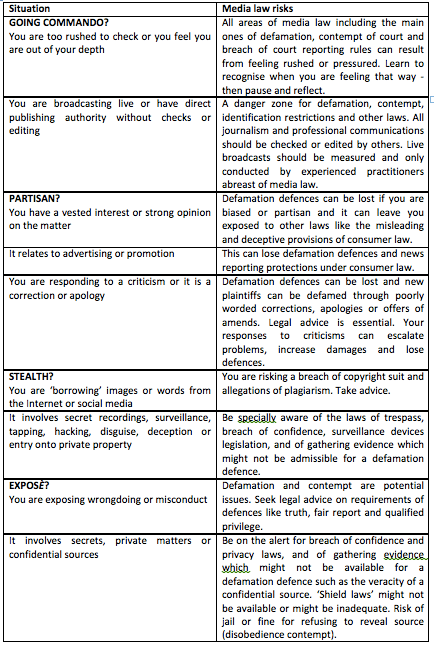
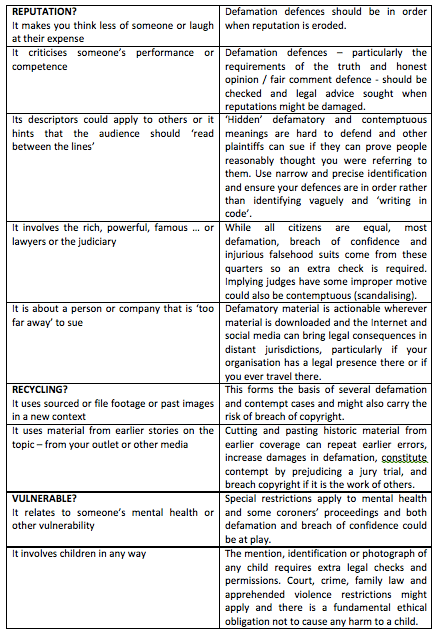
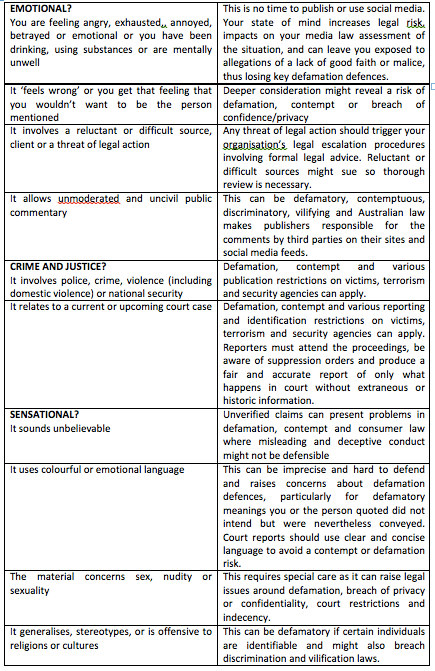
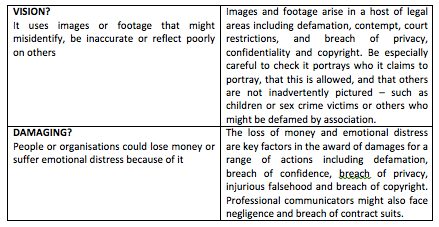
I have recently revisited the issue with groups of working journalists, asking them to identify situations they believed prompted them to be on high alert for media law problems. I have combined their observations with my own into this table of situations and risks.

This table is a work in progress, so I would really appreciate your comments and suggestions for further categories as I work to fine-tune it for inclusion in our next edition of The Journalist’s Guide to Media Law.

ML1

ML3 ML2

ML4


Disclaimer: While I write about media law and ethics, nothing here should be construed as legal advice. I am an academic, not a lawyer. My only advice is that you consult a lawyer before taking any legal risks.

© Mark Pearson 2017
Leave a comment

Filed under blogging, defamation, free expression, journalism, journalism education, media ethics, media law, mindful journalism, online education, reflective practice, social media, terrorism

Interview Part 4 – Strengths and pitfalls of online courses

By MARK PEARSON

This is the fourth and final edited transcript of my interview with Griffith University doctoral candidate David Costin, who recently interviewed me as part of his research into engaging with the online environment in higher education.  Over the past three installments we have discussed my design of an online / on campus course in media law (Part 1), how principles of ‘mindful journalism’ have influenced the course design (Part 2) and some suggested strategies to embed online learning (Part 3). This week we explore the strengths and pitfalls of online courses.


Q (David Costin):        What are the gaps and barriers that you see that hinder you as being an effective online operator? You’ve mentioned one about rules, about the boundaries of …. of the uni itself, but what other gaps are you seeing, or barriers?

A (Mark Pearson):         Time is a barrier, the time element, because the ideal, the face-to-face environment commits you to so many hours in the classroom, the students know you will be there, certain consultation hours, they know they can come to see you. The online environment is meant to be amenable to the learner, but it doesn’t necessarily sit with the teachers’ availability. So you know, whatever the learning problem, whether it’s just a technical thing with the quiz not working or whatever, the online student might encounter that at 3:00 a.m. because it suits their schedule, but to maintain one’s own sanity and life balance, one can’t be available 24/7 to online students. And sometimes they’ll get frustrated that they’ve had to wait to get a response. That doesn’t happen very often, but nevertheless, the ideal would be for them to get immediate responses to such problems, but that’s – until we get teaching bots – that’s some way away.

Q:        Yeah, yeah.

A:         So that springs to mind as one constraint. Another is, I mean I talked about institutional barriers to the design, but there’s also the industrial labour issue of teaching online. And (my School) … has been very good with this and I have online tutors that are compensated comparably with the on-campus versions. For academic staff, there is the workload issue and that’s looking reasonable at the moment for online development, but it’s, you know, the risk is trying to force fit online to traditional models and to under-allow for all of this development and nurturing and engagement that has to happen for online to work, to undervalue that in workload and in rewards within the system.

Q:        Okay, so you’re saying so therefore part of that is I suppose a lot of your work is developing that relationship with students, but that’s not really fixed into any particular workload or that you could put a monetary value on it or anything else like that.

A:         Well it is, it’s so many hours of workload per week that you would devote to that and the jury is out as to whether that’s enough to cater to that many online students, isn’t it? I mean teaching is somewhat of a calling and you suffer angst if you think your students are being underserviced, but the more hours you put into it, the lower your hourly rate becomes, you know, for whether you’re a casual worker on so much per hour, you’ve done your hours that were allocated, but there’s some student crying for help. You know, what do you do? Your calling tells you, you offer the help.

Q:        That’s right.

A:         You then become a volunteer and that’s nice for you and me at this stage of our careers, maybe we can afford to be volunteers a little bit, but the struggling young mum or dad that’s trying to feed the family on sessional …

Q:        Yeah, wages.

A:         … rates or whatever, it becomes a – I believe if it’s managed poorly and it’s undercompensated, it’s an exploitation of people in those situations.

Q:        Well it becomes an ethical type of practice I suppose.

A:         Mm.

Q:        You mentioned before, you’ve done a couple of courses within . about supporting – about the development of online. What are the support structures that you’ve found have really helped you in the development of your online course?

A:         Workload allowance for the development. So I mean academic workload is done on a formula that changes regularly within institutions. It’s a points-based formula at the moment, but it’s meant that I haven’t had to teach a full load of classroom teaching in the semesters that I’ve been developing or … revising the (online) courses. So the institution’s been willing to take a full professor out of the classroom to invest in the design and then the offering of such courses.

Q:        Okay.

A:         The other – not so much constraint but important impediment – in this area is the fact that a lot of work is done in the establishment of online courses, but there has to be, just as in vehicle maintenance, there has to be a schedule of service maintenance updating, freshening. And unless that is allowed for in the budgetary and workload approaches of the institution, what you get is what sadly has become the fate of online distance correspondence courses through the ages, is that you just get people who may or may not care about it anymore and the course is just getting rustier and rustier, the readings getting older and older, the technology is being further and further behind the state-of-the-art at the moment and this obviously is going to impact both enrolments but more important on the learning that’s happening in the course – rusty courses.

Q:        It’s a good term, I like that term, ‘rusty courses’. And I’ll go back to – and this is, of course, I suppose one other question I was going to ask, you mentioned at the start you believe there was more courses adapted to the online environment. In your opinion, what do you think, is it more, like this particular course is more gravity, more orientated towards online? Are there other courses you think are more orientated towards the online than others, in what you’ve experienced so far?

A:         The term ‘hybrid courses’ or ‘hybrid learning’ is bandied around.

Q:        Yeah.

A:         I haven’t seen a very strict definition of it. For some people it seems to mean some online components to a standard course. To others, it means a course that can be undertaken fully online or on campus. With this one, it is the latter and I’ve tried to make it so that it is as valuable a learning experience to the online student and also that opportunity is fully available to the on-campus students.

Q:        Flexibility, yeah, comes through all the time. And I suppose, you know, this kind of comes on to the last question in that in the course that you’re developing for the online, but you’ve taken your own thinking processes and you’ve I suppose looked at where you want the kids to be, the students to be, but what other things do you do that strengthens your own skills in that teaching and learning environment, the students’ environment?

A:         What do I do that strengthens my own skills?

Q:        Mm, what do you do? Obviously you reflect upon your teaching.

A:         Yes.

Q:        Which is one of those – knowing things that work.

A:         Yeah.

Q:        But do you depend on – do you go and talk to your other colleagues about other strategies you can utilise or do you go and experiment on a MOOC (Massive Open Online Course) and come back and incorporate those things?

A:         Well I’ve done both of those things. I write about some of these experiences and practises in the academic literature. I maintain a blog, which I’ve been doing for about five or six years now, with – it varies, but with like a monthly contribution, but there’s been two in the last two weeks, you know, it’s just according to time and what happens, called Journlaw, which has a mixture of things to do with commentary or snippets about media law, abstracts and excerpts from my writings or articles, just referring people to those things. And when I do those guest interviews, I’ll throw them on there, so there’s sort of a central place where students and others can go there. And I’ll do mini reports or live blogs of conferences with relevance to that area, so instead of just going to sleep as a delegate at a conference, I’ll keep myself awake by taking a couple of photos and writing a news story about the presentation and whacking it onto the blog, those sorts of things. So there’s that, there’s the academic output. I have done a few of the MOOCs as you mention. What else do I do? The academic’s life, I’ve noticed, the pressures and demands over many years has become more intense in recent years than it was in the earlier stages of my career. So I don’t do as many sort of learning and teaching grant applications, writing about learning and teaching in learning and teaching sorts of journals or got to many of the seminars for staff and that sort of thing, just because there’s only so many hours in the day and certain priorities, KPIs you’re rewarded for.

Q:        Yeah, so what you’re saying is you’re prioritising what you believe as part of the important strategies that will help you through the parts of your course.

A:         Yeah and I do some leisure reading about it. In other words, if I’m an airport bookshop and there’s a – I mean that thing with the formative quizzes and repeating the question just came from some random popular book on embedding learning that I found in an airport bookshop and I was interested in reading about, but it’s not something – I mean the thing I do read a lot about at the moment is Buddhist ethical principles and mindfulness and that kind of thing, so that is influencing me a lot at the moment.

Q:        But you’re adapting too.

A:         Yeah, whenever I do those things, I think is there a way that that has relevance to either my research or my writing. And I build some of the principles into the research. So we did a big ‘Reporting Islam’ project which is just finishing up now. I finished in December, but it’s about a $900,000 over three years that we’ve just done. It had many dimensions to it, but part of it was developing this app …. And so my colleague has continued with the project, is negotiating with future hosts for it and everything. But associated with this were a lot of training courses we developed for journalists, a handbook on Reporting Islam, a newsroom handbook that is there in PDF version as well as we printed a few copies for our expert panellists and so on. But I guess my point is, this thinking around the online stuff has also led to a very practical research project which has academic outputs but also newsroom and social application. [Calls up www.reportingislam.org ]. So you start to get, like I recorded this interview with (journalist Peter Greste) – I didn’t record it, I took a cameraman to report it and it talks about the importance of reporting upon Islam accurately, basic information about the religion and things that get commonly confused, some basic myths about some of the common things like the different types of headdress or whatever. And then so going from that, basic terminology and then putting it into practice with a checklist for journalists to identify, like a little quiz on how inclusive their newsroom is, basic reporting tips, protocols they should follow when reporting Islam and the voices of journalists who are respected from a range of media about pitfalls in misreporting of Islam. Then very importantly, driving home with students the effects of misreporting …

(Audio visual playing)

A:         … the impact on people in the community and what bad reporting or negative reporting, associating them all as terrorists and whatever can have. And so this is taken from another body of literature with permission with our actors’ voices talking about their focus group.

(Audio visual playing)

Q:        Okay.

A:         But we had actors and photo stock images to capture the person that’s said those things in those research projects. And I have recorded these interviews with different experts about the research.

(Audio visual playing)

Q:        Mm.

A:         So journalists and students can get that actual research base to the effects and then similar to what I’ve done in the media law thing, we’ve developed scenarios that actually have all of the components here for practice reporting on a Muslim issue. So the scenario is explained, there are tasks that they have to do within a two-hour class, you know, council papers about a proposed mosque, tips that they would follow in reporting some images that we’ve had taken that they choose from for it and a selection of quotes, including some of which are actually live acted.

(Audio visual playing)

A:         That kind of stuff and a similar one on a terror arrest, because that’s a commonly misreported scenario with an actual court case following it and so on. And then a list of resources and people, journalists can go to. So that was quite an achievement, but the reason I mention it is a lot of these same principles have gone into there. So there are the mindfulness principles, – what’s my intent with this story?, why am I going to cover in this?, what’s the language I’m going to be using?. All of that’s built in to some of the resources.

Q:        It’s also that lived experience, isn’t it?

A:         Mm.

Q:        You’re there, so from where I sit, you’ve got that lived experience of what you’re seeing. You’ve got your background as to that journalism component, plus the ethics coming in on top of that, plus the mindfulness.

A:         Mm.

Q:        So it comes together in a product, one way, that can be practically and which people can then access and I suppose that end point for where they want to be.

A:         That’s the idea of it. We won the Queensland Multicultural Award last year for media, communication.

Q:        Wow, well done indeed. Well thank you very much for your time.

A:         Alright, okay, absolute pleasure.

Q:        I’ve enjoyed it.

———–

Disclaimer: While I write about media law and ethics, nothing here should be construed as legal advice. I am an academic, not a lawyer. My only advice is that you consult a lawyer before taking any legal risks.

© Mark Pearson 2017

Leave a comment

Filed under blogging, Buddhism, defamation, Eightfold Path, free expression, journalism, journalism education, media ethics, media law, mental health, mindful journalism, online education, reflective practice, social media, terrorism

Interview Part 3 – Strategies to embed media law learning

By MARK PEARSON

This is Part 3 of my interview with Griffith University doctoral candidate David Costin, who recently interviewed me as part of his research into engaging with the online environment in higher education.  Over the past two installments we have discussed my design of an online / on campus course in media law and have examined how principles of ‘mindful journalism’ have influenced the course design. This week we explore some strategies to embed media law learning.

Q (David Costin):  Obviously you’ve thought about that end point [of students applying their media law knowledge in the workplace].

A:  (Mark Pearson) … I have the opportunity and the good fortune as a consultant to be able to train some journalists in the workplace … and I’ve done that for more than 20 years …. That feeds back into the loop because quite often in the class are my own students from these classes and it’s interesting to see what they do or don’t remember, although I haven’t actually formally tested that. So what niggles away at me, at this late stage of my career, is that I haven’t seen many of my graduates – I can’t recall my graduates getting into actual legal trouble and that would be one sign, but nevertheless, I sort of say ‘there but for the grace of God walk I’, you know, because you do know there are those 50 per cent students and they might have been away the day we did defamation (although it’s very unlikely, there’s a fair bit of it in the course).

Q:        Yeah.

A:         And these days they’re often, you know, going to be contractor workers rather than fully employed by an organisation, perhaps running their own blog. And so in the area of contempt, jail is a possibility, a substantial fine, certainly professional disgrace and in defamation there’s huge damages; they can lose their family home. And thankfully I haven’t seen that happen to my students, but it’s an area where if they were away the day they did one of those important things, then it’s a risk. So what is the retention of this knowledge in the workplace? That would be a wonderful research project to go back and revisit some of these people years on or whatever. I mean you know, media law training session only last year I had one of my students from 20 years ago at another institution, you know, so there are people there that would provide data for it I suppose.

Q:        Yeah, yeah.

A:         But I mean maybe I’m half scared to do so because it’s a worry, the extent to which they may not actually retain much of that knowledge (laughs).

Q:        But you know, I can see, you know, that again, that reflective stance drives, you know, I suppose where you want and it’s also updating that course at the same time, because as you said, you know, this area’s changing so much all the time.

A:         Mm.

Q:        And I suppose it also feeds into the question of, you know, what do you see is effectiveness in this environment.

A:         Mm.

Q:        So what you just indicated a student from 20 years ago, came back and came on the course, but is there other things that you see, other than the stats at the end of every semester, as being effective in this environment when you’re teaching in the online environment?

A:         Well I remember an earlier lecturer I worked with in my career talked about seeing the ‘whites of their eyes’, you know that expression?

Q:        Mm, yep, yep.

A:         And there are moments where you see that, that you know the knowledge at least for that one student is deeply embedded and has made a real difference. And from time to time you get that – I had that only yesterday, right? It was only a very small moment, but I’m very conscious of mindful practice being dismissed or being looked at sceptically as sort of some new age thing or being dismissed by other academics or whatever or students thinking I’m pushing some religion on them or something like that. So when I tell them about that, I frame it in terms of both the Buddhist principles – meditation and mindfulness – but also (Donald) Schon and reflective practice, but I’d also introduce them to a term that rarely any of them have ever heard of which is form the psychological and educational literature called ‘metacognition’. And I talk about that as either thinking about your own thinking or reflecting upon your own learning, depending on whether you’re looking at it from psychology. So in this particular class yesterday, I had an African law student in the class and I’d done that early in the – like week one or two of the semester – and yesterday (in the final week of revision) we were just talking about something, I can’t even remember what the topic was, and she said, “Ah yes, that’s metacognition. I’ve just practised metacognition.” And so to me, that’s a success, that’s just a skerrick of evidence of someone having learnt something in the course.

Q:        The ah-ha moment.

A:         Yeah, yeah. But the very important change we’ve made with the course this semester meant that I was getting that feeling a lot yesterday in my lectures as well and that’s because I’ve gone from, partly through very pragmatic and practical reasons, I’ve gone from a sit-down final exam in a lecture theatre – open book but handwritten into exam books – … I’ve gone from that to a take-home finale difficult problem, take-home exam over 10 days; 1500 words, written in exam style, loosely referenced but just so as answering those same basic questions, but a finale problem. And they submit it via Turnitin, plagiarism detection and all of that. And in the lectures yesterday, it hit home how important that is. Because I read somewhere some time ago that there are all pros and cons to, you know, obviously there’s security issues with take-home exams …

Q:        That’s right.

A:         That may happen. But in the lectures yesterday, here was a fully engaged class, many of whom I’d never seen before. They may have been following it on Lecture Capture or whatever, but here they were, for Professor Pearson to walk them through the take-home exam problem and to speak – I spoke in what you might call cryptic or code terms about the issues that were arising and highlighting on the screen the things that they might identify, without spoon-feeding them and giving them all the answers and reinforcing the fact that the students who had engaged in all the learning activities will know what I’m talking about here, that this word, confidential source here means certain things, it means things from different parts of the course, (etc). Well, they were just fully engaged because they had a vested interest in embedding this material for 40 per cent of their overall grade for the course. Now the difference is that the sit-down exam tests the level of knowledge that they know at that point for whoever knows how long afterwards, that they may have crammed for that two hours in week 12 or 13 or whatever it happens to be. This one is – if they’ve done the course, it’s designed so they shouldn’t take more than a day to do it, but some of them have the chance to actually engage with all of that over those 10 days, if they’ve never even come to a class, and I’ve got much more hope because the test mainly drills defamation and contempt, which are the two big ticket areas and it’s my way of being a little bit reassured that people would get over the line with their final take-home exam are at least familiar with those terms and understand a bit of their operation in a hypothetical newsroom environment.

Q:        Okay.

A:         So there are pros, there are cons, but I could see learning happening in a traditional lecture yesterday, which is somewhat unusual, sadly.

Q:        Unique.

A:         Yeah, yeah.

Q:        Okay, so two questions. You’ve established then your own benchmark, using that process, you’ve got your own type of benchmark in the back of your mind, as to what you want the students to achieve using this process?

A:         The take-home exam?

Q:        Yeah, yeah.

A:         Yeah, well yes, we still have to have a final moderation meeting for the tutors for the marking of the exam, but the pass point will be a demonstrated ability to identify those key issues of media law and to come up with a plausible navigation of those issues in such an environment and showing a basic knowledge of some key laws and cases that would inform that decision.

Q:        Okay. So then the other part of the question is, where did you come across this idea or have you adapted along the way or it’s been an experience, you know the take-home exam experience has been something that you’d wanted to try, or you’d read about it or you’ve adapted it before over the period of time?

A:         Well as long as I remember, there have been take-home exams in some university courses and I’m wracking my brain, thinking of one I’ve ever done myself as a student. I can’t think of one right now. It’s a small extension of a more intense newsroom exam situation that I’ve run at an earlier institution with my media law students, which was the sit-down open-book exam where it’s actually given to the students and then they can either sit there or go away, phone a friend, do whatever they like, as a journalist would do in that environment and come back in two hours with their answer. So it’s an adapted version of that which I hope is actually going to work better. But a point I was going to make earlier about the design of online and everything is that there’s a lot of pragmatism and there are a lot of sort of constrictions or institutional boundaries that you have to work within while you’re still trying to engage with students and enhance their learning and cover the appropriate content. And I mean luckily journalism doesn’t have some industry accreditation as well, you know, because I’d hate to think in accounting or law you’d also be managing those external – or psychology – you’d be managing external requirements as well. So the design of such courses is kind of its own cryptic crossword because for every decision you’re making about a certain format or learning tool, you’re having to think, is this going to work on the Nathan campus, is it going to work on the Gold Coast campus, how does it operate with OUA, what are the online students going to be able to do with this, what are the institutional rules around this? Because the institutional rules have things like no more than 20 per cent of online assignments in the course, you know, that kind of stuff. And so how do we navigate all of these things but still come up with a coherent, meaningful curriculum and pedagogy that’s actually best practice? That’s the challenge, I mean I don’t know whether I’ve achieved it here, but it’s a work in progress.


NEXT WEEK: Strengths and pitfalls of  online courses

———–

Disclaimer: While I write about media law and ethics, nothing here should be construed as legal advice. I am an academic, not a lawyer. My only advice is that you consult a lawyer before taking any legal risks.

© Mark Pearson 2017

Leave a comment

Filed under blogging, Buddhism, defamation, Eightfold Path, free expression, journalism, journalism education, media ethics, media law, mental health, mindful journalism, online education, reflective practice, social media, terrorism

Interview Part 2 – A mindful dimension to media law course design

By MARK PEARSON

Griffith University doctoral candidate David Costin recently interviewed me as part of his research into engaging with the online environment in higher education and has kindly allowed me to reproduce sections of that interview transcript in my blog.  Last week, in the first edited installment, we discussed my design of an online / on campus course in media law. This week we delve further into how principles of ‘mindful journalism’ have influenced the course design…

Q (David Costin):        Okay, so it’s practical – so I suppose what you’ve done is you’ve set up so it’s a practical, interactive course with reflection at the same time, which would then assist them in their development down the track with it, I suppose.

A (Mark Pearson):         The approach incorporates – the mindful journalism part of it is incorporating the idea that journalists aren’t going to be able to sit there and meditate in the lotus position in the newsroom, but if they learn to pause to reflect and they learn to take opportunities to do so, whether it’s on the train to work or in what others might call a ‘smoko’ break at work and they think through some of these basic principles there, then the theory goes that they might eventually, after doing this many times, be in what both Schon and others call ‘in the zone’, which is basically the consummate expert being able to reflect in action, but it being somewhat of an innate process so that they are almost subconsciously reflecting upon their learning to make the right decisions in those moments. And the basic Buddhist principles that go into my writings about all of this are from what is foundational to all of Buddhism called the ‘Eightfold Path’. And it’s not a religious thing, in fact some call Buddha the first psychologist and phenomenologist, but the principles are ‘right understanding’ – so this is from 2500 years ago, all right and it was meant for monks, but … part of the integrated reflection and he made a big point of saying all of this is integrated, it’s not just one or the other, the path is not uniform steps, but ‘right understanding’. ‘Right livelihood’ – so how does what I’m doing match my livelihood? Is this what I went into it for? You know, which is very important for journalists in this modern environment. ‘Right intent’ – so what is my intent here with this story or this, (from my perspective), with this lesson or this interview today? o basically having that partly considered. ‘Right speech’, because back then it was just oral, but that’s all form of communication and in multimedia it’s very important for journalists to think, you know, ‘how am I communicating this?’, ‘am I using both the right form of expression in speaking to this source or student or whatever it happens to be?’, or and also the way I’m actually putting the words together. ‘Right action’, so what behaviours am I exercising and should I exercise in this situation? ‘Right effort’, and the effort is all-embracing because it comes back to, you know, ‘how often am I reinforcing thinking about this, you know, reflecting upon these issues?’. ‘Right mindfulness’, which obviously for the monks it’s hours of meditation, but for the working journalist, it’s a moment of reflection – just to stop and go, “Oh, okay, I did media law today, what did I really pick up from that?” And that’s embedding the learning through reflecting.

Q:        Reflective practice, yeah.

A:         Yeah and the final one is ‘right concentration’ and that’s being ‘in the zone’, that’s basically putting it together so that it’s all happening and you’re able to adapt any of those elements appropriately for the circumstances.

Q:        I like that because in a couple of weeks’ time I’ve actually been asked to speak on a panel to third year students and I could see that translating across very, very nicely indeed as to their effectively – what they see and into a long term view, because that’s beautiful.

A:         Yeah, well to be quite frank, while I work in journalism, I can see that applying at an ethical and a practical level very much in teaching and it could be some – I mean I’m late in my career, but it could be at some stage I move part of it across into there and apply it there as well.

Q:        Mm, no, it’s simple. I mean to say, that’s a firm foundation, isn’t it?

A:         It is, yeah and it’s not ramming some religion down someone’s throat.

Q:        No.

A:         It’s basically a map of life.

Q:        Yeah, exactly right. And I suppose that comes on in the next question too, I mean to say, when you’ve been reflecting and then you’ve altered the course at the same time, so then I suppose the next question is what do you see as an effective operator in that online environment to your students? Because obviously, you know, you’ve got an encompassing overview of what you want to do, okay?

A:         Mm.

Q:        But what do you see as being an effective operator in that online environment for you?

A:         Yeah, it’s – no course or approach can be all things to all people. And I believe in my area, a professional area, only some curricula areas are particularly well suited to online, to totally online delivery.

Q:        Okay.

A:         So I don’t think anything and in fact Schon was all about the teacher is the coach and the studio environment. For professional education, I really think nothing beats the shoulder-to-shoulder coaching by a real …

Q:        Person.

A:         … experienced practitioner, just as the concert pianist, how effectively are you going to become a pianist by doing an online course in playing the piano? Yeah, some people might, you know, and there could be – these days there are all sorts of ways you could envisage that.

Q:        Yeah.

A:         But the question is, would any of them match sitting shoulder-to-shoulder with the maestro in a studio situation, masterclass situation, for at least part of that journey? So I’m lucky that media law and the other course that I’ve designed here for public relations and crisis communication people called ‘Social Media Law and Risk Management, they lend themselves to that because you know, these days it’s much of the way journalists communicate and because of that knowledge base to the thing and then the problems that are written problems, accompanied by a whole bunch of AV material. So you’ll see that there’s those mini lectures which MOOC experience has told us is best done up to 18 minute bursts. So this one goes just beyond it at 22 minutes for the very first one and it’s …

(Audio visual playing)

A:         All right, all that sort of stuff. Now that’s the mini lecture and so that’s reinforced for online students with just a copy of the slides. And then there is, as you’re probably aware, from …. University there’s also the full slides that are available through the Lecture Capture.

Q:        Yeah.

A:         So that’s the full two-hour version, one hour and 50 and some of them will want to immerse themselves in that, but it’s proven to be not that effective a way of, certainly in its analogue form, it’s actually very effective for foreign students particularly, the videoed lecture version, because they like to slow it down in the pace, pick it up for the, you know, so there are certain students that like that. And there’s also, I mean the genre of university study, there’s something about having lectures like that, rather than just having a bunch of materials you could get on any old MOOC, you know, so there’s something about the full-on thing. So the slides and the lectures are there for them as well. Now we make both campus’ lectures, which are repeats, available to all the students and the reason for that is occasionally there is a glitch with the recording, but more of a problem for my class is typically they’re – well this semester they were timetabled on a Monday and a Tuesday and you have the public holiday problem.

Q:        Yeah, okay.

A:         So that way the whole cohort can go to the other day’s lecture, because we had Anzac Day on a Tuesday and then the other Monday public holiday, so at least they get the lecture that week. So there are those things and then in addition to that, some people are very visually driven and over the past, the time I’ve been here at …., four-and-a-half years, I’ve put together a number of interviews, some of them are on Skype, with experts in the field or people who have been through that particular media law experience. And every one of the modules has one or two of these guest lectures. So what that does is give an anchor in the real newsroom experience to complement the theory, I suppose, or I try to make it as far from theoretical as we can in the class, but just so that they’re seeing that there’s a practical edge to it. The other thing is that although we might from time to time get a live guest, I will try to film that professionally because that’s just a one-off thing and lost forever unless it’s captured for other students to enjoy. It’s very rare you get a live guest who will appear at both campuses in that week and otherwise it just becomes part of the Lecture Capture experience and is just a one-off for that trimester ever.

Q:        To utilise again and again, like you said.

A:         Yeah and the final element is in each of the modules I do a – I got this off the MOOCs, ‘Office Hours’ – and the ‘Office Hours’ is basically positioning yourself in my home or work office.

(Audio visual playing)

A:         So you’ve got the idea of that and that’s what we’re talking about there within the …

Q:        Mm.

A:         Yeah, it’s just amazing, it’s 400 students and at any moment you’ve got people that haven’t studied for a long time or they’ve got various stressors in their life, they’re not very technologically literate and it’s just amazing how many still don’t know to press that. So that basically tells them a lot more about the actual assessment.

Q:        But it’s interesting from my side looking in because you’re accommodating and I suppose this is your character, maybe it’s part of your own character too, that you can accommodate – you’re accommodating, you’re also entrepreneurial, because I haven’t seen anything like that before.

A:         Oh really?

Q:        Yeah, yeah and it’s quite interesting.

A:         Have you gone on MOOC though?

Q:        Oh yeah, I’ve done – yeah.

A:         When MOOCs came out, I immersed myself in a few of those just to pick up from that experience.

Q:        Okay and that’s certainly coming through as well, that people go out on their own and experiment and then come back and bring that wealth of information with them at the same time.

A:         Mm.

Q:        So obviously – and the flexibility, because you’ve obviously, from your own life experience as well, you realise that students are doing different things at different times. So you take that flexibility into account as well. So I can see those things coming through.

A:         Yeah.

Q:        And also that reflective practice.

A:         Yeah, yeah.

Q:        One of your other colleagues actually used the term ‘pracademic’.

A:         Oh okay, that’s nice.

Q:        It is a nice term because all your work is practical, very practical and it’s aimed at I suppose the end point of where you want your students to be.


NEXT WEEK: Strategies to embed media law learning

———–

Disclaimer: While I write about media law and ethics, nothing here should be construed as legal advice. I am an academic, not a lawyer. My only advice is that you consult a lawyer before taking any legal risks.

© Mark Pearson 2017

Leave a comment

Filed under blogging, Buddhism, defamation, Eightfold Path, free expression, journalism, journalism education, media ethics, media law, mental health, mindful journalism, online education, reflective practice, social media, terrorism