Tag Archives: Buddhism

Keynote: Strategies for building mindful reflection into communication and education

By MARK PEARSON

My keynote address last week to the international research conference at the University of Colombo, Sri Lanka, introduced strategies for enabling students and colleagues to reflect mindfully in the course of their communication and education.

The edited shorter address follows. The full version is available from the organisers (udari@spc.cmb.ac.lk ) and will be published in the conference proceedings later this year.

Thank you for the honour of delivering this keynote address. I thank and acknowledge the conference organisers, chair, university officials, invited dignatories, delegates and students.

I wish to acknowledge the traditional owners of this land where I have written and delivered this address – the Kombumerri people of the Yugambeh language group of indigenous peoples in Australia – and to their elders past, present and emerging.

I also acknowledge the communication, ethical and legal codes and practices they developed over tens of thousands of years, and to the cultural rules underpinning human communication in all communities internationally, including in Sri Lanka.

This paper introduces some strategies for enabling students and colleagues to reflect mindfully when engaging in their communication and education. In doing so it attempts to lay some foundation stones for proposing such strategies – offering the intellectual narrative of their conception and development.

Over the past decade I have been exploring the possibilities for mindful reflection in journalism – a concept I first raised in my UNESCO World Press Freedom Address in Auckland in 2013. That – and a follow-up article on mindful journalism in an academic journal led to an approach by the pioneer of this field, the late Professor Shelton Gunaratne to join him and our colleague Dr Sugath Senarath in the editing and authorship of the book Mindful Journalism in 2015, where we expounded upon how the various steps of Buddhism’s Noble Eightfold Path could underpin a more mindful approach to news gathering, selection and reporting. In the nine years since its publication I have attempted to develop strategies for applying mindfulness strategies in journalism, communication and legal education – to help students and colleagues forge solutions to ethical dilemmas that might constitute a genuine ‘middle way’. I thank Dr Senarath and the organising committee for inviting me here today to discuss some of those practical tools for use in the communication and education contexts.

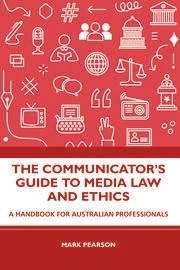
As my new book explains, professional communicators and educators can draw upon a range of reflective tools including variations of mindfulness-based meditation techniques expounded by the Buddha 2500 years ago to help them take a considered and purposive approach to ethical and legal decision-making.

Buddhism does not have an historical monopoly on the art of reflection. Socrates described self-examination as central to a virtuous life. The English philosopher John Locke (1632–1704) summed up the practice we now know as ‘metacognition’ (Tarricone, 2011) – being consciously aware of one’s own thinking and doing.

This is similar to the secular approach developed three centuries later by educationalist Donald Schön, whose research aimed to equip professionals with the ability to make crucial decisions in the midst of practice, which he called ‘reflection-in-action’ .

The application of MBM to morality and by extension to professional ethics echoes the step of ‘Right Conduct’ in the Noble Eightfold Path – samma kammanto – which involves ‘a call to understand one’s behaviour more objectively before trying to improve it’ and ‘to reflect on actions with an eye to the motives that prompted them’ (Smith and Novak, 2003: 43).

Communicators and educators need to ‘reflect-in-action’ upon ethical dilemmas as they arise in the midst of their work (Schön, 1987: 26).

The lack of reflection can lead to unnecessary harm to others. Unethical behaviour can exacerbate the trauma that victims have already encountered in shocking news events. Unlawful practice can bring reputational or financial damage to others and awards of damages or even jail terms for the offending communicators (Pearson, 2024, p.50).

Another crucial reason why it is important to engage in some method of careful reflection before making an ethical or legal decision is the mental health of the communication professionals and educators themselves.

In my recent book I stress the importance of students identifying their own unique ‘moral compass’ – their sense of right and wrong behaviour that can stem from a combination of a host of factors including one’s upbringing, religion, and values along with their professional ethical codes (Pearson, 2024, p.16).

As an exercise, I ask students to sit for a few moments to reflect upon influences upon their own moral decision-making and then draw their unique moral compasses, attributing the four main points on the compass to the four prime influences on their moral decisions, with the lesser points representing other factors.

I suggest this is a worthwhile exercise for all of us – teachers, students and practitioners.

Interconnections between MBM and mental health

Psychological studies of trauma have uncovered the notion of ‘moral injury’ – where individuals feel they have compromised their moral compasses through their unethical behaviour and blame themselves for the harm that has resulted when the professional expectations of an employee was at odds with that individual’s moral principles.

So students need a toolkit of techniques for inward reflection they can use to assess their thought processes, emotional states, workplace situations, learning and, most importantly, their ethical and legal decision-making (Pearson, 2024, p. 60).

The answer to pausing to identify the ‘red flags’ that might represent an ethical or legal dilemma lies in a developing a routine system of reflection. These might be situations or emotions, identifiable via mindful reflection.

Obviously, the key here is being able to identify a problematic emotion or situation, red flag it, then pause to weigh an appropriate ethical and legal course of action.

The approach calls upon students and communicators to pause to adopt the elements of the Eightfold Path into these eight steps of mindful reflection:

Stage of reflection Explanation
How might I improve this communication to minimise risk? [Wise Speech – Samma vaca ] Reconsider your words in any communication you are undertaking and refine and edit them to conform with legal requirements.

We put this into practice in the classroom in a pilot research project (Pearson, 2023) where mindfulness-based reflections were offered regularly during a media law course, with a strong emphasis upon emotional and situational analysis of media law dilemmas .

There were a variety of responses from 90 students to the mindfulness reflection experience. Some saw it as invaluable for their learning, lives and careers.

They said they were “reviewing in more depth”, “raising a mental flag on sections which were still unclear”, giving “a moment to understand the course better”, “consolidate learning”, helping “info to sink in”, and “consolidating the information” (Pearson, 2023).

Numerous respondents highlighted the mental health benefits of the practice.

Some students commented on the pause to reflect function and its benefits:

It made me realise that many times before making a decision or judgement, did I not stop to think or consider my actions.

Another said it trained them to “step back and assess an area, or myself, before venturing into a position, or stance or opinion”. This was metacognition in evidence (Flavell 1976; Tarricone 2011) – thinking about their own thinking – and ‘reflection-in-action’ actually happening (Schön 1987).

Such accounts offer encouragement to those incorporating pause and reflect exercises in their textbooks (Baker 2020; Pearson 2024). They give hope that some instruction in this might assist students to actually execute those strategies when encountering occupational dilemmas after graduation.

In this summary of my full paper – available from the organisers – we have journeyed through definitions of mindfulness in its modern educational context having established its roots in Buddhism and philosophy. We have learned how we might map our own moral compasses. We have looked at the relationship between MBM and mental health, and its potential for offering resilience to post-traumatic stress for journalists reporting tragic and gruesome stories. We have outlined MBM as a tool for ethical decision making. And we have reviewed a recent pilot project where students reported the pros and cons of engaging in MBM in the media law curriculum. Much is still to be explored in the application of this two millennia-old practice to tertiary education and communication and educational practice. I hope some of you are interested enough to undertake research to shed further light on this enlightening path with so many potential benefits.

References

Baker, S (2020) ‘The Ethics of Advocacy: Moral Reasoning in the Practice of Public Relations’, in Wilkins L and Christians CG (eds) The Routledge Handbook of Mass Media Ethics, 2nd edition, Taylor and Francis, NY. https://doi.org/10.4324/9781315545929

Bhikkhu, T. 2018, ‘The Buddha’s original teachings on mindfulness’, Tricycle – The Buddhist Review, 5 March, <https://tricycle.org/article/satipatthana-sutta-mindfulness/&gt;.

Blum, L. 2022, ‘Iris Murdoch’, The Stanford Encyclopedia of Philosophy, Winter 2022 Edition, Zalta, E.N. and Nodelman, U. eds, <https://plato.stanford.edu/archives/win2022/entries/murdoch/&gt;.

Bok, S. 1978, Lying: Moral Choice in Public and Private Life, Pantheon Books, New York.

Drumwright, M. and Murphy, P. 2013, ‘How advertising practitioners view ethics: Moral muteness, moral myopia, and moral imagination’, Journal of Advertising, 33 (2), 7– 24.

Feinstein, A. and Storm, H. 2017, The Emotional Toll on Journalists Covering The Refugee Crisis, Reuters Institute for the Study of Journalism, Oxford.

Germer CK, Siegel RD and Fulton PR (2005) Mindfulness and Psychotherapy, New York: Guilford Press.

Gunaratne, Shelton A., Mark Pearson and Sugath Senarath, (2015). Mindful Journalism and News Ethics in the Digital Era – A Buddhist Approach. Routledge, NY.

Gunaratne, S. A. (2005) The Dao of the press: A humanocentric theory, Cresskill, NJ, Hampton

Gunaratne, S. A. (2007) Let many journalisms bloom: Cosmology, Orientalism and freedom, China Media Research, Vol. 3, No. 4 pp 60-73

Gunaratne, S. A. (2009) A Buddhist view of journalism: Emphasis on mutual causality, Javnost: The Public, Vol. 16, No. 2 pp 61-75

Litz, B. T., Stein, N., Delaney, E., Lebowitz, L., Nash, W. P., Silva, C., & Maguen, S. 2009, ‘Moral injury and moral repair in war veterans: A preliminary model and intervention strategy’, Clinical Psychology Review, 29(8), 695–706. <https://doi.org/10.1016/j.cpr.2009.07.003&gt;

Locke, J. 1959, An Essay Concerning Human Understanding, Dover Publications, NY.

Merriam-Webster (2022) [online dictionary]. https://www.merriam-webster.com/dictionary/mindfulness

Pearson, M. (2024). The Communicator’s Guide to Media Law and Ethics – A Handbook for Australian Professionals. Routledge, London and New York.

Pearson, M. (2023). Student perceptions of mindful reflection as a media law teaching tool. Australian Journalism Review. 45 (2) pp. 197–211.

Pearson, M., McMahon, C., O’Donovan, A., & O’Shannessy, D. (2021). Building journalists’ resilience through mindfulness strategies. Journalism22(7), 1647-1664. https://doi.org/10.1177/1464884919833253

Pearson, M., McMahon, C., and O’Donovan, A. (2018) ‘Potential benefits of teaching mindfulness to journalism students’. Asia Pacific Media Educator (December). 28:2: https://doi.org/10.1177/1326365X18800080

Pearson, M. (2014). Towards ‘mindful journalism’: Applying Buddhism’s Eightfold Path as an ethical framework for modern journalism, Ethical Space 11 (4): 38 – 46.

Pearson, M. (May 5, 2013). Press freedom, social media and the citizen. Inaugural NZ UNESCO World Press Freedom Day Lecture 2013. Pacific Media Centre, AUT Auckland. Available: https://journlaw.com/2013/05/05/press-freedom-social-media-and-the-citizen-my-2013-unesco-world-press-freedom-day-lecture/

Riskin, LL and Wohl, RA (2015). ‘Mindfulness in the Heat of Conflict: Taking STOCK’ Harvard Negotiation Law Review, 20. https://ssrn.com/abstract=2754646

Schön, D. 1987, Educating the Reflective Practitioner: Toward a New Design for Teaching and Learning the Professions, Jossey-Bass, San Francisco.

Shay J. 2014.Moral injury’. Psychoanalytic Psychology, 31(2), 182–191.

Smith, H. and Novak, P. (2003) Buddhism: A concise introduction, New York, Harper San Francisco

Tarricone P (2011) The Taxonomy of Metacognition. Psychology Press, East Sussex.

Trammel RC (2015) ‘Mindfulness as Enhancing Ethical Decision-Making and the Christian Integration of Mindful Practice’, Social Work and Christianity 42(2): 165–177.

Disclaimer: While I write about media law and ethics, nothing here should be construed as legal advice. I am an academic, not a lawyer. My only advice is that you consult a lawyer before taking any legal risks.

© Mark Pearson 2024 – the moral right of the author has been asserted.

Leave a comment

Filed under Buddhism, cognitive reflection, defamation, Eightfold Path, journalism, journalism education, media ethics, media literacy, meditation, mindful journalism, privacy, reflective practice

Plenary address: Applying Buddhist principles to communication law and ethics – a mindful approach

By MARK PEARSON

 I had the honour of delivering an online plenary address on mindful communication last week to a seminar organised by the Bhawanipur Education Society College in Kolkata, India.

Coverage of the seminar in Edugraph

The seminar’s coverage in Edugraph

The topic was ‘Applying Buddhist principles to communication law and ethics: a mindful approach’.

The paper linked key principles from Buddhism’s Noble Eightfold Path to best practice in communication law and ethics.

It explained how a mindful and reflective approach to the ethical and legal consequences of professional communication can strengthen the credibility of communication and journalism and serve to minimise suffering and karmic consequences – both for the practitioner and the audience.

Special attention was paid to the practical and secular application of the key Buddhist principles of wise intent, wise speech, wise action and wise mindfulness in the professional communication process. Techniques for reflection in the midst of busy communication workplaces – including brief mindful reflections, journalling and mindmapping – were flagged and considered.

I drew upon my authored and co-authored books and research articles to offer illustrative examples of the application of such tools to legal and ethical problems including defamation, invasion of privacy, and breach of confidentiality.

Different religious approaches to truthfulness and honesty were also considered.

The starting point for students to identify their own ‘moral compass’ – the key biographical influences that inform their own system of morality –  was explained.

Also crucial is the ability to recognise the point at which an ethical or legal dilemma is arising and then to pause to reflect upon its implications and a suitable course of action.

The elements of Buddhism’s Noble Eightfold Path offer a starting point for this analysis because they are straightforward principles that can be distilled from most religions and philosophies but can be presented in a simple list form to offer a moral lens through which the professional ethical rules and the media laws of society can be assessed.

For some of my related research, please see:

Pearson, M. (2024). Chapter 3: Tools for reflection in a communication context. In Pearson, M. (2024). The Communicator’s Guide to Media Law and Ethics – A Handbook for Australian Professionals (Routledge, London and NY). Pp. 49-76. https://doi.org/10.4324/9781003372752-4

Pearson, M. (2014). Towards ‘mindful journalism’: Applying Buddhism’s Eightfold Path as an ethical framework for modern journalism, Ethical Space 11 (4): 38 – 46. http://www.communicationethics.net/journal/v11n4/feat1.pdf

Gunaratne, S.A; Pearson, M. and Senarath, S. (eds) (2015). Mindful Journalism and News Ethics in the Digital Era: A Buddhist Approach (Routledge, NY). https://doi.org/10.4324/9781315723341

Morton, T. and Pearson, M. (2015), Zones of silence: Forensic patients, radio documentary, and a mindful approach to journalism ethics. Pacific Journalism Review. 21 (2): 11-32. https://doi.org/10.24135/pjr.v21i2.113

Pearson, M. (2015). Enlightening communication analysis in Asia-Pacific: Media studies, ethics and law using a Buddhist perspective. International Communication Gazette, 77 (5): 456-470. https://doi.org/10.1177/1748048515586945

Pearson, M. (2019). “Spirituality in Journalism”, in Bernadette Flanagan and Lazlo Zsolnai (eds) (2019) The Routledge International Handbook of Spirituality and Society, Routledge, London. pp. 419-426 [ISBN 9781138214675 ] https://doi.org/10.4324/9781315445489

Pearson, M., McMahon, C., O’Donovan, A., & O’Shannessy, D. (2021). Building journalists’ resilience through mindfulness strategies. Journalism22(7), 1647–1664. https://doi.org/10.1177/1464884919833253

Pearson, M. (2023). Student perceptions of mindful reflection as a media law teaching tool. Australian Journalism Review. 45 (2) pp. 197–211. https://doi.org/10.1386/ajr_00132_1

Disclaimer: While I write about media law and ethics, nothing here should be construed as legal advice. I am an academic, not a lawyer. My only advice is that you consult a lawyer before taking any legal risks.

© Mark Pearson 2024 – the moral right of the author has been asserted.

Leave a comment

Filed under Buddhism, cognitive reflection, defamation, Eightfold Path, journalism, journalism education, media ethics, media literacy, meditation, mindful journalism, privacy, reflective practice

Addressing the Sri Lankan Press Council on media law and mindful journalism

By MARK PEARSON

For the past two weeks I have been in Sri Lanka, where my speaking and interview schedule has been arranged by Dr Sugath Senarath, my co-author of our book Mindful Journalism and News Ethics in the Digital Era: A Buddhist Approach (Shelton Gunaratne, Mark Pearson and Sugath Senarath eds; Routledge, NY, 2015).
srilankawithsugath

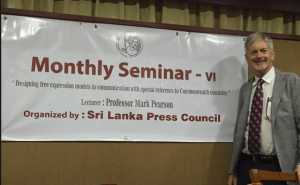
Professor Mark Pearson (@journlaw) at the Sri Lanka Press Council event. Photo: Julie Pearson

The highlight was my address to the Sri Lankan Press Council last Wednesday (August 31) on the topic “Designing free expression models in communication with special reference to Commonwealth countries – a mindful Australian perspective”.

I offer the full text of the address to you here. [Please note that sections are excerpted from earlier work, including The Journalist’s Guide to Media Law (co-authored with Mark Polden, Allen & Unwin, 2015), Mindful Journalism (reference above) and my unpublished 2013 address to the Timor Leste National Congress for Journalists.]


Press Commissioner, Press Council Chair and board members, co-author and host Dr Sugath Senarath, academic and media colleagues, journalism and media students and young reporters and other honored guests…

Thank you sincerely for having me here today to talk about the important topic of free expression – a fundamental feature in a working democracy.

It is important that all citizens – particularly journalists and politicians – have a grasp of the principles of free expression, media freedom and their historical context.

Origins of free expression

The free expression of certain facts and views has always been a dangerous practice, with countless people put to death for expressing religious or political views throughout history. Many more have been imprisoned, tortured or punished for such expression. Socrates in 399 BCE elected to drink a poison—hemlock—rather than recant his philosophical questioning (Brasch and Ulloth, 1986, p. 9). The history of freedom of expression is as much a history of censorship, because when free expression has been threatened, intellectuals have been called upon to defend it. It was Johann Gutenberg’s invention of movable type in about 1450 and the massive growth in the publishing industry over the sixteenth and seventeenth centuries in the form of newsbooks and the activities of ‘pamphleteers’ that first triggered repressive laws, and then the movement for press freedom (Feather, 1988: 46). (It is interesting that these individuals were the forerunners of the citizen journalists and bloggers we know today—often highly opinionated and quick to publish speculation and rumour.)

srilankapcaddress

Delivering the Sri Lankan Press Council address in Colombo. Photo: Julie Pearson

The pamphleteers took umbrage at government attempts to impose a licensing system for printers from the mid-sixteenth century (Overbeck, 2001: 34). Political philosopher and poet John Milton took aim at this in 1644 with Areopagitica, a speech to the parliament appealing for freedom of the presses. He went on to utter the famous free speech principle: ‘Give me the liberty to know, to utter, and to argue freely according to conscience, above all liberties.’ (Patrides, 1985: 241). Milton inscribed his name on the title page of his unlicensed work, in defiance of the law he was criticising. The notion of free expression had spawned its offspring: press freedom.

Part of Milton’s argument centred on the ‘marketplace of ideas’—the belief that truth will win over falsehood when the two compete. This proposition of a contest between truth and falsehood was often used during the seventeenth and eighteenth centuries to justify freedom of expression (Smith, 1988: 31). It continues in public discourse today.

srilankawithbanner

Two of the co-authors of ‘Mindful Journalism’, Professor Mark Pearson (left) and Dr Sugath Senarath from the University of Colombo.

Philosopher and political theorist John Locke took up the fight after Milton’s death. Under his social contract theory, governments are there to serve the people, and central to this is freedom of expression (Overbeck, 2001: 36).

Like Milton, Locke campaigned for the end of the English printing licence system, which expired in 1694 (Overbeck, 2001: 36). Those to speak out against restrictions on press freedom at the turn of the eighteenth century included novelist and journalist Daniel Defoe, who wrote ‘An Essay Upon the Regulation of the Press’ around 1704 (Brasch and Ulloth, 1986: 62), and John Trenchard and Thomas Gordon who, under the pen name ‘Cato’, wrote a series of letters about freedom in the 1720s (Brasch and Ulloth, 1986: 64–8).

England’s foremost philosopher of the late nineteenth century, John Stuart Mill, articulated the need for free speech in a liberal democratic society in On Liberty, first published in 1859 (Mill, 1991). He wrote:

The time, it is to be hoped, is gone by, when any defence would be necessary of the ‘liberty of the press’ as one of the securities against corrupt or tyrannical government. No argument, we may suppose, can now be needed, against permitting a legislature or an executive, not identified in interest with the people, to prescribe opinions to them, and determine what doctrines or what arguments they shall be allowed to hear. (1991: 20)

Mill’s On Liberty built on Milton’s ‘marketplace of ideas’ to define the boundaries of freedom of expression in the modern nation-state. One of the great legal minds of the eighteenth century, Sir William Blackstone, in his Commentaries on the Laws of England, had a great impact on the evolution of press freedom by defining it as the absence of ‘previous restraints upon publications’ (Blackstone, 1765–69: 151–2).

Blackstone’s notion of ‘prior restraint’ has underscored the development of media law in the United States. The idea was that freedom of the press could tolerate no restrictions before publication, such as licensing and taxes that had been imposed in Britain, but that the law should take its course after publication to punish those who abused this freedom. Publications should be tax and licence free, but subject to laws like defamation and contempt once published. In both Britain and its colonies, a common weapon for silencing the press had been the crime of ‘seditious libel’—any serious criticism of government or the Crown, whether or not the criticism was truthful. William Murray, Lord Chief Justice and Earl of Mansfield (1704–93), had coined the expression ‘the greater the truth, the greater the libel’ (Whitton, 1998), ensuring that truth would not stand up as a defence to seditious libel.

Despite these restrictions, basic press freedom had taken hold in Britain. Some thought the press had gone too far. In this context, the expression ‘the Fourth Estate’ was coined. At that time, there were said to be three ‘estates of the realm’—the Lords Spiritual, the Lords Temporal and the Lords Common. In 1790, English statesman Edmund Burke is said to have pointed to the press gallery in parliament and said: ‘There are three estates in Parliament but in the reporters’ gallery yonder sits a fourth estate more important far than they all.’ (Inglebart, 1987: 143).

The libertarian ideals on which press freedom is based were not confined to Britain. The movement for civil rights and individual liberties spread throughout Western Europe during the seventeenth to nineteenth centuries, epitomised by the French Revolution in 1789, leaving a legacy of press freedom throughout that region and its colonial outposts.

In Western democratic societies, journalists often take their liberties for granted. But there has never been utterly unshackled free speech or a completely free media: we operate on an international and historical continuum of free expression through to censorship. It is only over the past half-century that the notion of free expression and a free media has gained traction on a broader international scale.

Free expression internationally

There is no enforceable worldwide agreement on free expression as a fundamental human right, although some nations and regions have entrenched free expression in their constitutions. The key international document is the United Nations Universal Declaration of Human Rights, which in 1948 enshrined free expression at Article 19:

Everyone has the right to freedom of opinion and expression; this right includes freedom to hold opinions without interference and to seek, receive and impart information and ideas through any media regardless of frontiers.

At face value, this statement seems to give all the world’s citizens a right to free expression. While a declaration of a lofty goal, it has many limitations, as we will see.

Stronger protections came internationally in 1966 when the United Nations (UN) adopted the International Covenant on Civil and Political Rights, prompting a series of binding treaties. The covenant introduces a right to free expression for the world’s citizens, again at Article 19.

However, the right is limited because the covenant also recognises duties, responsibilities and restrictions covering respect for the rights and reputations of others, and the protection of national security, public order, public health or morals. Add to this the fact that many countries either have not ratified the covenant, or have not incorporated its provisions to make them part of their domestic law—as in the case of Australia.

At least three major democratic English-speaking nations in addition to the United States have bills of rights enshrining free speech. British and European liberal ideals found their way into the wording of the American Declaration of Independence in 1776, the US Constitution in 1789 and its Bill of Rights in 1791. Central to the Bill of Rights was the First Amendment to the US Constitution:

Congress shall make no law respecting an establishment of religion, or prohibiting the free exercise thereof; or abridging the freedom of speech, or of the press; or the right of the people peaceably to assemble, and to petition the Government for a redress of grievances.

US government attempts to restrain publications in the national interest have usually failed on First Amendment grounds.

The Canadian Charter of Rights and Freedoms (1982), like the US First Amendment, recognises freedom of the press as part of section 2(b), which confers upon every citizen the following freedoms: ‘freedom of thought, belief, opinion and expression, including freedom of the press and other media of communication’. The United Kingdom and New Zealand legislation does not mention media freedom, opting instead for the broader term ‘freedom of expression’.

New Zealand’s Bill of Rights, enacted in 1990, states at section 14:Everyone has the right to freedom of expression, including the freedom to seek, receive, and impart information and opinions of any kind in any form’. In 2011, the New Zealand Supreme Court found that the right protected Valerie Morse, an anti-war protester who burned her country’s flag during a dawn memorial service in Wellington. Her conviction for offensive behaviour was set aside.

Despite this, there are many nations with such a free expression clauses in their constitutions where their governments have chosen to ignore them to advance their own interests or to prevent scrutiny of their actions. This has sometimes led to the harassment, assault, imprisonment and even murder of journalists. I note that the Sri Lankan Constitution also enshrines “freedom of speech and expression including publication” and it is encouraging that your new government has taken some first steps towards honouring that right which appears to have been neglected in recent decades. The recent passage of a Right to Information Act is one such encouraging step. Of course, such freedom of information instruments in many countries are ineffective because of the large numbers of exemptions to the release of documents available to governments, the cost of making applications, and the glacial speed with which bureaucracies approve requests for government information – using refusals and appeals to wear down the journalists rightfully seeking facts and information on behalf of the citizenry.

For many truth-seekers and truth-tellers, the commitment to free expression has taken the form of physical injury or danger—even death. The Committee to Protect Journalists (CPJ) lists more than 1200 journalists confirmed as killed in the course of their work since 1992, including 27 in 2016 to date. As a former correspondent for Reporters Without Borders, I must highlight the fact that the world is watching the new Sri Lankan government to see how enthusiastically it pursues and prosecutes those responsible for the murder of 19 journalists in this country since 1992 – criminals who it seems have been able to conduct their assassination of this democracy’s messengers with complete impunity. I suggest the Press Council might consider keeping this issue on the agenda in the interests of media freedom and as a tribute to those who have paid the ultimate price for exercising their Constitutional right to free expression.

Throughout the Asia-Pacific region, many others have died, suffered violence or have been imprisoned for what they report. Some have suffered in other ways, as the victims of lawsuits by those who set out to gag them.

Australia

Australia’s early history was marked by considerable censorship of its media, although an early battle between Governor Darling and the Chief Justice in 1827 prevented the licensing of newspapers.

Australia has no equivalent to the US First Amendment enshrining freedom of the press. However, in recent decades the High Court of Australia has recognised an implied freedom to communicate on matters of politics and government.

Press systems and ethical frameworks are on the agenda in all societies, and we are challenged to accommodate free expression and its close relative, press freedom, within new regulatory, technological and cultural contexts.

Recent inquiries into media regulation in the United Kingdom (Leveson, 2012), Australia (Finkelstein, 2012) and New Zealand (Law Commission, 2013) have recommended major changes to the regulation of media corporations and the ethical practices of journalists. Their motivation stems, at least ostensibly, from public angst—and subsequent political pressure—over a litany of unethical breaches of citizens’ privacy over several years in the United Kingdom, culminating in the News of the World scandal and the subsequent revelations at the Leveson Inquiry (2012), all of which had an undoubted ripple effect in Australia.

Two major inquiries into the Australian news media in 2011 and 2012 prompted a necessary debate over the extent to which rapidly converging and globalised news businesses and platforms might require statutory regulation at a national level. Four regulatory models emerged—a News Media Council backed by recourse to the contempt powers of courts; a super self-regulatory body with legislative incentives to join; a strengthened Australian Press Council policing both print and online media; and a government-appointed Public Interest Media Advocate.

All proposals for any such government intervention with media freedom by such a controlling body by a Press Council or News Council were rejected after considerable pressure from media organisations as anathema to free expression.

Both inquiries acknowledged—and rejected—the notion of a revamped Australian Press Council, proposed in various submissions and in appearances by its then chair. The Australian Press Council was established in 1976 as a newspaper industry ‘self-regulatory’ body—a purely voluntary entity with no powers under law.) Nevertheless, both during and after these two reports, and with new support from most of its members, the Press Council moved quickly to ramp up its purview and powers to address many of its documented shortcomings, such as the refusal of some member newspapers to publish its findings and the threat of withdrawal of funding from others (Simpson, 2012). It locked its members into four-year commitments and established an independent panel to advise on a review of content standards.

At the same time as these changes to media regulation were being proposed, several reformulations of existing media laws were being considered by state, territory and federal governments and their respective law-reform bodies. They covered such topics as privacy law, media classification, intellectual property, cyber-bullying, shield laws and national security laws. Of these, new shield laws have subsequently been introduced in most Australian jurisdictions. Media law and regulation constitute a field subject to continual scrutiny and change, which makes it all the more important for students and professional communicators to keep pace with developments.

It is noteworthy that the self-regulatory institution journal­ists fear most – more than the Press Council and other self-regulation tribunals, is the ABC’s weekly program Media Watch, which was first screened in 1989. Its website promotes it as follows: ‘Everyone loves it until they’re on it’ (www.abc.net.au/mediawatch/). Criticised for being sometimes trite, and often bitchy, Media Watch has exposed some of the nation’s most spectacular ethical breaches over the past two decades. These include blatant instances of plagiarism and privacy invasion and, most famously, an exposé of secret payments being made to talkback radio stars for their endorsement of products and services without the knowledge of their listeners. While Media Watch itself has no sanctions available, the power of the program lies in the fact that ethical breaches and glaring errors are screened on national television, when journalists know their colleagues are watching. The ultimate tool of media self-regulation can indeed be the media itself!

There are several ways journalists in other countries considering regulatory models can learn from this recent experience in Australia.

  1. Comparisons can be dangerous. Even in a democracy with a long history of relatively free expression politicians and governments will seek out and seize any opportunity to regulate the media. International comparisons can be dangerous because we operate within different political and cultural frameworks. When they were arguing for their media reforms, Ministers cited RSF’s World Press Freedom Index, using the argument that Finland remained in number one position there despite having a statutory mechanism for its press regulation. They failed to mention that Finland also has a section in its Constitution guaranteeing free expression and the free flow of information so all laws are formed and applied against that backdrop. It also lacks the hundreds of other media laws that impact on free expression in other countries like Australia.
  2. Beware of regulation creep. Existing laws such as defamation and contempt that apply to all citizens go a long way towards controlling media behavior. I have seen few serious ethical breaches that could not be handled by the existing laws. Once media laws have been introduced it is hard to wind those laws back to re-establish eroded freedoms. Australia passed more than 60 new anti-terror laws after the September 2001 attacks on the US – many impacting on the media – and few of those have been wound back. Media regulation is hard to undo because governments like to have that power.
  3. Don’t trade press freedom. Well meaning journalists and academics are sometimes willing to sacrifice media freedom because of the misbehavior of some media personnel. When you offer governments new powers to control the misbehaviour of some elements in the media you need to accept that those same powers might be used against you at some later stage.
  4. Beware de facto licensing. There is the temptation to issue journalists with accreditation and registration in actual or de facto licensing schemes. While journalists might like the idea of carrying an official card with privileged access, the narrow defining of journalists and journalism by governments presents a real danger to free expression because it privileges some citizens over others as communicators. This gives those issuing and revoking such licenses influence over the message itself. It is even less appropriate in a new era of blogging and social media because the nature of news and journalism is even harder to define. Citizens might become reporters temporarily because of the scale of an event or issue or on an ongoing basis in a narrow field of interest that might momentarily become of broader public interest. It is inappropriate that they should have to seek registration or licensing as a journalist or that they should be punished for reporting without such official licence. Rather, their words or actions should be subject only to the communication limitations placed on all citizens, and in a working democracy they should be limited to only extreme breaches.
  5. Judge a proposed law by its ultimate possible sanction. The best test when trying to gauge the potential impact of new media regulations is not the assurances of their proponents that they will be used only rarely and only in extreme cases, or perhaps not used against journalists. The real test is to look at the ultimate maximum sanctions available and if these involve the potential jailing or fining of journalists then they are anathema to press freedom in a democracy.
  6. Media freedom is above politics. Media regulation was certainly a long overdue debate in Australia, but it was politicised from the outset which undermined the likelihood of the implementation of any of the proposals. Some political parties supported tougher regulation of the media because they had been the target of adverse coverage. A basic human right like free expression should be above politics in a democracy, yet most governments will strive to limit it.
  7. Media freedom is above commercial interest. Opponents of media regulation need to be careful they are not being seen as simply protecting their own commercial enterprises. Criticism of the recommendations by the larger Australian media groups on free expression grounds – particularly by Murdoch executives – were dismissed as a defence of their vested interests (Meade and Canning, 2012). It helps to recruit other senior intellectuals in defence of media freedom – including academics, business leaders and other public intellectuals.
  8. Be wary of ethics codes imposed by governments. Too often governments use ethics codes as a Trojan Horse to push through tougher restrictions on journalists. Ethical codes should be SELF regulatory systems, not legally enforceable instruments carrying potential fines and jail terms.
  9. Training and education in law and ethics is crucial. Media outlets need to be more pro-active in developing better in-house processes for assessing ethical decisions and in explaining those decisions to their audiences. All reforms will, of course, need to be supplemented with better training of journalists about their rights and responsibilities and broader education of ordinary citizens to raise their understanding of the important role of the media in a democracy.
  10. Educate the community about free expression and a free media. The constitutional right to press freedom and free expression need to be part of every school’s civics curriculum and media organisations need to remind their audiences of this constitutional right and its important history at every opportunity.

Mindful Journalism

Just as important as external regulatory and legal systems are the internal processes of journalists’ decision-making – their internal ‘moral compasses’. I have explored this phenomenon in developing the concept of ‘mindful journalism’ with colleagues Shelton Gunaratne and Sugath Senarath in a recent book – Mindful Journalism – published by Routledge in New York last year.

We explore the possibilities of applying some of Buddhism’s core principles to the secular phenomenon of journalism. It must be accepted that Buddhist practices such as ‘mindfulness’ and meditation have been adopted broadly in Western society in recent decades and have been embraced by the cognitive sciences in adapted therapeutic ways (Segal et al 2012).

Each of the constituent steps of the Noble Eightfold Path – understanding free of superstition, kindly and truthful speech, right conduct, doing no harm, perseverance, mindfulness and contemplation – has an application to the modern-day practice of truth-seeking and truth-telling – whether that be by a journalist working in a traditional media context, a citizen journalist or a serious blogger reporting and commenting upon news and current affairs.

We do not propose a definitive fix-all solution to the shortcomings in journalism ethics or their regulation. Rather, ‘mindful journalism’ is an acknowledgment that the basic teachings of one of the world’s major religions can offer guidance in identifying a common – and secular – moral compass that might inform our journalism practice as technology and globalization place our old ethical models under stress. Media coverage can be vastly improved with the application of such principles – working towards a journalism of wisdom and compassion.

One of the problems with emerging citizen journalism and news websites is that their proponents do not necessarily ascribe to traditional journalists’ ethical codes. In a global and multicultural publishing environment the challenge is to develop models that might be embraced more broadly than a particular country’s repackaging of a journalists’ code. However, codes of ethics have often failed to work effectively in guiding the ethics of the traditional journalists for whom they were designed, let alone the litany of new hybrids including citizen journalists, bloggers, and the avid users of other emerging news platforms. Core human moral principles from key classical teachings like the Noble Eightfold Path could form the basis of a more relevant and broadly applicable model for the practice of ‘mindful journalism’.

The recent international inquiries triggered by poor journalism ethical practices have demonstrated that journalism within the libertarian model appears to have lost its moral compass and we need to explore new ways to recapture this. We should educate journalists, serious bloggers and citizen journalists to adopt a mindful approach to their news and commentary accommodating a reflection upon the implications of their truth-seeking and truth-telling as a routine part of the process. They would be prompted to pause and think carefully about the consequences of their reportage and commentary for the stakeholders involved, including their audiences. Truth-seeking and truth-telling would still be the primary goal, but only after gauging the social good that might come from doing so.

Journalists must tell uncomfortable truths for the benefit of society and for the proper functioning of democracies. Politicians particularly need to have thick skins in recognition of the transparency and accountability of the public positions they hold. Before they attack the media they need to reflect upon whether they are acting through craving, attachment or ego.

Even the Buddha allowed for such uncomfortable truths to be spoken. In the Abhaya Sutta, the Buddha addressed Prince Abhaya on the qualities of Right Speech. He related to the prince six criteria for deciding what is worth saying. The third represents how the mindful journalist might approach such criticism of public figures:

[3] “In the case of words that the Tathagata knows to be factual, true, beneficial, but unendearing and disagreeable to others, he has a sense of the proper time for saying them.

Mindful journalists should strive to get their timing correct, but there is no doubt that painful truths sometimes must be spoken. This requires reflection, meditation and insight in the planning and execution of a story to help alleviate suffering. A functioning democracy requires that such unendearing and disagreeable statements sometimes be made about our fellow citizens – particularly those entrusted with the public purse and special powers. It is no less than the role of the Fourth Estate to fulfil this function, and it is heartening to see that Sri Lanka is again investing in the fundamental freedoms that allow journalists to do so. I am sure the Sri Lankan Press Council can play an important role in advocating for press freedom and encouraging a robust journalism of truth, wisdom and compassion.

Thank you.

———–

Disclaimer: While I write about media law and ethics, nothing here should be construed as legal advice. I am an academic, not a lawyer. My only advice is that you consult a lawyer before taking any legal risks.

© Mark Pearson 2016

Leave a comment

Filed under blogging, Buddhism, citizen journalism, Eightfold Path, free expression, media ethics, mental health, social media

‘Right Speech’ and media law – mindful journalism as an analytical tool

By MARK PEARSON

Our book Mindful Journalism and News Ethics in the Digital Era: A Buddhist Approach (Shelton Gunaratne, Mark Pearson and Sugath Senarath eds; Routledge, NY, 2015)  explored the possibilities of applying mindfulness techniques to journalism practice.

Screen Shot 2015-05-29 at 3.08.59 pm

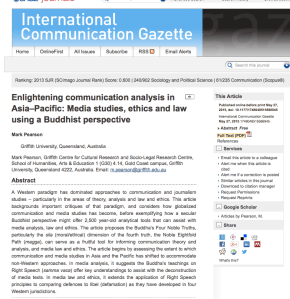
I  recently wrote an article on the “Right Speech” aspect of mindful journalism for the International Communication Gazette titled ‘Enlightening communication analysis in Asia-Pacific: Media studies, ethics and law using a Buddhist perspective’. Its abstract and link to the full article is available here.

The article backgrounds important critiques of the Western approach to communication  studies, and considers how globalized communication and media studies has become, before exemplifying how a secular Buddhist perspective might offer 2,500 year-old analytical tools that can assist with media analysis, law and ethics.

The article proposes the Buddha’s Four Noble Truths and their associated Noble Eightfold Path (magga) can be fruitful tools for informing communication theory and analysis, and media law and ethics.

In media analysis, it suggests the Buddha’s teachings on Right Speech (samma vaca) offer key understandings to assist with the deconstruction of media texts. In media law and ethics, it extends the application of Right Speech principles to comparing defences to libel (defamation) as they have developed in four Western jurisdictions.

Here is a brief extract showing the potential for exploring media law using a Buddhist/mindful journalism framework:

The ultimate contest over media talk and Right Speech happens in the courts when media texts face charges for their criminality or are the subject of civil suits over their alleged infringement on citizens’ rights like copyright, confidentiality and defamation. There is also value in applying a mindful, Buddhist approach to the study of communication and media law. We can hardly reject the teachings of the founder of one of the world’s greatest religions as inappropriate in a communication law context on exclusively secular grounds because that would imply our so-called secular approaches to communication and media theory and ethics have no religious roots. No Western academic could deny deep-seated Abrahamic influences upon the cultural origins of media law and its scholarship. A whole body of literature on the philosophy of science and religion attests to it. In media law and ethics, libertarian approaches to press freedom espoused by the likes of Milton, Mill and Jefferson arose in an era when political, cultural and religious notions of rights were intertwined. For example, the most famous treatise against licensing of the press – Milton’s Areopagitica – was prefaced with an explanation that Moses, David and Paul the Apostle were all learned because they were able to read widely. Milton wrote:

…as good almost kill a Man as kill a good Book; who kills a Man kills a reasonable creature, Gods Image; but hee who destroyes a good Booke, kills reason it selfe, kills the Image of God, as it were in the eye (Milton, 1644).

The U.S. Supreme Court cited Areopagitica in the landmark defamation case of New York Times v. Sullivan (1964) 376 US 254, when explaining why it would be counter-productive to move the burden of proving truth to the defendant (NY Times v. Sullivan, Footnote 19). Thus, by only two degrees of separation, we find Judeo-Christian teachings informing a key decision on news media talk in one of the most purportedly secular of institutions – the U.S. Supreme Court. Related to this, as Rolph (2008: 38-43) notes, defamation as the tort used to contest objectionable speech, first arose in England in 1222 in the ecclesiastical (church) courts where it remained a spiritual offence for about four centuries. Damage to a reputation was seen to be an offence to the target’s soul – a right that only God should possess – to be judged only by God’s earthly adjudicators, the clergy. There was even recourse for appeals from English ecclesiastical court judgments to the Pope (Rolph, 2008: 45). From the 16th century, defamation actions were increasingly brought in the common law courts, with the courts developing a list of allegations with which they would deal, without needing proof of actual damage being caused by the defamation (Morison & Sappideen 1989: 173). Even today the Catechism of the Catholic Church lists ‘detraction’ (essentially gossip – or disclosing ‘another’s faults and failings to persons who did not know them’) as a sin – or an ‘offense against truth’ (Catechism of the Catholic Church, para 2477). Thus, defamation action – the legal action available to those subjected to damaging media talk – has a traceable Christian genealogy.

In this globalised, multi-cultural and multi-jurisdictional Web 2.0 era there should be no reason why the Judeo-Christian lens should have a monopoly on our examination of communication law. A mindful reading of defamation law benefits from a consideration of both Right Speech principles and concepts of necessary truth-telling. While it is far-fetched to expect judges and legislators in the West would turn to Buddhism for the reform of defamation law, an effort to abide by truth-telling and Right Speech principles could operate effectively when professional communicators are attempting to avoid libel litigation when pursuing their stories. Further, they present excellent tools for an alternative analysis.

Analysis of the development of defamation defences in Canada, the UK, Australia and the U.S. benefit from a Buddhist reading. In Grant v. Torstar Corp., 2009 SCC 61, [2009] 3 S.C.R. 640, the Supreme Court of Canada developed a ‘responsible communication’ defence to defamation for matters which might not have been able to be proven absolutely as true, but were still diligently reported and were clearly in the public interest to be aired within the spirit of the Canadian Charter of Rights and Freedoms protection of free expression. Chief Justice McLachlin summed up the relevant factors of the ‘responsible communication’ defence on a demonstrable matter of public interest in these terms:

  • seriousness of the allegation
  • public importance of the matter
  • urgency of the matter
  • status and reliability of the source
  • whether the plaintiff’s side of the story was sought and accurately reported
  • whether the inclusion of the defamatory material was justifiable
  • whether a defamatory statement’s public interest lay in the fact that it had been made rather than whether it was truthful
  • other relevant circumstances

The court drew upon similar criteria to those developed earlier in the UK case of Reynolds v. Times Newspapers Ltd [2001] 2 AC 127 as part of the common law qualified privilege defence and elements of the statutory qualified privilege defence in Australia’s uniform Defamation Acts 2005.

The most significant First Amendment case in recent decades was New York Times v. Sullivan (1964) 376 US 254 where it was ruled that public of­ficials had to meet tough new tests before they could succeed in a defamation action even if the allegations in the article were proven false. It established that plaintiffs who were ‘public officials’ had to prove a media defendant had acted with ‘actual malice’ if they were to win a defamation action, even if the defamatory allegation was untrue. The test has since been expanded to apply to any ‘public figure’— essentially anyone who is well known to the public, has taken on some public role or who has participated voluntarily in some controversy. While the prin­ciple has some difficulties in definition and application, it has meant the media in the United States have been free to publish criticism of virtually anyone in the public domain, even if the criticism proves to be unfounded, just so long as they have not acted maliciously or in ‘reckless disregard’ of the truth.

It is possible to implement a Buddhist approach using the Right Speech teachings from the Noble Eightfold Path to conduct an analysis in this area of communication law. The author proposes to do this more thoroughly in future work. However, for the purposes of this argument we might return to the Abhaya Sutta … and contrast these defences as they have been developed in these jurisdictions (Thanissaro, 1997). Crucial to the Canadian ‘responsible communication’ defence and its qualified privilege cousins in the UK and Australia is the extent to which reporters and publishers honestly believe in the truth of the defamatory material published, even though they might not have the firm evidence to prove this in court. They would pass the Buddhist (mindful journalism) test if they had an honest belief the material was “factual, true, beneficial” while perhaps being “unendearing and disagreeable to others”, as long as they had chosen the “proper time” for reporting it (Thanissaro, 1997). However, the U.S. defences driven by the First Amendment takes this liberty a step too far under this schema, because it allows unbeneficial, unendearing and disagreeable material to be published about public figures as long as it has not been done with malice. It also allows for untruthful gossip-mongering, as identified earlier in the Saleyyaka Sutta (Nanamoli, 1994) as ethically problematic. Such analysis shows promise in the field of media law analysis, reform and policy development because it provides a working ethical framework to apply to legislation and the fact scenarios of particular cases.

I’ve also written a shorter account of the basic principles of mindful journalism in the journal Ethical Space: The International Journal of Communication Ethics, and the editors have been kind enough to make that article available for free viewing as a feature item on their website here. You might also want to explore some of their other fascinating articles on media ethics here and perhaps subscribe.

———–

Disclaimer: While I write about media law and ethics, nothing here should be construed as legal advice. I am an academic, not a lawyer. My only advice is that you consult a lawyer before taking any legal risks.

© Mark Pearson 2016

Leave a comment

Filed under blogging, Buddhism, citizen journalism, Eightfold Path, free expression, media ethics, mental health, social media

How to challenge a ban on naming a mental health patient

By MARK PEARSON

UTS colleague Associate Professor Tom Morton, ABC lawyer Hugh Bennett and I will deliver a paper in Melbourne next week on our experiences applying to the Mental Health Tribunal of NSW for permission to name a forensic mental health patient in an ABC documentary and in our academic works.

CMCLlogoforblog19-11-15The occasion is the 2015 IP and Media Law Conference, hosted by the Centre for Media and Communications Law at the University of Melbourne Law School, November 23-24. The full program is here. I plan to blog a few of the highlights of the sessions I attend.

Our paper is titled ‘Mental health and the media: a case study in open justice’ and we present on the first morning of the conference. Here is its abstract:

News and current affairs reportage about forensic mental health cases raises a host of competing interests, including the public’s right to know about mental health tribunal processes; a patient’s right to privacy, treatment, and recovery; and victims’ and the broader community’s interest in learning the longer term consequences of a publicised serious criminal act. This article details a case study of the legal processes involved in applications for permissions to identify a forensic mental health patient in NSW in an Australian Broadcasting Corporation Radio National Background Briefing documentary ‘The Man Without a Name’ and in subsequent research blogs and scholarly works including this article. It begins by backgrounding the restrictions on publicising mental health tribunal cases in Australia, summarising the case study, examining the specific restrictions applying to the Mental Health Review Tribunal in NSW, detailing the processes followed in the successful application by the authors to name the patient, comparing the case with Australian and British cases, and making some recommendations for further research and reform.

Tom and I recently co-authored an article on the ethics of that same experience in Pacific Journalism Review, titled ‘Zones of silence: Forensic patients, radio documentary, and a mindful approach to journalism ethics’. Here is our abstract. Full contents of the edition and subscription details can be seen here. Reference: Morton, T. and Pearson, M. (2015). Zones of silence: Forensic patients, radio documentary, and a mindful approach to journalism ethics. Pacific Journalism Review, 21(2), 11-32.

———–

Disclaimer: While I write about media law and ethics, nothing here should be construed as legal advice. I am an academic, not a lawyer. My only advice is that you consult a lawyer before taking any legal risks.

© Mark Pearson 2015

3 Comments

Filed under blogging, Buddhism, citizen journalism, Eightfold Path, free expression, media ethics, mental health, social media, Uncategorized

Zones of silence: Forensic patients, radio documentary, and a mindful approach to journalism ethics

By MARK PEARSON

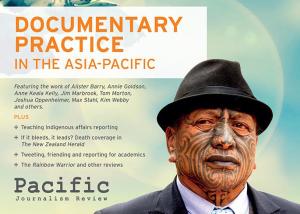
Congratulations to Pacific Journalism Review editors David Robie, Annie Goldson and Barry King on their newly released special edition ‘Documentary Practice in the Asia-Pacific’.

I was honoured to be invited by research colleague Associate Professor Tom Morton from UTS to co-write an article centred upon the law and ethics behind his ABC Background Briefing documentary ‘The Man Without A Name’, broadcast in 2014. In the article we detail the story behind the documentary and the legal and ethical challenges we faced in navigating the publishing restrictions of the NSW Mental Health Act and some related legislation.

PJR Special Edition vol21(2) OP FINAL CORRECTED 685wide_0

Cover of the special Pacific Journalism Review edition Volume 21 (2)

Here is our abstract:

This article explains a collaborative and critically reflective journalism research project stemming from the wish of an incarcerated forensic mental health patient to be named in public communication about his case. The authors are academics and journalists who embarked upon a combination of journalism, legal processes and academic research to win the right to name Patient A in a radio documentary and in academic works—including this journal article and research blogs. As a case study, it explains the theoretical and ethical considerations informing the journalism and the academic research, drawing upon traditions of documentary production, the principle of open justice and the ethical framework of ‘mindful journalism’. It concludes by drawing lessons from the project that might inform future practitioners and researchers embarking upon works of journalism and research involving vulnerable people and a competing set of rights and public interests.

Full contents of the edition and subscription details can be seen here.

———–

Disclaimer: While I write about media law and ethics, nothing here should be construed as legal advice. I am an academic, not a lawyer. My only advice is that you consult a lawyer before taking any legal risks.

© Mark Pearson 2015

Leave a comment

Filed under blogging, Buddhism, citizen journalism, Eightfold Path, free expression, media ethics, mental health, social media, Uncategorized

Mindful journalism in focus on @RNmediareport

By MARK PEARSON

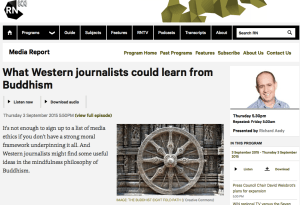
Mindful journalism was the focus of a segment on Radio National’s Media Report (@RNmediareport) this week (September 3, 2015) when I was interviewed by host Richard Aedy (@richardaedy) on the application of Buddhist ethics to reporting.

Interested? You can listen to the 10 minute segment here.

Screen Shot 2015-09-04 at 9.46.24 am

Our book Mindful Journalism and News Ethics in the Digital Era: A Buddhist Approach (Shelton Gunaratne, Mark Pearson and Sugath Senarath eds; Routledge, NY, 2015)  explored the possibilities of applying mindfulness techniques to journalism practice.

I’ve also written a shorter account of the basic principles in the journal Ethical Space: The International Journal of Communication Ethics, and the editors have been kind enough to make that article available for free viewing as a feature item on their website here. You might also want to explore some of their other fascinating articles on media ethics here and perhaps subscribe.

I’ve also written an article on the “Right Speech” aspect of mindful journalism for the International Communication Gazette titled ‘Enlightening communication analysis in Asia-Pacific: Media studies, ethics and law using a Buddhist perspective’. Its abstract and link to the full article is available here.

Screen Shot 2015-05-29 at 3.08.59 pmThe article backgrounds important critiques of the Western approach to communication  studies, and considers how globalized communication and media studies has become, before exemplifying how a secular Buddhist perspective might offer 2,500 year-old analytical tools that can assist with media analysis, law and ethics.

The article proposes the Buddha’s Four Noble Truths and their associated Noble Eightfold Path (magga) can be fruitful tools for informing communication theory and analysis, and media law and ethics.

The article begins by assessing the extent to which communication and media studies in Asia and the Pacific has shifted to accommodate non-Western approaches.

In media analysis, it suggests the Buddha’s teachings on Right Speech (samma vaca) offer key understandings to assist with the deconstruction of media texts. In media law and ethics, it extends the application of Right Speech principles to comparing defences to libel (defamation) as they have developed in four Western jurisdictions.

Here is a brief extract on that aspect:

In this globalised, multi-cultural and multi-jurisdictional Web 2.0 era there should be no reason why the Judeo-Christian lens should have a monopoly on our examination of communication law. A mindful reading of defamation law benefits from a consideration of both Right Speech principles and concepts of necessary truth-telling. While it is far-fetched to expect judges and legislators in the West would turn to Buddhism for the reform of defamation law, an effort to abide by truth-telling and Right Speech principles could operate effectively when professional communicators are attempting to avoid libel litigation when pursuing their stories. Further, they present excellent tools for an alternative analysis.

Analysis of the development of defamation defences in Canada, the UK, Australia and the U.S. benefit from a Buddhist reading. In Grant v. Torstar Corp., 2009 SCC 61, [2009] 3 S.C.R. 640, the Supreme Court of Canada developed a ‘responsible communication’ defence to defamation for matters which might not have been able to be proven absolutely as true, but were still diligently reported and were clearly in the public interest to be aired within the spirit of the Canadian Charter of Rights and Freedoms protection of free expression. ..

It is possible to implement a Buddhist approach using the Right Speech teachings from the Noble Eightfold Path to conduct an analysis in this area of communication law. The author proposes to do this more thoroughly in future work. However, for the purposes of this argument we might return to the Abhaya Sutta cited earlier and contrast these defences as they have been developed in these jurisdictions (Thanissaro, 1997). Crucial to the Canadian ‘responsible communication’ defence and its qualified privilege cousins in the UK and Australia is the extent to which reporters and publishers honestly believe in the truth of the defamatory material published, even though they might not have the firm evidence to prove this in court. They would pass the Buddhist (mindful journalism) test if they had an honest belief the material was “factual, true, beneficial” while perhaps being “unendearing and disagreeable to others”, as long as they had chosen the “proper time” for reporting it (Thanissaro, 1997). However, the U.S. defences driven by the First Amendment takes this liberty a step too far under this schema, because it allows unbeneficial, unendearing and disagreeable material to be published about public figures as long as it has not been done with malice. It also allows for untruthful gossip-mongering, as identified earlier in the Saleyyaka Sutta (Nanamoli, 1994) as ethically problematic. Such analysis shows promise in the field of media law analysis, reform and policy development because it provides a working ethical framework to apply to legislation and the fact scenarios of particular cases.

The article applies the ‘Right Speech’ principles of Buddhist ethics to analysis of the Royal family prank call episode which resulted in a High Court appeal in Australia and to a racial discrimination case heard in Australia’s Federal Court over comments on a West Australian news website.

———–

Disclaimer: While I write about media law and ethics, nothing here should be construed as legal advice. I am an academic, not a lawyer. My only advice is that you consult a lawyer before taking any legal risks.

© Mark Pearson 2015

Leave a comment

Filed under blogging, Buddhism, citizen journalism, Eightfold Path, free expression, media ethics, mental health, social media

Towards a mindful approach to media law and ethics

By MARK PEARSON

Our book Mindful Journalism and News Ethics in the Digital Era: A Buddhist Approach (Shelton Gunaratne, Mark Pearson and Sugath Senarath eds; Routledge, NY, 2015)  explored the possibilities of applying mindfulness techniques to journalism practice.

How might we begin to apply Buddhist ethical systems to the analysis of media law and ethics?

I explore this question in an article just published online and to appear in a forthcoming print edition of the International Communication Gazette.

It is titled ‘Enlightening communication analysis in Asia-Pacific: Media studies, ethics and law using a Buddhist perspective’. Its abstract and link to the full article is available here.

Screen Shot 2015-05-29 at 3.08.59 pmThe article backgrounds important critiques of the Western approach to communication  studies, and considers how globalized communication and media studies has become, before exemplifying how a secular Buddhist perspective might offer 2,500 year-old analytical tools that can assist with media analysis, law and ethics.

The article proposes the Buddha’s Four Noble Truths and their associated Noble Eightfold Path (magga) can be fruitful tools for informing communication theory and analysis, and media law and ethics.

The article begins by assessing the extent to which communication and media studies in Asia and the Pacific has shifted to accommodate non-Western approaches.

In media analysis, it suggests the Buddha’s teachings on Right Speech (samma vaca) offer key understandings to assist with the deconstruction of media texts. In media law and ethics, it extends the application of Right Speech principles to comparing defences to libel (defamation) as they have developed in four Western jurisdictions.

Here is a brief extract on that aspect:

In this globalised, multi-cultural and multi-jurisdictional Web 2.0 era there should be no reason why the Judeo-Christian lens should have a monopoly on our examination of communication law. A mindful reading of defamation law benefits from a consideration of both Right Speech principles and concepts of necessary truth-telling. While it is far-fetched to expect judges and legislators in the West would turn to Buddhism for the reform of defamation law, an effort to abide by truth-telling and Right Speech principles could operate effectively when professional communicators are attempting to avoid libel litigation when pursuing their stories. Further, they present excellent tools for an alternative analysis.

Analysis of the development of defamation defences in Canada, the UK, Australia and the U.S. benefit from a Buddhist reading. In Grant v. Torstar Corp., 2009 SCC 61, [2009] 3 S.C.R. 640, the Supreme Court of Canada developed a ‘responsible communication’ defence to defamation for matters which might not have been able to be proven absolutely as true, but were still diligently reported and were clearly in the public interest to be aired within the spirit of the Canadian Charter of Rights and Freedoms protection of free expression. ..

It is possible to implement a Buddhist approach using the Right Speech teachings from the Noble Eightfold Path to conduct an analysis in this area of communication law. The author proposes to do this more thoroughly in future work. However, for the purposes of this argument we might return to the Abhaya Sutta cited earlier and contrast these defences as they have been developed in these jurisdictions (Thanissaro, 1997). Crucial to the Canadian ‘responsible communication’ defence and its qualified privilege cousins in the UK and Australia is the extent to which reporters and publishers honestly believe in the truth of the defamatory material published, even though they might not have the firm evidence to prove this in court. They would pass the Buddhist (mindful journalism) test if they had an honest belief the material was “factual, true, beneficial” while perhaps being “unendearing and disagreeable to others”, as long as they had chosen the “proper time” for reporting it (Thanissaro, 1997). However, the U.S. defences driven by the First Amendment takes this liberty a step too far under this schema, because it allows unbeneficial, unendearing and disagreeable material to be published about public figures as long as it has not been done with malice. It also allows for untruthful gossip-mongering, as identified earlier in the Saleyyaka Sutta (Nanamoli, 1994) as ethically problematic. Such analysis shows promise in the field of media law analysis, reform and policy development because it provides a working ethical framework to apply to legislation and the fact scenarios of particular cases.

The article applies the ‘Right Speech’ principles of Buddhist ethics to analysis of the Royal family prank call episode which resulted in a High Court appeal in Australia and to a racial discrimination case heard in Australia’s Federal Court over comments on a West Australian news website.

———–

Disclaimer: While I write about media law and ethics, nothing here should be construed as legal advice. I am an academic, not a lawyer. My only advice is that you consult a lawyer before taking any legal risks.

© Mark Pearson 2015

2 Comments

Filed under blogging, Buddhism, citizen journalism, Eightfold Path, free expression, media ethics, mental health, social media, Uncategorized

Election postscript: a mindful analysis of media coverage

By MARK PEARSON

[This blog was first published in the St James Ethics Centre’s Living Ethics newsletter, Issue 93, Spring 2013. See here.]

Australian journalists operate under an array of ethical guidelines, including the MEAA Code of Ethics and numerous employer and industry codes of practice.

hogansWhile these documents differ widely in their wording, they espouse common values of truth, accuracy, fairness and the public’s right to information. They disapprove of invasions of privacy, disclosure of confidential sources, discriminatory language, subterfuge, deception, plagiarism and conflicts of interest.

When it comes to assessing the ethics of news coverage of an event as broad in scope as a federal election we find some guidance in such codes but other moral frameworks can add value.

Although I am not a Buddhist, I have recently found value in applying some of that religion’s foundational principles – in a secular way – to the assessment of journalism ethics and have been sharing this approach with colleagues and students through my writing and teaching.

It is also a useful lens through which to review some key elements in media coverage of the 2013 federal election.

The approach centres on the belief that journalists can adopt a mindful approach to their news and commentary which requires a reflection upon the implications of their truth-seeking and truth-telling as a routine part of the process. It calls upon them pause and think carefully about the consequences of their reportage and commentary for the stakeholders involved, including their sources and their audiences.

Truth-seeking and truth-telling are still the primary goal, but only after gauging the resulting social good or harm.

Each of the constituent steps of Buddhism’s Eightfold Path – understanding free of superstition, kindly and truthful speech, right conduct, doing no harm, perseverance, mindfulness and contemplation – provides a framework for such analysis.

Space prohibits the examination of all of them here, but at least three issues arose in the election worthy of such reflection.

  1. Fact checking. The Buddhist notion of ‘right views’ focuses on a deeper explanation of root causes and the clinical testing of claims. The emergence of the ‘fact checker’ was a welcome development via Politifact Australia, the ABC’s Fact Checking Unit and The Conversation’s Election FactCheck. A longer term impact of such a tool might be that politicians are prompted to think twice before issuing scaremongering and outlandish statements.
  2. The News Corp anti-Labor campaign. The principle of ‘right intent’ calls upon us to reflect upon the genuine motivations for Rupert Murdoch’s Australian newspapers adopting such a blatant and belittling attack on the incumbent government. Cynical mock-ups like the Daily Telegraph’s ‘Hogan’s Heroes’ and the Courier Mail’s ‘Send in the Clown’ front pages might be excused as tabloid fun but they hardly indicate ‘right intent’ and ‘right speech’ in the Buddhist moral framework. The motivation could surely not have been to gain circulation, given the fact that the coverage stood to alienate perhaps one third of readers. It will be fascinating to see at the next audit whether this stance accelerated the decline of those newspapers’ circulations. If the intent was to win influence with the likely government, then this should have been disclosed.
  3. Presidential-style coverage. Just because political parties choose to run a presidential style of campaign does not oblige news organisations to embrace it. The Buddhist principle of ‘right effort’ invokes a steady, patient and purposeful path and ‘right mindfulness’ demands a considered and reflective approach to reportage. Each of these is difficult when reporters are assigned to traipse around the nation and cover political leaders engaging in stage-managed, superficial appearances at factories, schools and sausage sizzles. It is belittling to the enterprise of journalism to see some of its leading lights – and notable watchdogs – being led by the leash as mere lapdogs. It was particularly noticeable in a campaign where neither leader made a notable gaffe. We are left to imagine what might have been revealed if only these political journalism superstars had been afforded the time to do some real digging. Sometimes being ethical demands us to say ‘no’ to an under-utilisation our talents, which was clearly the case here.

livingethicscoverThe ultimate test of ethical political reporting in a democracy is the extent to which that journalism best informs the citizenry to maximize the value of each and every vote. In that respect, Australian journalism still has much to learn.

———–

Disclaimer: While I write about media law and ethics, nothing here should be construed as legal advice. I am an academic, not a lawyer. My only advice is that you consult a lawyer before taking any legal risks.

© Mark Pearson 2013

2 Comments

Filed under blogging, Buddhism, citizen journalism, Eightfold Path, free expression, media ethics, social media, Uncategorized

Mindful ethics for bloggers

By MARK PEARSON

[This blog was first published on the citizen journalism election site No Fibs, edited by Margo Kingston.]

Bloggers and citizen journalists come from an array of backgrounds and thus bring varied cultural and ethical values to their blogging.

No Fibs asks its citizen journalists to follow the MEAA Code of Ethics, and the journalists’ union has recently made a concerted effort to bring serious bloggers into its fold through its FreelancePro initiative.

This would have bloggers committing to a ‘respect for truth and the public’s right to information’ and the core principles of honesty, fairness, independence, and respect for the rights of others. Specifically, they would subscribe to the 12 key principles of fair and accurate reporting; anti-discrimination; source protection; refusal of payola; disclosure of conflicts of interest; rejection of commercial influences; disclosure of chequebook journalism; using honest newsgathering methods and protecting the vulnerable; disclosing digital manipulation; not plagiarising; respecting grief and privacy; and correcting errors. These can be overridden only for ‘substantial advancement of the public interest’ or where there is ‘risk of substantial harm to people’.

A decade ago in the US, Cyberjournalist.net cherry-picked the lengthy  Society of Professional Journalists Code of Ethics and proposed its own Bloggers’ Code of Ethics.

All this is fine for bloggers who are former working journalists, student journalists who hope to work in that occupation, and for serious bloggers who view their work as journalism even though it might only be a hobby or attract a pittance in payment. But many bloggers make the conscious decision not to identify as journalists, and thus need to revert to a personal moral framework in their work.

I have been exploring this in recent months and have coined the expression ‘mindful journalism’ after finding that many fundamental Buddhist principles – applied in a secular way – lend themselves to serious blogging when other moral compasses might be absent. Parts of this blog are drawn from my paper delivered to the IAMCR conference in Dublin in June, 2013.

Please do not interpret this as an attempt to convert bloggers to Buddhism. I am not a Buddhist and believe that followers of any of the world’s major religions will find core values in their scriptures that serve this process just as well.

It is just that Buddhism’s Eightfold Path is a simple expression of key moral values that can underscore ethical blogging: understanding free of superstition, kindly and truthful speech, right conduct, doing no harm, perseverance, mindfulness and contemplation.

It was while writing my recent book Blogging and Tweeting Without Getting Sued (Allen & Unwin, 2012) that I decided a guide to safe online writing required more than a simple account of ‘black letter law’. It forced a re-examination of the fundamental moral underpinnings of Internet and social media communication. Being safe legally normally requires a careful pre-publication reflection upon the potential impacts of one’s work upon one’s self and others – or what a Buddhist might explain in terms of ‘mindfulness’ and ‘karma’.

Dalai Lama’s recent book – Beyond Religion – Ethics for a Whole World (2011) – explored his vision of how core ethical values might offer a sound moral framework for modern society while accommodating diverse religious views and cultural traditions. Buddhist practices like mindfulness and meditation have been adopted broadly in Western society in recent decades and have been accepted into clinical psychology. Even the MEAA Code of Ethics states: “Ethical journalism requires conscientious decision-making in context.”

This is premised on the belief that journalists and serious bloggers can adopt a mindful approach to their news and commentary which requires a reflection upon the implications of their truth-seeking and truth-telling as a routine part of the process. They would be prompted to pause and think carefully about the consequences of their reportage and commentary for the stakeholders involved, including their audiences. Truth-seeking and truth-telling would still be the primary goal, but only after gauging the social good that might come from doing so.

So what are these core principles and how might they apply to an election blogger?

Each of the constituent steps of the Eightfold Path – understanding free of superstition, kindly and truthful speech, right conduct, doing no harm, perseverance, mindfulness and contemplation – has an application to the modern-day practice of truth-seeking and truth-telling – whether that be by a journalist working in a traditional media context, a citizen journalist or a serious blogger reporting and commenting upon political news.

Let’s explore its eight steps.

1. Right views.  A fundamental principle of Buddhism is that all things in the world are at once impermanent, unsatisfactory and non-substantial. News, too, is about the impermanent and the unsatisfactory. It is premised upon identifying to audiences what has changed most recently, focusing especially on the most unsatisfactory elements of that change. The notion of ‘right views’ can incorporate a contract with audiences that accepts a level of change at any time, and focuses intention upon deeper explanations of root causes, strategies for coping and potential solutions for those changes prompting the greatest suffering. In election blogging, it moots for less scare-mongering, more careful consideration of policies and the clinical testing of claims.

2. Right intent. This calls upon the blogger to reflect upon the genuine motivating reasons why he or she is blogging at all, then why they might be writing this particular commentary, and finally why they are selecting a particular turn of phrase or quote to make a point. Such a reflective approach can be revealing. How is humanity being improved by this action? Is it motivated in some way by ego or for the betterment of society? This might prompt a change in mindset from bringing news ‘first’ in a competitive sense but ‘best’ and most meaningfully to an audience in a qualitative sense. Of course, it would not be ‘news’ if were not delivered relatively soon after its occurrence, but in this era of instant communication this step reinforces the notion of ‘responsible truth-seeking and truth-telling’ – authoritative and credible news and commentary, obtained ethically, and delivered as soon as possible (after such reflection) to retain its relevance and utility without losing its veracity.

3. Right speech. This step relates to both truthful and charitable expression and, interpreted narrowly, that second element could present a fundamental challenge to the very concept of political commentary as we know it. It certainly places serious questions about the gossip and mud-slinging orientation of much political coverage. The notion of telling the truth and being accurate lies at the heart of journalism practice and is foremost in most ethical codes internationally. While a single empirical fact might be subject to scientific measurement and verification, any conclusions drawn from the juxtaposition of two provable facts can only constitute what a scientist would call a ‘theory’ and the rest of us might call ‘opinion’. Gossip about the private lives of politicians, barbed commentary, imposing labels upon them like the “Flimflam Man”, the “Mad Monk” or “Dr No”, and cynical mock-ups like the Daily Telegraph’s Hogan’s Heroes front page all fail the test of ‘right speech’. That is not to say harsh and uncomfortable truths must not be told.  It is the way they are told that is crucial to this principle.

4. Right conduct. The fourth step of ‘right conduct’ goes to the core of any moral or ethical code and invokes a reflection on the actual practices involved. Here, journalism codes offer useful guidance in their lists of “do’s” and “do not’s.” Even journalism ethical codes can gain wider understanding and acceptance by appealing to fundamental human moral values and not just offering a proscriptive list of prohibited practices. A recent example is the Fairfax Media Code of Conduct which poses questions employees might ask themselves when faced with ethical dilemmas that might not be addressed specifically in the document, including:

  • Would I be proud of what I have done?
  • Do I think it’s the right thing to do?
  • What will the consequences be for my colleagues, Fairfax, other parties and me?
  • What would be the reaction of my family and friends if they were to find out?
  • What would happen if my conduct was reported in a rival publication?

While this approach seems to focus on the potential for shame for a transgressor, it offers an example of a media outlet attempting to encourage its employees to pause and reflect in the midst of an ethical dilemma – what educationalist Donald Schön (1987, p. 26) called ‘reflection-in-action’.

5. Right living. The Buddha identified certain livelihoods that were incompatible with a morally pure way of living, shaped of course by the cultural mores of his place and time 2500 years ago. They included poison peddler, slave trader, prostitute, butcher, brewer, arms maker and tax collector. Some of these occupations might remain on his list today. We are left to wonder how the worst of political coverage – intrusion, rumor-mongering, name-calling, mud-slinging, and agenda-pushing for commercial purposes – advances the enterprise of journalism or the personal integrity of an individual journalist who chooses to ply that trade. This is where political bloggers working outside the mainstream media can distinguish themselves by applying a mindful approach to their work.

6. Right effort. The step of ‘right effort’ was directed by the Buddha in a predominantly spiritual sense – a steady, patient and purposeful path to enlightenment. However, we can also apply such principles to the goal of ethical blogging and citizen journalism in a secular way. We might sometimes see the hurried scoop and accompanying kudos as an end in itself. There can also be an emphasis on productivity and output at the expense of attribution and verification. Of course, stories and blogs could evolve into lengthy theses if they were afforded unlimited timelines and budgets. Commercial imperatives and deadlines demand a certain brevity and frequency of output. Both can be achieved with continued attention to the core principle of purposeful reflection upon the ethics of the various work tasks and a mindful awareness of the underlying mission of one’s enterprise. External factors will continually threaten a blogger’s commitment to this ethical core, requiring the ‘right effort’ to be maintained at that steady, considered pace through every interview, every blog, every working day and ultimately through a full career. As the Dalai Lama wrote in Beyond Religion: “The practice of patience guards us against loss of composure and, in doing so, enables us to exercise discernment, even in the heat of difficult situations (p. 142).” Surely this is a useful attribute for the reporter, citizen journalist and blogger.

7. Right mindfulness. This is the technique of self-examination I have selected as central to an application of these principles to blogging and citizen journalism. Effective reflection upon one’s own thoughts and emotions is crucial to a considered review of an ethical dilemma in a publishing context. It is also essential to have gone through such a process if you are later called to account to explain their actions. Many ethical decisions are value-laden and inherently complex. Too often they are portrayed in terms of the ‘public interest’ when the core motivating factor has not been the greater public good but, to the contrary, an ego or a commercial imperative. The Leveson Report into the excesses of the British press detailed numerous instances where such forces were at play, often to the great detriment to the lives of ordinary citizens. Buddhists (and many others) adopt mindfulness techniques in the form of meditation practice where they reflect upon their thoughts and emotions without reacting to them. While I have found this practice useful, I am by no means suggesting citizen journalists or bloggers adopt the lotus position in the midst of a breaking news to peacefully contemplate their options. The extent to which individuals might want to set aside time for meditation in their own routines is up to them, but at the very least there is much to be gained by adopting the lay meaning of ‘being mindful’. In other words, bloggers might pause briefly for reflection upon the implications of their actions upon others – the people who are the subjects of their blogs, other stakeholders who might be affected by the event or issue at hand, the effects upon their own reputations and the community standing of others, and the public benefits ensuing from this particular truth being told in this way at this time. There is a special need to be mindful of the vulnerabilities of some individuals you write about. Our own research has examined how coverage might impact on those who might belong to a ‘vulnerable group’ or who might simply be ‘vulnerable’ because of the circumstances of the news event. This concern for others also invokes the notion of compassion for other human beings, a tenet central to the teachings of all major religions, and a hallmark of Buddhism. The Dalai Lama explains that true compassion for others requires that sometimes we must call to account those who abuse power: “Depending on the context, a failure to respond with strong measures, thereby allowing the aggressors to continue their destructive behaviour, could even make you partially responsible for the harm they continue to inflict (Dalai Lama, 2011, p. 59).”

8. Right concentration. Some have compared ‘right concentration’ to being in ‘the zone’ in elite sporting terminology – so focused on the work at hand that there is a distinctive clarity of purpose. It is such concentrated attention that is required of consummate professionals in the midst of covering a major event. It is at this time that we actually enter ‘the zone’ and are able to draw on core ethical values to produce important reportage and commentary within tight deadlines, paying due regard to the impact of their work upon an array of individual stakeholders and to the broader public interest. It is in this moment that it all comes together for the mindful journalist or blogger – facts are verified, comments from a range of sources are attributed, competing values are assessed, angles are considered and decided and timing is judged. And it all happens within a cool concentrated focus, sometimes amidst the noise and mayhem of a chaotic news event.

We cannot expect the millions of bloggers and citizen journalists internationally to abide by a unified moral or ethical code. Some will draw upon foundational principles from the Koran, the Bible, the Torah or Confucianism. Others will reflect upon classic secular guidelines like Dale Carnegie’s How to Win Friends and Influence People or Rudyard Kipling’s If. And some of us might find guidance in these eight steps developed more than two millennia ago.

———–

Disclaimer: While I write about media law and ethics, nothing here should be construed as legal advice. I am an academic, not a lawyer. My only advice is that you consult a lawyer before taking any legal risks.

© Mark Pearson 2013

3 Comments

Filed under blogging, Buddhism, citizen journalism, Eightfold Path, free expression, media ethics, social media, Uncategorized