Tag Archives: media

Reporting Islam project wins Queensland Multicultural Award

By MARK PEARSON

Our Reporting Islam project team won the Communication and Media Achievement Award category of the Queensland Multicultural Awards on Saturday (August 20, 2016).

My co-investigator Associate Professor Jacqui Ewart and project manager Abdi Hersi accepted the award on behalf of our team.

Here are the award details, as outlined in media statements from Griffith University and the Minister for Multicultural Affairs, Grace Grace.

For more information about the project and its resources, please see www.reportingislam.org.


Reporting Islam Project wins Qld Multicultural Award

[Griffith University media statement]

Griffith University has won a 2016 Queensland Multicultural Award for its ground-breaking Reporting Islam Project.

Led by Associate Professor Jacqui Ewart and Professor Mark Pearson from the School of Humanities, Languages and Social Science, the world-first project aims to combat the negative stereotyping of Islam and Muslims in the media.

Since its inception in 2014, the project team has created a suite of research-based multi-media training and education resources for Australian media practitioners and tertiary institutions.

“The Queensland Multicultural Awards are a great initiative and we are honoured to be this year’s winners in the communication and media achievement category,” Associate Professor Jacqui Ewart said.

“Our project is about improving the quality of mainstream news media relating to Islam through the development of research-based best practice resources for journalists to encourage more mindful and accurate reporting of Muslims and the Islamic faith.”

“Our team has developed an app, a website, a reporting handbook, audio visual materials and two training packages.”

Find out more: Multicultural Awards finalists

Muslims negatively stereotyped

Associate Professor Ewart said the idea for the project was sparked by research showing that Islam and Muslims were routinely and negatively stereotyped in Australian news media.

“There is ample evidence of the negative impact of this news media coverage on Australian Muslims.

“We believe that fair, ethical and accurate reporting on matters involving Islam and Muslims will help promote social cohesion and feelings of inclusiveness for Muslim people and help build community confidence and resilience.”

Developed in consultation with south east Queensland Muslim community leaders and Australian news media organisations, the project team is delivering targeted training courses nationally.Strong partnerships have also been formed with Australian Muslim community members, international academic experts, educators and media industry personnel. The project team’s innovative and proactive approach promotes acceptance and understanding of Islam across diverse cultural groups and the wider community.

The 2016 Queensland Multicultural Awards were announced at the Logan Entertainment Centre on Saturday, August 20 as part of Queensland’s Multicultural Month celebrations.


Media statement from Minister for Employment and Industrial Relations, Minister for Racing and Minister for Multicultural Affairs, The Honourable Grace Grace:

Saturday, August 20, 2016

Awards recognise Queensland’s brightest multicultural achievers

Queensland’s brightest multicultural achievers have been recognised at today’s Queensland Multicultural Awards, held in Logan.

Multicultural Affairs Minister Grace Grace announced the eight winners and congratulated all 27 finalists during a gala luncheon that was also attended by Health Minister and Member for Woodridge Cameron Dick.

“These awards recognise some of the outstanding organisations and individuals who are such a vital part of Queensland’s multicultural success story,” she said.

“Community groups, volunteers, businesses and sporting organisations are just some of those recognised by these prestigious awards.

“I want to congratulate all finalists for their efforts to create a harmonious and inclusive Queensland.

“It really is the icing on the cake to be having these awards during Queensland Multicultural Month, Queensland’s largest multicultural celebration.”

Ms Grace said all finalists were setting a great example and providing inspiration to all Queenslanders.

“They remind us that Queensland always has, and always will, depend on the skill and talent of people drawn from all parts of the globe,” she said.

Communication and Media Achievement Award – Reporting Islam Project Team (Nathan). They aimed to combat the negative stereotyping of Islam and Muslims in the media through the development of a research-based, best practice guide for journalists reporting on stories about Islam and Muslims

Queensland Multicultural Award winners:

  • Minister’s Multicultural Award – Multicultural Community Centre (Newmarket). The centre assists migrants, refugees and disadvantaged members of the community through settlement services, training and employment support
  • Outstanding Volunteer – Naseema Mustapha (Highgate Hill). She was involved in causes such as blanket and clothing drives to assist asylum seekers, English tutoring, fundraising for orphanages in Africa and the Griffith University Refugee Students’ Association Refugee Day Festival.
  • Business Excellence Award – Townsville Hospital and Health Service (Townsville). The hospital partnered with TAFE North Queensland to provide work experience to 18 refugee and migrant job seekers. The program also gave participants their first experience in gardening, painting, food preparation, cleaning and plumbing at Townsville Hospital.
  • Communication and Media Achievement Award – Reporting Islam Project Team (Nathan). They aimed to combat the negative stereotyping of Islam and Muslims in the media through the development of a research-based, best practice guide for journalists reporting on stories about Islam and Muslims
  • Employment, Education and Training Innovation Award – Private Enterprise – The Multicultural Sports Club (Logan) is an initiative of Multicultural Youth Queensland, a youth-led innovative, not-for-profit organisation which provides targeted services, programs and projects to improve life outcomes for young people aged 12 to 30 years old.
  • Employment, Education and Training Innovation Award – Public Sector – Queensland Police Service Academy – ROLE program (Oxley). The program pairs police with students from a Brisbane high school where they work with mentors and encourage Year 9 students to participate in team building activities
  • Services and Communities Award – Individual – Regina Samykanu-Vuthapanich (Gatton). She set up the first Youth Council in the Lockyer Valley, established the Gatton Multicultural Festival and the Overseas Students Association Support Group. She also founded the Lockyer Valley Multicultural Association and the Somerset Migrant Resource Centre.
  • Services and Communities Award – Organisation – The Friends of HEAL Foundation (Yeronga). The organisation provides creative arts therapy to young people from refugee backgrounds and also helps refugee children settle into their new community

For more details on Queensland Multicultural Month head to www.qld.gov.au/multiculturalmonth

———–

Disclaimer: While I write about media law and ethics, nothing here should be construed as legal advice. I am an academic, not a lawyer. My only advice is that you consult a lawyer before taking any legal risks.

© Mark Pearson 2016
Leave a comment

Filed under free expression, Islam, journalism, journalism education, media ethics, Muslim, Reporting Islm

Reporting Islam in the spotlight at #AEJMC16

By MARK PEARSON

My sabbatical semester travels now have me in Minneapolis for the annual convention of the Association for Education in Journalism and Mass Communication – #AEJMC16.

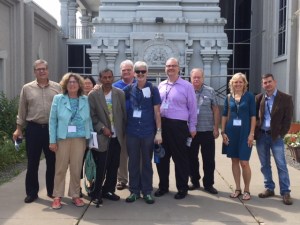
Visiting the Hindu temple in Minneapolis with the Religion and Media interest group from AEJMC with my Mindful Journalism co-author Shelton Gunaratne (front row, second from left).

Visiting the Hindu temple in Minneapolis with the Religion and Media interest group from AEJMC with my Mindful Journalism co-author Shelton Gunaratne (front row, second from left). [Photo: Julie Pearson]

I’m presenting a paper titled “Perspectives of journalists, educators, trainers and experts on news media reporting of Islam and Muslim communities in Australia and New Zealand”, showcasing research from our @ReportingIslam project, written with colleagues Jacqui Ewart (@jacquiewart) and Guy Healy.

Our paper uses data from an Australian study to ascertain issues associated with news media coverage of Islam and Muslims from the perspectives of journalists, journalism educators and media trainers. We draw on data from interviews with 37 journalists, editors, educators, media trainers, Muslim community leaders and other experts located in Australia and New Zealand to explore their understandings of the ways stories about Islam and Muslims are reported and why.

We’re looking forward to the feedback from colleagues after two interesting sessions on similar topics yesterday.

On Wednesday we visited Muslim, Hindu and Christian places of worship in Minnesota with the Media and Religion interest group from the conference (pictured left).

———–

Disclaimer: While I write about media law and ethics, nothing here should be construed as legal advice. I am an academic, not a lawyer. My only advice is that you consult a lawyer before taking any legal risks.

© Mark Pearson 2016
Leave a comment

Filed under blogging, Buddhism, citizen journalism, Eightfold Path, free expression, Islam, journalism, journalism education, media ethics, mental health, mindful journalism, social media, terrorism

Gearing up for a stimulating and mindful #wjec16

By MARK PEARSON

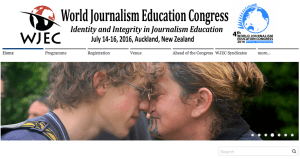
Many of the leading lights in journalism education internationally gather in Auckland next week for the fourth World Journalism Education Congress at AUT Auckland.

WJECWebsiteScreenshotFor me, it will be a busy start to a sabbatical semester and I am looking forward to chairing a session, being respondent for another, a panellist in a 21st century ethics discussion, and presenting two conference papers with @ReportingIslam project colleague Jacqui Ewart (@jacquiewart).

Interested? Here are the session descriptions and abstracts. See the full program here.

WJEC preconference of the Journalism Education and Research Association of Australia (JERAA), AUT Pacific Media Centre (PMC) and Media Educators Pacific (MEP), Wednesday, 13 July 2016, 4-5.30pm

A Research-driven Approach to Developing a Best Practice Checklist for Journalists Reporting upon Islam and Muslims

Prof Mark Pearson and Prof Jacqui Ewart (Griffith University, Australia)

This paper explains the processes undertaken to research, develop and trial a checklist for journalists or journalism students for the ethical and mindful reporting of stories involving Islam as a religion or Muslim people. The presenters outline an innovative approach to such a task where the international literature in the field and follow-up research informed the creation of an extended checklist which was then refined according to the perceived needs and priorities of the journalists and students who were presented with it.

This paper presents the methodology and results of the study implementing exactly that approach, which might inform future approaches to the development of such guidelines across a broad range of reporting topics. The study formed part of a major Australian Government funded project involving the creation of research-based resources on the mindful reporting of Islam and Muslim people.

Academic research papers stemming from international studies on reporting Islam and journalism ethics were searched. We also undertook 29 interviews with journalists, journalism educators, journalism students and academics with expertise in the media and Islam in Australia and New Zealand. Topics covered included best and poor practice and curricular and pedagogical approaches to educating journalists for more mindful reporting. We analysed this data – previous studies and the interview transcripts – as a crucial part of the development of an extended list of 30 questions journalists and editors might ask themselves when covering a story related to Islam or Muslim people. Journalists, educators and journalism students (n = 123) attending workshops throughout 2015 were presented with the 30 questions and were asked to nominate the 10 they felt were most important (in no particular order), using a variation of “forced choice” testing in survey methodology (Frederick, 2004, pp. 397-398). The responses were then ranked in order of importance into a “Top Ten” checklist and subsequently built into the project’s resources and curricula which were in turn trialled with journalists, journalism educators and students at several sites in four Australian states and in Canberra. This paper explains that the approach has at least three benefits – the pedagogical advantage of the embedded learning happening while the participants perform the ranking; the reassurance for the teaching resource developers that the selected guidelines are considered the most important by the target groups; and the enhanced credibility of the resulting guidelines for those subsequently using them. The paper details the methodological and educational research underpinning the approach and presents the resulting refined checklist.

Frederick, R. (2004). Forced-choice testing. In M. Lewis-Beck, A. Bryman, & T. Liao (Eds.), Encyclopedia of social science research methods. (pp. 397-398). Thousand Oaks, CA: Sage.

WJEC Conference, July 14, 11am-12.30pm

Panel 2: 21st century ethical issues in journalism
WG404
This panel explores the ethics of journalism in an environment where journalistic authority is diminished and new relationships with news publics are being sought. The speakers, drawing on a range of philosophical positions, will explore arguments around journalistic independence, engagement with the public good, transparency and sincerity. In doing so, the panel members will trace some of the major fault lines in contemporary journalism ethics around truth-telling and accountability and assess ways through which journalists can morally justify their work.
Chair: Donald Matheson, Canterbury University (New Zealand)
Panelists:
Mark Pearson, Griffith University (Australia)
Cherian George, Hong Kong Baptist University (Hong Kong)
Linda Steiner, University of Maryland (United States)
Respondent: Stephen Ward, University of British Columbia/University of Wisconsin-Madison (Canada)
WJEC Conference, July 16, 11-12.30pm
Paper session: 21st Century Ethical Issues in Journalism 3
WG607

Eliciting Best Practice in Reporting Islam: Case studies from Australia

Mark Pearson and Jacqui Ewart, Griffith University

Much is known about the poor practices adopted by some news media outlets in their coverage of Islam and Muslims, but relatively little research has been conducted into what might constitute best practice in this important area of reportage (Pintak & Franklin, 2013; Rupar, 2012). In this presentation we discuss two case studies from Australia, involving a range of approaches to reporting stories involving Islam and Muslims. These case studies were part of the first stage of a projected three-stage project aimed at developing best practice resources to encourage the more mindful reporting of Islam and Muslims. The first case study includes a set of examples of news media reporting of proposed and existing mosques and prayer rooms. We chose this particular case study because the international literature revealed that mosque proposals and construction projects frequently became the focus of negative news media coverage (DeHansas and Pieri 2011; Dunn, 2001; Alleivi, 2009). Key journalistic lessons to emerge from the examination of the articles about coverage of planned, proposed or existing mosques included the need to: pay attention to the type of language used in news reports; focus on using non-inflammatory language; ensure a range of voices are heard in reports; avoid giving attention to extreme points of view held by a minority; ensure images are in context; verify the veracity of protestors’ claims; assess the proportion of protesting residents in the particular community; embed ongoing coverage of issues affecting Muslim communities into the news schedule; and consider the broader social and current affairs context when covering stories about Islam and Muslims.

The second case study focuses on two approaches to national media coverage of radicalisation and association of Muslim people with violence and terrorism because the international body of research highlights the tendency of news media to make connections between, or conflate, these issues (Altheide, 2007; Murphy et al, 2015; Pintak and Franklin, 2013; Rupar, 2012).

There were some similarities and some differences between the approaches of the two national media outlets (newspaper and public television) to essentially the same topic of radicalisation of Australian Muslim men at approximately the same point of history. Both used a range of sources including some experts, mainstream Muslims and radicalised militants and/or their friends or associates; demonstrated a lack of detail on the sponsorship of their key expert sources; and simplified and sensationalised the issue in key aspects. Differences included: a generalised headline damaging the credibility of the newspaper’s overall coverage and the television program’s use of a moment of conflict in its promo; the newspaper’s use of a single expert source and the television program’s use of several; the newspaper’s profile of a single Muslim suburban woman for its ‘typical’ or ‘mainstream’ Muslim perspective as opposed to the television program’s inclusion of a range of diverse Muslim voices from different ethnic groups and locations; and the newspaper’s delay in offering Muslim community leaders’ perspectives until its follow-up coverage the next day as distinct from the television program including several such voices.

Using the international literature about best practice in reporting Islam and Muslims and the findings from our analysis of the case studies, we draw upon the research, our case studies and selected data from a series of interviews with experts to present a schema of 30 best practice questions journalists might reflect upon when reporting Islam and Muslims.

References

Allievi, S. (2009). ‘Conflicts Over Mosques in Europe: Policy Issues and Trends–NEF Initiative on Religion and Democracy in Europe’, Network of European Foundations.

Altheide, D.L. (2007). The Mass Media and Terrorism, Discourse and Communication, 1(3): 287-308.

De Hanas, D.N., and Pieri, Z.P. (2011). Olympic Proportions: The Expanding Scalar Politics of the London ‘Olympics Mega-Mosque’, Sociology 45(5): 798-814.

Dunn, K. M. (2001), Representations of Islam in the politics of mosque development in Sydney. Tijdschrift voor economische en sociale geografie, 92: 291–308.

Murphy, K., Cherney, A., and Barkworth, J., (2015), forthcoming). Avoiding Community Backlash in the fight against terrorism: Research Report.

Pintak, Lawrence and Franklin, Stephen (eds) (2013). Islam for Journalists; A Primer on Covering Muslim Communities in America. [Digital newsbook]. US Social Science Research Council; Edward R Murrow College of Communication, Washington State University. Available: https://www.rjionline.org/downloads/islam-for-journalists

Rupar, V. (2012). Getting the facts right: Reporting ethnicity and religion. A study of media coverage of ethnicity and religion in Denmark, France, Germany, Greece, Hungary, Italy, Lithuania, Slovakia and the United Kingdom.[Project Report]. Brussels: International Federation of Journalists. Available: http://ethicaljournalisminitiative.org/en/contents/eji-study-2012

—-

RELATED:

More on the Reporting Islam Project:

Griffith University Red Couch interview: Spotlight on Reporting Islam

ALSO RELATED:

Related to my ethics panel presentation, our recent book Mindful Journalism and News Ethics in the Digital Era: A Buddhist Approach (Shelton Gunaratne, Mark Pearson and Sugath Senarath eds; Routledge, NY, 2015)  explored the possibilities of applying mindfulness techniques to journalism practice.

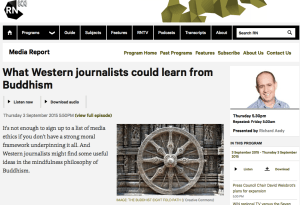
Interested? You can listen to my 10 minute interview on Radio National’s Media Report here.

Screen Shot 2015-09-04 at 9.46.24 am

See also my account of the basic principles of mindful journalism in the journal Ethical Space: The International Journal of Communication Ethics, and the editors have been kind enough to make that article available for free viewing as a feature item on their website here. You might also want to explore some of their other fascinating articles on media ethics here and perhaps subscribe.

———–

Disclaimer: While I write about media law and ethics, nothing here should be construed as legal advice. I am an academic, not a lawyer. My only advice is that you consult a lawyer before taking any legal risks.

© Mark Pearson 2016
2 Comments

Filed under blogging, Buddhism, citizen journalism, Eightfold Path, free expression, Islam, journalism, journalism education, media ethics, mental health, mindful journalism, social media, terrorism

Mindful journalism – Bhutanese style

[This review was first published in Media International Australia, May 2016; 159 (1) as ‘Book Review: The Dragon’s Voice: How Modern Media Found Bhutan’]

By MARK PEARSON

Few of us would pass up the chance to spend a year working in the Kingdom of Bhutan – mythologized in media coverage as a Shangri-La nestled in the Himalayas with its own Gross National Happiness Index.

Australian journalist and academic Bunty Avieson seized that opportunity and travelled (with her partner and young daughter) to work on a fledgling private newspaper in that tiny nation soon after its Fourth King had licensed it as part of a modernisation initiative.

The Dragon’s Voice – How Modern Media Found Bhutan (available here) is Avieson’s memoir of that experience. It is an entertaining work of popular non-fiction reflecting the author’s writing acumen and sense of narrative as a former editor of Woman’s Day and editorial director of New Idea. Yet it also has a depth of scholarship drawing upon Avieson’s more recent work as an academic researcher and journalism educator.

The Dragon’s Voice: How Modern Media Found Bhutan

Author: Bunty Avieson

University of Queensland Press, 2015, 240pp

ISBN: 978 0 7022 5357 7

DragonsVoiceCoverThe people of Bhutan are predominantly Buddhist and this navigation of opposites in life’s course is what Buddhists call the ‘Middle Path’. There are numerous examples throughout the book of Avieson and her Bhutanese newspaper colleagues endeavouring to find such a middle way between extremes.

Avieson takes up the challenge of portraying the deeper layers of a country whose image is over-simplified by its international media framing as a quaint oddity whose citizens are happily trapped in a bygone era on top of the world.

She does not shy away from important issues of censorship (including self-censorship), crime, poverty, natural disasters, domestic violence and the toll of the rapid pace of modernization.

Several threads run through the work, but one of the most important is the paradox centred upon the birth of a newspaper in Bhutan; coinciding with the death of printed newspapers in much of the developed world.

It is a particularly Buddhist and Bhutanese approach to journalism adopted by the Observer’s leadership team – mindful journalism in action. (See the reviewer’s own work on mindful journalism here.)

Avieson explains the newspaper’s owners Tenzin Wangdi and Phuntsho Wangmo asked some of the nation’s wisest and most ethical intellectuals to help develop guiding principles for the newspaper.

The resulting mission statement began with a Buddhist assertion “that all things exist in interdependence is an age-old wisdom”, before vowing to “uphold and strengthen the values and principles that bind this small but great kingdom together”. It continued: “We are a voice with a conscience, and our efforts are aimed at enriching people’s lives through unbiased content intended to inform, educate and entertain.”

Avieson proceeds to chronicle the successes gained and the challenges faced by the newspaper’s journalists and other staff as they set about redefining reporting about Bhutanese people in a Bhutanese style. She details the very practical problems of distribution to remote regions and the inexperience of staff, along with bizarre news topics including one about a town where men believe their wives have crooked vaginas and another about a ghost that lives in a rock.

The newspaper relied largely on government advertising, creating a fear of retaliation over critical stories, a situation not unique to Bhutan. Buddhist principles even influenced the types of advertisements the owners will carry. For example, the Observer would not run ads for cars because “it would be unkind to make villagers desire something they can’t afford”.

Occasionally the reader gets an insight into the profound influence Avieson had on the newspaper in her short time there – drawing upon her many years of experience as a magazine editor with layout, design, photography commissioning and selection and in the production of themed editions and special magazines.

While her modest approach is in keeping with the Buddhist theme, the reader is left wondering how involved Avieson became in the day to day journalism of the operation.

Successful memoirs need to do much more than document a passage of the author’s life. Avieson has achieved this in The Dragon’s Voice. It is purportedly about a year in Bhutan but in the telling it prompts important questions about the media, society and life.

We are left pondering how we would do journalism differently if we had the chance to reinvent it, and then it dawns upon us that that is exactly what journalists in the developed world are trying to do right now. There is much they can learn from Avieson’s account of her time with the Bhutan Observer.

———–

** Listen to author Bunty Avieson’s interview about the book with ABC Radio National Media Report host Richard Aedy here.

———–

Disclaimer: While I write about media law and ethics, nothing here should be construed as legal advice. I am an academic, not a lawyer. My only advice is that you consult a lawyer before taking any legal risks.

© Mark Pearson 2016

Leave a comment

Filed under blogging, Buddhism, Eightfold Path, free expression, journalism, media ethics, mental health, mindful journalism, social media

Ethical lessons from the 60 Minutes abduction saga

By MARK PEARSON

International readers of this blog might be unaware of the national debate in Australia over the involvement of an Australian 60 Minutes television current affairs crew in last month’s abduction of two children in Lebanon who were the subject of a parental custody dispute.

The Australian mother of the child – Sally Faulkner – and the reporter Tara Brown and her three crew were jailed for two weeks along with the alleged abduction contractor Adam Whittington who remained in jail seeking bail this week.

The Nine Entertainment Company announced an investigation into the circumstances surrounding its flagship current affairs program’s involvement in the failed abduction attempt.

Following that announcement (April 21, 2016) ABC Gold Coast’s Matt Webber interviewed me about the ethical dimensions of the saga.

Here is the recording of that interview. [Transcription below by Virginia Leighton-Jackson].

SoundcloudInterviewScreenshot

Interview with ABC Gold Coast’s Matt Webber

Matt Webber: Let’s concentrate on the Nine Network for now. What are the main questions it needs to answer?

Mark Pearson (@journlaw): Well Matt, I think in your introduction you started to hit upon the main questions, and I think they’re questions that need [answering] – I mean hindsight is a wonderful thing and it’s very easy for an academic like me to be looking at this in hindsight and saying all the things that should have been done. But the sorts of questions that you were just asking [are relevant] – Who is involved? Who are the stakeholders? Who are those who might get hurt through such a story? The first thing Channel Nine should be doing, I believe, is setting up accountable systems where those questions are actually asked before stories are embarked upon. And that involves…

MW: Are we naive to think that wouldn’t happen?

MP: I don’t think so; I think people would get carried away, and particularly in a highly emotionally charged story like a custody battle it’s very easy to hear one party’s side of the story. Another issue here is of course is the simple fact of obeying laws. Now, there seems to be like a cultural view that has come through this story that going to another place, the ‘other’, a place like Lebanon, excuses journalists from doing what would be absolutely illegal for them to be doing here in Australia. I mean only a couple of years ago one of the leading news stories was a custody battle over children in Queensland where the Italian father had won custody of the children, and the family – the grandparents and the mother – were fighting the order of the court that the children be taken back to Italy. What if that had happened in that case? Just say the order had gone the other way and the father and an Italian TV crew was here and the children were grabbed on the streets of the Gold Coast and taken, and the plan was to take them to a boat at Southport, and somehow the TV crew had helped fund the abduction. Can people imagine what would have happened there? So what Channel Nine needs to be asking is what is going on there culturally in their mindset about these sorts of stories to think that it’s okay to do that in Lebanon, but it’s not okay to do it in Australia. What’s their view of another country’s legal system that allows that to happen?

Now there’s still a lot of this story to come out, facts that we will hear about – you just played a part of the father’s version of whether or not people are being paid or whatever. The truth of all of that will eventually come out. But I think what Channel Nine needs to do is actually follow the privacy guidelines of ACMA, the Broadcasting Authority, but follow them to the letter. They are not obligatory, but they need to actually look at them; where it says that children are more vulnerable, and the privacy of children is something that really needs close scrutiny. And in public interest – what they might call public interest doesn’t outweigh the rights of children to be considered. A story like this has ripple effects across a whole range of stakeholders, and they need to actually have a formalised process which goes through considering the potential impact on all of those involved – including in this case, the news crew.

MW: Indeed. Mark Pearson, a professor in journalism at Griffith University. Often ‘journalistic ethics’ is a pair of words that is tossed around fairly liberally. The Code of Ethics that journalists need to adhere to, are they sufficiently aware of it? Or are they far too ignorant of it, either wilfully or otherwise?

MP: Well, journalists do know about the Code of Ethics, and most journalists these days have been through some journalism program, like a degree or whatever and have learned about the Code of Ethics. But the big problem with the Australian journalists’ Code of Ethics, and most others, is that there is a whopping ‘get-out’ clause. What it says is that all of these are things that should be strived for, but if the public interest, or if the story is of such public concern then that excuses journalists, outweighing those ethical considerations. But it does make specific reference to chequebook journalism – now I’m not saying that’s happened in this case, is it chequebook journalism to help fund an operation? Well, that’s something we’ll be able to discuss once more facts come out. But also things like dealing with children and the vulnerable, and thinking of those potential implications.

So I think it’s more than just journalists’ ethics: it’s a basic moral code that most humans think twice before they do something that is related to or can impact badly on children’s lives. And so if anything comes of this, I would hope that people take special care, and newsrooms implement practices that ring extra alarm bells if there are going to be children involved in any story.

MW: What about those who will argue that look, commercial television is, particularly commercial TV Current Affairs, is a wild and woolly old world, boundaries will always be pushed; that’s the nature of capitalism in many regards. This shouldn’t come as any surprise that this sort of thing is happening. What do you say to those types?

MP: Well if there is a commercial or a capitalism argument for breaching ethics I think you can counter that with another equally commercial or capitalist argument: and that is the only thing that journalism has left these days, compared with its internet rivals, compared with the jungle of news breakers out there who might be citizen journalists or people doing it simply for a commercial imperative, the only thing that we have remaining to sell news is credibility and respect in the community. And that comes through having an ethical code that journalists adhere to. I think 60 Minutes has lost a lot of credibility out of this, and I think Channel Nine will be reviewing that because there is a commercial loss involved when you’ve overstepped the mark and you lose respect in the eyes of the community. 60 Minutes used to be a wonderful news brand, and Channel Nine will be asking what’s happened to that in the wake of this episode.

MW: Interesting observations, Mark Pearson, I really appreciate your time. Thank you.

MP: Thanks Matt

MW: Mark Pearson, Professor of Journalism and Social Media at Griffith University’s School of Humanities (Languages, and Social Science).

—-

RELATED:

Our book Mindful Journalism and News Ethics in the Digital Era: A Buddhist Approach (Shelton Gunaratne, Mark Pearson and Sugath Senarath eds; Routledge, NY, 2015)  explored the possibilities of applying mindfulness techniques to journalism practice.

Interested? You can listen to my 10 minute interview on Radio National’s Media Report here.

Screen Shot 2015-09-04 at 9.46.24 am

See also my account of the basic principles of mindful journalism in the journal Ethical Space: The International Journal of Communication Ethics, and the editors have been kind enough to make that article available for free viewing as a feature item on their website here. You might also want to explore some of their other fascinating articles on media ethics here and perhaps subscribe.

———–

Disclaimer: While I write about media law and ethics, nothing here should be construed as legal advice. I am an academic, not a lawyer. My only advice is that you consult a lawyer before taking any legal risks.

© Mark Pearson 2016

Leave a comment

Filed under blogging, Buddhism, citizen journalism, Eightfold Path, free expression, media ethics, mental health, social media

‘Right Speech’ and media law – mindful journalism as an analytical tool

By MARK PEARSON

Our book Mindful Journalism and News Ethics in the Digital Era: A Buddhist Approach (Shelton Gunaratne, Mark Pearson and Sugath Senarath eds; Routledge, NY, 2015)  explored the possibilities of applying mindfulness techniques to journalism practice.

Screen Shot 2015-05-29 at 3.08.59 pm

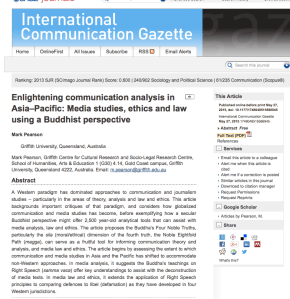
I  recently wrote an article on the “Right Speech” aspect of mindful journalism for the International Communication Gazette titled ‘Enlightening communication analysis in Asia-Pacific: Media studies, ethics and law using a Buddhist perspective’. Its abstract and link to the full article is available here.

The article backgrounds important critiques of the Western approach to communication  studies, and considers how globalized communication and media studies has become, before exemplifying how a secular Buddhist perspective might offer 2,500 year-old analytical tools that can assist with media analysis, law and ethics.

The article proposes the Buddha’s Four Noble Truths and their associated Noble Eightfold Path (magga) can be fruitful tools for informing communication theory and analysis, and media law and ethics.

In media analysis, it suggests the Buddha’s teachings on Right Speech (samma vaca) offer key understandings to assist with the deconstruction of media texts. In media law and ethics, it extends the application of Right Speech principles to comparing defences to libel (defamation) as they have developed in four Western jurisdictions.

Here is a brief extract showing the potential for exploring media law using a Buddhist/mindful journalism framework:

The ultimate contest over media talk and Right Speech happens in the courts when media texts face charges for their criminality or are the subject of civil suits over their alleged infringement on citizens’ rights like copyright, confidentiality and defamation. There is also value in applying a mindful, Buddhist approach to the study of communication and media law. We can hardly reject the teachings of the founder of one of the world’s greatest religions as inappropriate in a communication law context on exclusively secular grounds because that would imply our so-called secular approaches to communication and media theory and ethics have no religious roots. No Western academic could deny deep-seated Abrahamic influences upon the cultural origins of media law and its scholarship. A whole body of literature on the philosophy of science and religion attests to it. In media law and ethics, libertarian approaches to press freedom espoused by the likes of Milton, Mill and Jefferson arose in an era when political, cultural and religious notions of rights were intertwined. For example, the most famous treatise against licensing of the press – Milton’s Areopagitica – was prefaced with an explanation that Moses, David and Paul the Apostle were all learned because they were able to read widely. Milton wrote:

…as good almost kill a Man as kill a good Book; who kills a Man kills a reasonable creature, Gods Image; but hee who destroyes a good Booke, kills reason it selfe, kills the Image of God, as it were in the eye (Milton, 1644).

The U.S. Supreme Court cited Areopagitica in the landmark defamation case of New York Times v. Sullivan (1964) 376 US 254, when explaining why it would be counter-productive to move the burden of proving truth to the defendant (NY Times v. Sullivan, Footnote 19). Thus, by only two degrees of separation, we find Judeo-Christian teachings informing a key decision on news media talk in one of the most purportedly secular of institutions – the U.S. Supreme Court. Related to this, as Rolph (2008: 38-43) notes, defamation as the tort used to contest objectionable speech, first arose in England in 1222 in the ecclesiastical (church) courts where it remained a spiritual offence for about four centuries. Damage to a reputation was seen to be an offence to the target’s soul – a right that only God should possess – to be judged only by God’s earthly adjudicators, the clergy. There was even recourse for appeals from English ecclesiastical court judgments to the Pope (Rolph, 2008: 45). From the 16th century, defamation actions were increasingly brought in the common law courts, with the courts developing a list of allegations with which they would deal, without needing proof of actual damage being caused by the defamation (Morison & Sappideen 1989: 173). Even today the Catechism of the Catholic Church lists ‘detraction’ (essentially gossip – or disclosing ‘another’s faults and failings to persons who did not know them’) as a sin – or an ‘offense against truth’ (Catechism of the Catholic Church, para 2477). Thus, defamation action – the legal action available to those subjected to damaging media talk – has a traceable Christian genealogy.

In this globalised, multi-cultural and multi-jurisdictional Web 2.0 era there should be no reason why the Judeo-Christian lens should have a monopoly on our examination of communication law. A mindful reading of defamation law benefits from a consideration of both Right Speech principles and concepts of necessary truth-telling. While it is far-fetched to expect judges and legislators in the West would turn to Buddhism for the reform of defamation law, an effort to abide by truth-telling and Right Speech principles could operate effectively when professional communicators are attempting to avoid libel litigation when pursuing their stories. Further, they present excellent tools for an alternative analysis.

Analysis of the development of defamation defences in Canada, the UK, Australia and the U.S. benefit from a Buddhist reading. In Grant v. Torstar Corp., 2009 SCC 61, [2009] 3 S.C.R. 640, the Supreme Court of Canada developed a ‘responsible communication’ defence to defamation for matters which might not have been able to be proven absolutely as true, but were still diligently reported and were clearly in the public interest to be aired within the spirit of the Canadian Charter of Rights and Freedoms protection of free expression. Chief Justice McLachlin summed up the relevant factors of the ‘responsible communication’ defence on a demonstrable matter of public interest in these terms:

  • seriousness of the allegation
  • public importance of the matter
  • urgency of the matter
  • status and reliability of the source
  • whether the plaintiff’s side of the story was sought and accurately reported
  • whether the inclusion of the defamatory material was justifiable
  • whether a defamatory statement’s public interest lay in the fact that it had been made rather than whether it was truthful
  • other relevant circumstances

The court drew upon similar criteria to those developed earlier in the UK case of Reynolds v. Times Newspapers Ltd [2001] 2 AC 127 as part of the common law qualified privilege defence and elements of the statutory qualified privilege defence in Australia’s uniform Defamation Acts 2005.

The most significant First Amendment case in recent decades was New York Times v. Sullivan (1964) 376 US 254 where it was ruled that public of­ficials had to meet tough new tests before they could succeed in a defamation action even if the allegations in the article were proven false. It established that plaintiffs who were ‘public officials’ had to prove a media defendant had acted with ‘actual malice’ if they were to win a defamation action, even if the defamatory allegation was untrue. The test has since been expanded to apply to any ‘public figure’— essentially anyone who is well known to the public, has taken on some public role or who has participated voluntarily in some controversy. While the prin­ciple has some difficulties in definition and application, it has meant the media in the United States have been free to publish criticism of virtually anyone in the public domain, even if the criticism proves to be unfounded, just so long as they have not acted maliciously or in ‘reckless disregard’ of the truth.

It is possible to implement a Buddhist approach using the Right Speech teachings from the Noble Eightfold Path to conduct an analysis in this area of communication law. The author proposes to do this more thoroughly in future work. However, for the purposes of this argument we might return to the Abhaya Sutta … and contrast these defences as they have been developed in these jurisdictions (Thanissaro, 1997). Crucial to the Canadian ‘responsible communication’ defence and its qualified privilege cousins in the UK and Australia is the extent to which reporters and publishers honestly believe in the truth of the defamatory material published, even though they might not have the firm evidence to prove this in court. They would pass the Buddhist (mindful journalism) test if they had an honest belief the material was “factual, true, beneficial” while perhaps being “unendearing and disagreeable to others”, as long as they had chosen the “proper time” for reporting it (Thanissaro, 1997). However, the U.S. defences driven by the First Amendment takes this liberty a step too far under this schema, because it allows unbeneficial, unendearing and disagreeable material to be published about public figures as long as it has not been done with malice. It also allows for untruthful gossip-mongering, as identified earlier in the Saleyyaka Sutta (Nanamoli, 1994) as ethically problematic. Such analysis shows promise in the field of media law analysis, reform and policy development because it provides a working ethical framework to apply to legislation and the fact scenarios of particular cases.

I’ve also written a shorter account of the basic principles of mindful journalism in the journal Ethical Space: The International Journal of Communication Ethics, and the editors have been kind enough to make that article available for free viewing as a feature item on their website here. You might also want to explore some of their other fascinating articles on media ethics here and perhaps subscribe.

———–

Disclaimer: While I write about media law and ethics, nothing here should be construed as legal advice. I am an academic, not a lawyer. My only advice is that you consult a lawyer before taking any legal risks.

© Mark Pearson 2016
Leave a comment

Filed under blogging, Buddhism, citizen journalism, Eightfold Path, free expression, media ethics, mental health, social media

Privacy as a value for democratic societies – Beate Roessler #mediaiplaw

By MARK PEARSON

It is only in the past twenty or so years that the societal value of privacy has become of interest and still more recently that there has been a particular focus on the value of privacy for democracies, University of Amsterdam Professor of Ethics Beate Roessler proposed to the 2015 IP and Media Law Conference at the University of Melbourne Law School today (November 24).

“Privacy protection is necessary not only for individual freedom and autonomy but also for the functioning of the democratic society,” she said.

Professor Beate Roessler from the University of Amsterdam

Professor Beate Roessler from the University of Amsterdam

Beate Roessler is Professor of Ethics at the University of Amsterdam and chair of the Capacity group of Philosophy and Public Affairs. She also chairs its Department of Philosophy. In her keynote address she explored her work examining the difficulty of keeping up privacy standards on social network sites and the role of anonymity in social/political relations and the consequences of the loss of that anonymity.

Professor Roessler pointed to statements by Edward Snowden in 2013 and 2015 as an interesting focus upon the democratic value of privacy, where he had justified his revelations partly upon the contest between the state’s surveillance and the individual citizen’s privacy.

She listed three steps in the conceptualisation of privacy – firstly, the classic conception of Warren and Brandeis as the right to be let alone, the fundamental idea being that the right to freedom is protected by, and dependent upon, the right to privacy.

The second step after Warren and Brandeis was the ‘social dimensions of privacy’.
“The social norms which regulate privacy enable us to play different roles,” she said. “They enable us to play these different roles and have these different relations.
“If I started telling you now about my grandmother I would violate the demand of the role I am playing here. It is not just my autonomy, but it is also the norm itself that regulates our relations.
“Privacy is also a social practice, meaning the norms protect individual privacy and the right is part of the practice.
“Also respect for the privacy of other people is part of the practice. It is part of the deal of the social norms of privacy. The right to privacy and respect is always socially contextualised.

“The idea that we are democratic subjects is also the idea that our privacy is protected.”

She explained that the value of privacy has for the most part of the last hundred years been conceived of in purely individual terms: the protection of privacy being important or even constitutive for the protection of individual freedom and autonomy.

The third step after Warren and Brandeis was the significance of privacy for democracy.

“I want to argue that it is precisely this social and democratic value of privacy which is at stake in the digitized society,” she proposed.

She said events in Paris this month had not changed her mind about the value of privacy in democracy, but did make the issues more challenging to address publicly.
“Political participation is dependent on the protection of privacy,” she said.
The loss of privacy affects all social and political relations between people, she argued.
Although the right to privacy remains important as an individual right, the Snowden revelations have made clear that violations of privacy have immediate impact on our social lives as well as on liberal democracies.
Privacy is under pressure in the digitized society through state surveillance, consumer surveillance, via the ‘internet of things’, and through social network sites with the voluntary sharing of personal data including the self-tracking devices and the quantification of self movement.
“New technologies do have an impact on our relationships, for better or for worse.
“The right idea is to think about what does privacy do in our society, and if that changes how far can we go with that change?”
She used privacy settings as an example of the status of privacy in society: “Standard preferences are public, but privacy is an extra task or an achievement.”
“Our personal data are analysed by companies that are collecting, storing and mining as the default. It is what is happening if we do nothing.
“Forgetting, deleting is an extra task, an achievement.”
Anonymity was important to privacy, but as Snowden revealed our anonymity is not protected any longer.
“Lack of anonymity can cause loss of freedom, harmful for the individual and democratic society,” she said.
She pointed to the use of drones as the next “massive threat”.
She said arguments against anonymity such as accountability and public security did not allow for the fact that neither had increased markedly in recent years with large scale surveillance.
“The threat of a life without the protection of privacy involves the transformation of social and political relations,” she concluded.
“If we have to assume there is no privacy protection any longer in our social relations it means our social relations tend to get homogenized.
“How can I understand myself as a democratic subject if I can’t assume any longer that my privacy is not being protected?
“How do we change and how does society change, when our sense of privacy changes, when we lose the differences in self-presentation, possibilities of political participation, and when we lose the possibilities of control?”
From 2003-2010 Roessler was Socrates-Professor for the Foundations of Humanism at Leiden University. Before, she taught philosophy at the Free University, Berlin, Germany, and at the University of Bremen, Germany. Roessler studied philosophy at Tuebingen, London, Oxford, and Berlin and completed her PhD in 1988 at the Free University Berlin (on theories of meaning in analytic philosophy and hermeneutics). In November and December 2015 she is visiting as a research fellow at University of Melbourne, Melbourne Law School. Her publications include Social Dimensions of Privacy: Interdisciplinary Perspectives (edited with Dorota Mokrosinska, Cambridge: Cambridge University Press 2015) and The Value of Privacy (Polity Press, 2005).

The full conference program is here. Our paper (Pearson, Bennett and Morton) was titled ‘Mental health and the media: a case study in open justice’ (see earlier blog here) and was presented yesterday (November 23).

Those interested in privacy as a topic might also see my timeline of privacy in Australia here.

———–

Disclaimer: While I write about media law and ethics, nothing here should be construed as legal advice. I am an academic, not a lawyer. My only advice is that you consult a lawyer before taking any legal risks.

© Mark Pearson 2015

Leave a comment

Filed under Privacy, Uncategorized

Drilling down on suppression orders – with a call for reform #mediaiplaw

By MARK PEARSON

Suppression orders should be precise and address imminent publications likely to prejudice the case, not be futile and should only follow a request for removal, University of Melbourne senior lecturer Jason Bosland explained to the 2015 IP and Media Law Conference at the University of Melbourne Law School today (November 23).

Melbourne University's Jason Bosland calls for reform of suppression orders

Melbourne University’s Jason Bosland calls for reform of suppression orders

However, the courts continue to issue broad suppression orders that lack these qualities. Presenting a paper co-authored with Timothy Kyriakou, he explained that most suppression orders covered prior convictions and the vast majority were made against the “world at large” rather than at specific individuals or organisations.

“This indicates that orders are being made as a general precaution in a lot of cases rather than in response to an imminent publication,” he said.

He suggested reforms limiting magistrates’ court powers, giving all levels of the court system the same suppression order powers. Another anomaly was that the Supreme Court lacked power to issue a suppression order to ensure the safety of a person, a power held by the Magistrate’s Court.

His abstract explained:

In recent years, decisions in Victoria and New South Wales have considered the power of courts under the common law to restrain the publication of prejudicial material by the media, particularly in light of such material being published, or potentially published, on the internet.

This paper distills the principles established in those cases. It also considers whether and to what extent they continue to be relevant following the introduction of the Open Courts Act 2013 in Victoria and the Court Suppression and Non-publication Orders Act 2010 in New South Wales. It then examines the making of such orders in Victoria and assesses whether the courts have been complying with the relevant principles. Finally, some suggestions for reform are presented.

In his paper ‘The media’s standing to challenge departures from open justice’, Curtin Law School’s Michael Douglas argued the media was disadvantaged by suppression orders in ways most other parties were not.

Departures from open justice directly affect the legal rights and interests of media organisations. He argued that at common law, media organisations may intervene as of right, as a matter of natural justice, in any proceedings contemplating a departure from open justice.

“Open justice is essential to the integrity of our justice system. When a court departs from open justice, it is appropriate that media organisations are able to question whether the circumstances warrant the departure,” his paper stated. The paper addressed the issue of non-party media organisations’ standing to challenge departures from open justice.

In several jurisdictions, the issue is resolved by statute, but the position is not uniform around Australia.

The paper explained the position under the differing statutes and at common law. It focused on the common law position which remained in some jurisdictions, where the standing of media organisations was controversial.

“The orthodox view, expressed in older NSW authorities, is that media organisations have no absolute right to be heard at common law,” he stated, challenging that orthodoxy, following a contrary, Western Australian line of authority. The paper explored the link between principles of standing and the principles of natural justice drawn from High Court decisions.

The full conference program is here. Our paper (Pearson, Bennett and Morton) is titled ‘Mental health and the media: a case study in open justice’ (see earlier blog here).

———–

Disclaimer: While I write about media law and ethics, nothing here should be construed as legal advice. I am an academic, not a lawyer. My only advice is that you consult a lawyer before taking any legal risks.

© Mark Pearson 2015

Leave a comment

Filed under free expression, intellectual property, media ethics, media law, Media regulation, Uncategorized

How startups focus on the execution of business plans, with less intent on controlling IP

By MARK PEARSON

Entrepreneurs might undertake strategies that abandon formal IP protection in favour of being quicker to market and investing in capabilities – that is, focussing on an idea’s execution – University of Toronto Professor Joshua Gans told the 2015 IP and Media Law Conference, in his keynote address at the University of Melbourne Law School today (November 23).

JoshuaGandCMCL

Professor Joshua Gans delivering the keynote to the Media and IP Law Conference at the University of Melbourne.

He unveiled an economic model developed with colleagues Scott Stern and Kenny Ching featuring two key propositions.

“Execution allows you to maintain market leadership so control buys you only delay,” he said.

“Control only is cost in that regard. It only delays you without giving you additional benefit.

“Even aside from resource constraint issues, control and execution are substitute strategies. The whole is not greater than the sum of the parts. You want to advise firms to pursue control or execution but not both.”

He explained execution-oriented firms will hit key milestones more quickly and will be less dependent on significant venture capital investment.

He argued against what he said was the common assumption of IP analysis that the strength and use of IP is exogenous.

CMCLlogoforblog19-11-15“Here I argue that is is endogenous and depends on the choices of entrepreneurs/innovators in their business strategy,” he promised in his abstract.
“I demonstrate that entrepreneurs can undertake strategies that abandon formal IP protection in favour of being quicker to market and investing in capabilities — that is, focussing on execution.”

Joshua Gans is a Professor of Strategic Management and holder of the Jeffrey S. Skoll Chair of Technical Innovation and Entrepreneurship at the Rotman School of Management, University of Toronto (with a cross appointment in the Department of Economics). Since 2013, he has also been Area Coordinator of Strategic Management. He is also Chief Economist of the University of Toronto’s Creative Destruction Lab. In 2012, Joshua was appointed as a Research Associate of the NBER in the Productivity, Innovation and Entrepreneurship Program.

He has also co-authored (with Stephen King and Robin Stonecash) the Australasian edition of Greg Mankiw’s Principles of Economics (published by Cengage), Core Economics for Managers (Cengage), Finishing the Job (MUP) and Parentonomics (New South/MIT Press). Most recently, he has written an eBook, Information Wants to be Shared (Harvard Business Review Press).

The full conference program is here. Our paper (Pearson, Bennett and Morton) is titled ‘Mental health and the media: a case study in open justice’ (see earlier blog here).

———–

Disclaimer: While I write about media law and ethics, nothing here should be construed as legal advice. I am an academic, not a lawyer. My only advice is that you consult a lawyer before taking any legal risks.

© Mark Pearson 2015

Leave a comment

Filed under free expression, intellectual property, media ethics, media law, Media regulation, Uncategorized

How to challenge a ban on naming a mental health patient

By MARK PEARSON

UTS colleague Associate Professor Tom Morton, ABC lawyer Hugh Bennett and I will deliver a paper in Melbourne next week on our experiences applying to the Mental Health Tribunal of NSW for permission to name a forensic mental health patient in an ABC documentary and in our academic works.

CMCLlogoforblog19-11-15The occasion is the 2015 IP and Media Law Conference, hosted by the Centre for Media and Communications Law at the University of Melbourne Law School, November 23-24. The full program is here. I plan to blog a few of the highlights of the sessions I attend.

Our paper is titled ‘Mental health and the media: a case study in open justice’ and we present on the first morning of the conference. Here is its abstract:

News and current affairs reportage about forensic mental health cases raises a host of competing interests, including the public’s right to know about mental health tribunal processes; a patient’s right to privacy, treatment, and recovery; and victims’ and the broader community’s interest in learning the longer term consequences of a publicised serious criminal act. This article details a case study of the legal processes involved in applications for permissions to identify a forensic mental health patient in NSW in an Australian Broadcasting Corporation Radio National Background Briefing documentary ‘The Man Without a Name’ and in subsequent research blogs and scholarly works including this article. It begins by backgrounding the restrictions on publicising mental health tribunal cases in Australia, summarising the case study, examining the specific restrictions applying to the Mental Health Review Tribunal in NSW, detailing the processes followed in the successful application by the authors to name the patient, comparing the case with Australian and British cases, and making some recommendations for further research and reform.

Tom and I recently co-authored an article on the ethics of that same experience in Pacific Journalism Review, titled ‘Zones of silence: Forensic patients, radio documentary, and a mindful approach to journalism ethics’. Here is our abstract. Full contents of the edition and subscription details can be seen here. Reference: Morton, T. and Pearson, M. (2015). Zones of silence: Forensic patients, radio documentary, and a mindful approach to journalism ethics. Pacific Journalism Review, 21(2), 11-32.

———–

Disclaimer: While I write about media law and ethics, nothing here should be construed as legal advice. I am an academic, not a lawyer. My only advice is that you consult a lawyer before taking any legal risks.

© Mark Pearson 2015

3 Comments

Filed under blogging, Buddhism, citizen journalism, Eightfold Path, free expression, media ethics, mental health, social media, Uncategorized